
Quick answer: A useful marketing reporting discrepancy workflow records exactly which numbers disagree, their sources, the relevant date range and time zones, metric definitions, attribution settings, data-refresh time and the person responsible for checking each possibility. Categorise differences before calling them tracking failures. Use an agency reporting QA gate to explain legitimate platform differences and escalate genuine implementation defects before they reach the client presentation.
An account manager is preparing a quarterly review. Google Ads reports more conversions than the website analytics dashboard. The CRM shows fewer accepted leads than either platform, and a client spreadsheet has a fourth total. It is tempting to label one number wrong and adjust the slide so the columns match. That makes the deck look cleaner, but weakens trust when the client asks why the reported pipeline differs from sales records.
Different systems answer different questions. Advertising platforms measure according to their conversion settings and attribution rules. Website analytics captures events under its collection and identity rules. A CRM reflects real operational stages, including qualification, duplication and human disposition. A robust discrepancy workflow first asks whether the figures are supposed to match at all.
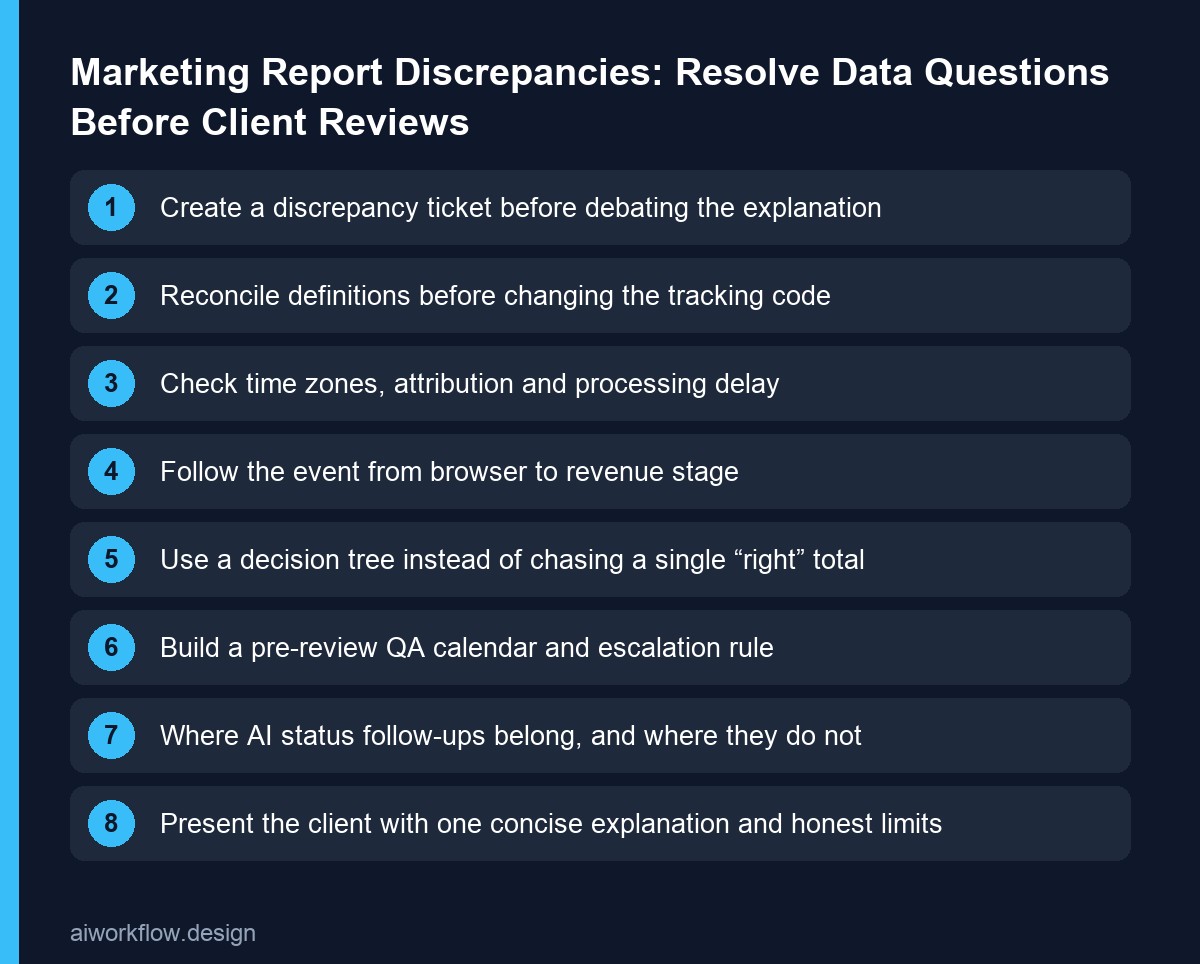
Create a discrepancy ticket before debating the explanation
Every disputed number needs a reproducible comparison. Record the client, campaign or property, screenshots or export references, first observed date, report author, data owner, and deadline for the client meeting. Include the exact source report, metric, dimensions, filters, attribution or conversion configuration and extraction time for both sides.
For example, “leads do not match” is an inadequate ticket. “GA4 generated 73 form_submit events between 1 and 31 October in the property time zone, while the CRM received 61 form submissions within the same claimed period” is testable once the event name, CRM inclusion rule and time zones have been checked. The figures in this example are illustrative, not observed client results.
Set severity based on business impact: a formatting error is different from a broken purchase event or a missing qualified-lead import. Keep the original evidence unchanged, and require a named analyst to document the root cause or the reason the figures cannot be reconciled precisely.
Reconcile definitions before changing the tracking code
Start with the calculation. Are both systems counting form submissions, unique people, qualified leads or sales? One person may submit twice. A CRM may deduplicate those submissions, while a GA4 event count still includes two events. Paid platforms may credit an action to an ad interaction under their own conversion window; a CRM may attribute it to the most recent salesperson or to the original inquiry source.
Next check inclusions and exclusions. One report may cover paid search only; another may include organic and direct traffic. One may filter test leads or internal activity; the other may not. A dashboard could define a “lead” as every contact click even though sales only acts on verified inquiries. The first correction might be a label or filter—not a change to the implementation.
Document a metric dictionary that includes the business question, source of record, counting method, exclusions, owner and intended use. Avoid using the label “conversions” with no explanation. Put the precise definition in a note accessible from each client-facing scorecard.
Check time zones, attribution and processing delay
Google’s GA4 data freshness guidance states that processing can take 24–48 hours and reports can change during that window. It also describes how attribution credit may change after collection. A same-day comparison is often provisional, especially when data has not completed processing or when key events were recently attributed.
Compare property and advertising-account time zones, day cutoffs, date ranges, lookback settings, channel grouping, attribution models and reporting identity where relevant. A lead recorded late in one time zone may fall into a different calendar day in another. A Google Ads attributed conversion and a GA4 key event can legitimately have different counting and credit rules.
Where BigQuery exports are used, do not assume that raw exported events and GA4 report totals must be identical. Google’s comparison guide outlines settings and reporting factors to check. Analytics teams should note which views are raw, processed, modelled, filtered or sampled, rather than presenting them as equivalent databases.
Follow the event from browser to revenue stage
For a genuine suspected tracking defect, trace a consented test journey through the form or checkout, tag-management setup, GA4 event, ad conversion, CRM creation, deduplication and downstream qualification. Use test identifiers and safe environments so validation does not pollute production sales reports. Confirm whether browser restrictions, consent decisions, ad blockers, redirects, cross-domain flows or server-side ingestion could explain missing records.
Check event naming and parameters, trigger conditions, repeated page loads, duplicate tags, form-success validation and transaction IDs. An analytics event firing on button click rather than confirmed form success may inflate the number. A thank-you event that fires on refresh may produce duplicates. A hidden form error may cause false positives if it does not stop the trigger.
Compare the CRM’s lead timestamps, contact IDs, source fields and acceptance states with the measurement policy. Never export sensitive user-level records into a general AI calling transcript or a broad agency task board. Use restricted diagnostic evidence, aggregate totals when possible, and a ticket reference accessible to authorised analysts.
Use a decision tree instead of chasing a single “right” total
If definitions differ, document which measure each platform represents and change the label, not the underlying data. If windows differ, align and rerun the extraction. If the data is still processing, mark the numbers provisional and schedule a final pull. If the test journey fails, open a technical incident with the implementation owner. If CRM acceptance is delayed, assign a sales-operations follow-up. If the discrepancy remains, present a bounded explanation and a dated investigation plan.
This approach helps avoid a damaging habit: forcing advertising, analytics and sales totals to match by subtracting unexplained records. Unresolved cases should not be silently changed to “fixed.” Preserve the original values and the reconciliation decision so the next month’s review can distinguish a corrected bug from an acknowledged difference in measurement rules.
Build a pre-review QA calendar and escalation rule
Plan a reporting freeze after the relevant data has matured enough for its intended use. An internal analyst checks source exports and metric definitions, the channel owner reviews performance commentary, the CRM owner verifies lead-stage or revenue claims, and the account lead signs off the final client narrative. If time is short, explicitly classify incomplete metrics rather than creating false certainty.
A well-designed QA board can include ticket ID, affected account, metric pair, variance or symptom, source links, suspected category, impact, investigation owner, next action, due date, resolution evidence and communication status. Set reminders for the owner of each step. Avoid automatically editing client-facing numbers in response to a phone update.
When the same mismatch occurs repeatedly, review whether the measurement specification or reporting template is ambiguous. The durable fix may be a single shared definition for MQL, accepted lead or booked sale. For lead ownership after acquisition, the site’s agency CRM lead-routing article covers a different but related handoff.
Where AI status follow-ups belong, and where they do not
A routine assistant can ask whether the reconciliation export is ready, which analyst owns a tracking bug or when the CRM owner will respond. A team using Autoza AI for monday.com may configure permitted status updates and reminders on a board. However, the product’s general check-in capability should not be described as automatic analytics reconciliation or certified financial reporting.
Do not let an AI summary conclude that a platform is fraudulent, that a consent configuration is lawful, or that a disputed revenue figure is correct. Analysts must examine the technical evidence; the appropriate client representative must approve explanations. This boundary makes automation safer and creates clearer accountability.
Present the client with one concise explanation and honest limits
The best reconciliation note states the questioned metric, the sources, what is different, what has been tested, what remains uncertain and when the next update is due. For example: “Ad-platform attributed leads and CRM accepted leads use different definitions. We have validated the form-success event; sales is reviewing rejected and duplicate records. We will report both counts with their labels rather than combine them.” This is clearer than a slide that simply announces a discrepancy has been resolved.
Keep your meeting focused on decisions. Is there a measurement fault that requires an urgent fix? Should the campaign optimisation objective change? Is the sales team missing handoffs? Or do the tools legitimately measure different stages? Once the difference is categorised, performance interpretation becomes more useful.
Next step: turn every metric dispute into a documented question
Select one recurring mismatch in a current account, define the two measures precisely and create a reproducible QA ticket. Then use AI Workflow Design’s products only where administrative follow-ups can help the real analysts close their actions faster.
Frequently asked questions
Why do GA4 and Google Ads conversion numbers differ?
They can use different counting, attribution, time-zone, processing and identity rules, and the configured conversion actions may not represent the same event. Compare settings, definitions and dates before deciding whether either platform has a defect.
What is the first step in an agency reporting QA process?
Create a reproducible comparison: exact metric names, filters, dimensions, date range, source reports, export timestamps and responsible owners. Do not ask an analyst to explain two screenshots without the settings used to produce them.
Should CRM accepted leads equal form submissions?
Not necessarily. The CRM may reject spam, merge duplicates, exclude existing customers or require manual qualification. Report form submissions, verified inquiries and accepted leads as distinct funnel stages where their definitions differ.
Can automated status calls fix an analytics discrepancy?
They can chase task owners and log progress. They cannot replace event debugging, source reconciliation or professional review. An AI-generated summary should not change the underlying measurement record or approve financial claims.
How should unresolved differences appear in a client report?
Show the relevant definitions, known causes, investigation status and material caveats. If a decision depends on an uncertain metric, state that uncertainty and assign the next evidence-producing action rather than using an unsupported number.
Related reading
- Co-Marketing Webinars: A Partner Deliverables Follow-Up Calendar
- Paid Media Launch QA: Who Confirms Tracking, Creative and Budget Controls?
- Agency CRM Lead Routing Handoffs: Follow Up on Sales Acceptance
- Multi-Market Campaign Assets: Tracking Translation and Local Approval
- Content Production Handoffs: A Call Plan From Brief to Publish
- More AI workflow guides