
Quick answer: A dependable co marketing webinar planning checklist gives both partners an agreed audience promise, an approved programme, one owner per asset, a common registration plan, promotional deadlines, consent and privacy rules, accessibility responsibilities, and a rehearsed event-day handoff. Track each deliverable separately from partner approval. Automated reminders may chase slide decks and social posts; they cannot approve claims, grant data-sharing consent or publish a partner’s name without permission.
A co-hosted webinar can look simple in a pitch: two brands contribute expertise, split promotion and share the leads. The problems often appear between teams. One partner publishes a different title, the event landing page uses an outdated headshot, the speaker changes the offer at the last minute, or nobody can explain what attendees agreed to when registering. The calendar showed a webinar date, but it did not show the decisions behind it.
The solution is an operational calendar tied to permissions, not just a list of marketing tasks. Build it before a campaign manager sends the first invitation. The objective is to make each partner’s commitments visible while preventing accidental misuse of customer data, unapproved logos or unsupportable promotional claims.
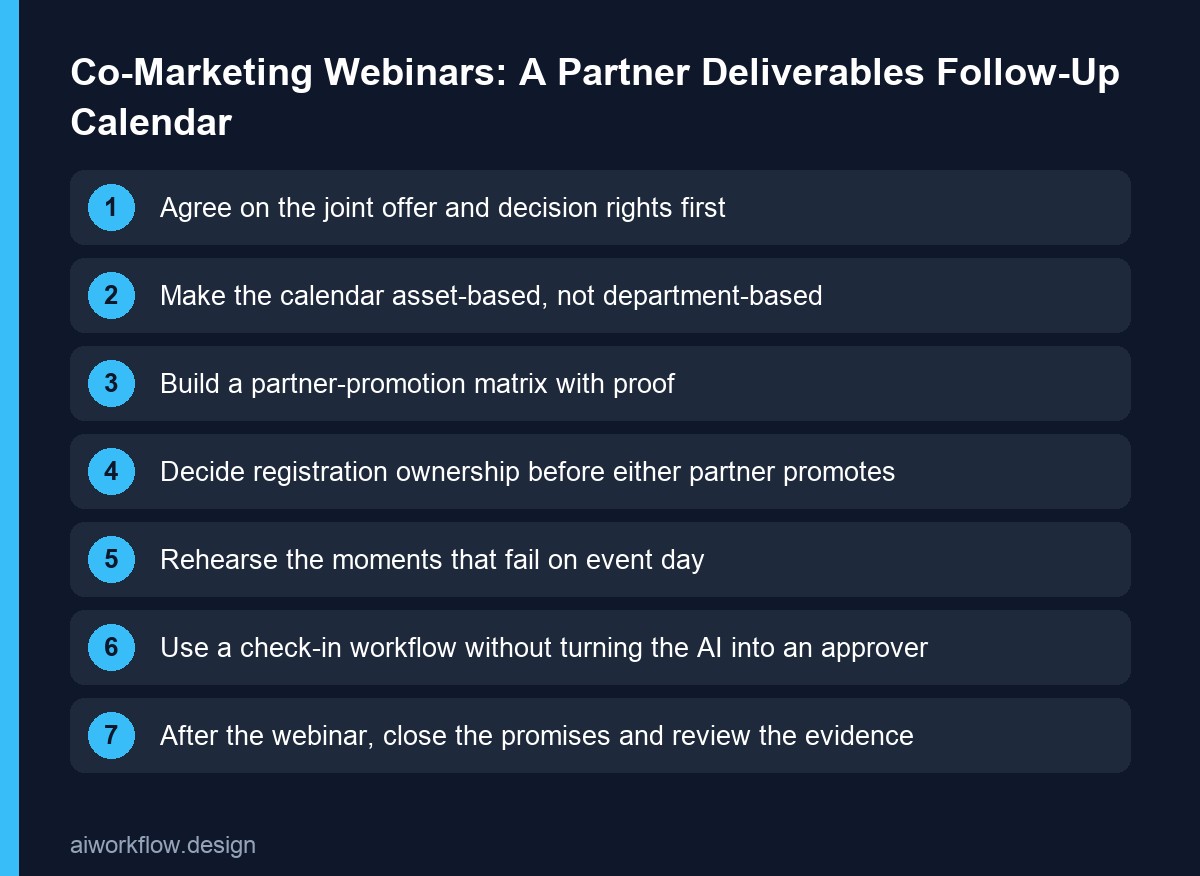
Agree on the joint offer and decision rights first
Write down who the session is for, the single question it will answer, expected learning outcomes, the speakers’ roles and what attendees will receive afterward. A webinar about AI workflows for operations leaders needs a different demonstration, CTA and qualification path from a webinar about agency analytics. If the audience is too broad, both partners may bring registrants who have little reason to attend.
Assign one accountable programme owner, one contact at each partner, a final creative approver and a privacy or data owner. Make clear who may change the event title, landing-page copy, speaker bio, brand assets and follow-up emails. Approval should be affirmative and recorded. “No comments by Friday” is not a reliable substitute when a formal partner agreement requires sign-off.
Check whether the commercial arrangement includes sponsorship, affiliate promotion, cross-selling or a compensated endorsement. Disclosure requirements depend on the relevant laws and facts; the FTC’s endorsement guidance provides useful US context. Marketing teams should not assume that calling something an educational webinar removes disclosure or truthful-advertising responsibilities.
Make the calendar asset-based, not department-based
Create one record per deliverable with a responsible creator, reviewer, version, approval deadline, distribution channel, live URL and evidence of publication. Typical assets include the landing page, registration form, calendar invitation, co-branded header, social graphics, email invitations, reminder sequences, speaker slides, rehearsal notes, recording permission and post-event resources.
Group tasks by milestone rather than “Partner A” and “Partner B.” A useful planning cadence is four weeks before for programme and registration decisions, three weeks for first invitations, two weeks for speaker slides and audience questions, one week for technical rehearsal and promotion review, and event day for presenter handoffs and consented follow-up. These are planning examples; a high-profile event may need far longer lead time.
The calendar must capture dependencies. If partner legal review is unfinished, the email campaign cannot honestly be marked ready. If the registration platform changes, the tracking links, confirmation email, consent notice and calendar invite need retesting. Give each dependency a named owner instead of leaving a warning in a comment thread.
Build a partner-promotion matrix with proof
For every channel, document the promised placement, scheduled date, approved message and what completion looks like. Partner A may own an email to its newsletter, while Partner B owns a LinkedIn event post and speaker outreach. A copywriter sending drafts is not equivalent to an email being approved, and an email being approved is not equivalent to its successful send.
Use states such as Draft, Submitted, Changes Requested, Approved, Scheduled, Published and Verified. Record the published URL or deployment evidence when available. Avoid reporting estimated reach as actual reach; distinguish planned sends, delivered messages, clicks, registrations and attendee numbers. If performance data cannot be shared because of privacy or contractual restrictions, use an agreed aggregated report instead.
A partner often has multiple internal reviewers. Give them a single approved feedback channel and a deadline. Conflicting edits from sales, legal and brand teams can create several “final” decks, so preserve the version ID and the person who authorised the public claim or design.
Decide registration ownership before either partner promotes
A co-marketing lead is still a person’s data. Record the registration platform owner, data controller or other applicable roles, privacy notice, form fields, retention plan, consent choices and the conditions for any sharing between partners. Joint branding does not automatically mean both organisations may add all registrants to ongoing marketing lists.
Separate operational emails needed to deliver the webinar from optional promotional subscriptions. Confirm lawful email-marketing practices applicable to the audience and location, and keep proof of relevant consent or other legal basis in the appropriate system. If the partners require a data-sharing arrangement, resolve it before launch rather than trying to invent permission after collecting names.
Test the full journey: registration, validation, confirmation, time-zone display, calendar file, reminders, meeting join link, unsubscribe preferences and post-event resources. Include mobile and accessibility checks such as meaningful form labels, readable presentation materials and a plan for captions or reasonable accommodations. The people responsible for any live captioning or interpretation need a technical rehearsal too.
Rehearse the moments that fail on event day
A full speaker rehearsal should confirm the host’s opening, disclosure wording, speaker transitions, slide-sharing permissions, demo account safety, question moderation, timing cues and incident contact. Decide what happens if a presenter loses connectivity, the poll fails or a participant asks for confidential customer information. The moderator should have authority to move to a backup segment without misrepresenting what is being demonstrated.
For product demonstrations, label fictional or sample data appropriately and do not show genuine customer information without proper authorisation. If the presentation contains regulated advice, require suitable qualified review. Give speakers a content deadline that leaves time to remove unsupported performance claims, outdated screenshots and confidential elements.
After the session, verify the recording against participant notices and permissions before sharing clips. A recording becoming available is not proof that every speaker or attendee granted unlimited reuse rights. Store approvals and expiry dates with the asset. A reusable partner agreement should address future edits, paid promotion and distribution rights explicitly.
Use a check-in workflow without turning the AI into an approver
A monday.com board can hold the event, milestone groups and deliverable items. Add owner, partner, stage, approved source URL, needed-by date, dependency, consent/permissions reviewer and next follow-up. Use the platform’s automation functionality to route notifications, but let named stakeholders approve public and legal content.
Where a distributed team already uses Autoza AI for monday.com, a limited pilot might ask: “Has the revised bio been submitted?”, “Who is reviewing the co-branded landing page?”, or “When will the rehearsal slides be ready?” Store brief progress notes; do not ask attendees for personal information or accept verbal authorisation of a new data-use agreement. The site’s website relaunch approval guide shows a related way to separate content-ready status from final publication authority.
For escalations, report the consequence: “Registration must remain unpublished until the privacy wording is approved” is more useful than “Partner B is late.” A clear next decision allows the programme owner to change the launch plan, reassign a permitted task or negotiate the impact with the partner.
After the webinar, close the promises and review the evidence
A completion checklist should cover attendance exports with authorised access, promised slide or resource delivery, recording review, approved partner follow-up, campaign source tagging and a joint retrospective. Report registrations, live attendance and pipeline impact as separate measures; none is a substitute for the others. If the CRM reports a sale later, verify attribution rather than automatically assigning the whole result to the webinar.
Ask each partner which obligations were difficult to complete and why. Too many approvals may signal an unclear owner; frequent late creative changes may indicate that the session promise was not decided early enough. Improve the next event’s dependency map rather than merely scheduling more reminders.
A final partner debrief should also record who may reuse the webinar title, screenshots, attendee quotations and recording clips in future campaigns. Promotional ownership and speaker permissions can outlast the event itself, but only within the rights that were actually granted. By logging restrictions and expiry dates at closeout, the next campaign manager does not have to reconstruct them from an email chain.
Next step: run one event with owned dependencies
Take a planned partner event and build a single approved timeline with clear review gates. Explore AI Workflow Design’s automation products for administrative follow-ups that help partners deliver on time while keeping brand, data and publishing decisions under human control.
Frequently asked questions
What belongs in a co-marketing webinar planning checklist?
Programme goals, speaker owners, partner approvals, registration and privacy arrangements, co-branded creative, promotional obligations, technical rehearsal, accessible delivery, event-day responsibilities, recording permissions and post-event reporting. Each item should have a due date and evidence of completion.
Who owns the webinar leads?
That depends on the actual data-collection setup, notices, agreements and applicable law. Two brands appearing on a landing page does not automatically permit unrestricted contact-list sharing. Document roles and use permissions before collecting registrations.
How early should co-hosts start promotion?
There is no universal lead time. Work backwards from the audience and required reviews. Many teams plan several weeks of asset preparation, invitations and reminders, then adjust based on the partners’ audience calendars and approval constraints.
Can an AI agent approve a partner’s slide deck or logo use?
No. It can request a status update and notify the content owner that a decision is outstanding. Claims, licensing, brand permissions and final public approval remain with authorised people under the agreed rules.
What should the post-webinar report measure?
At minimum, separately report channel exposure where verifiable, registrations, attendance, engagement, consented follow-up and qualified opportunities. Label the data source, reporting window and attribution assumptions rather than presenting all numbers as interchangeable.
Related reading
- Marketing Report Discrepancies: Resolve Data Questions Before Client Reviews
- Paid Media Launch QA: Who Confirms Tracking, Creative and Budget Controls?
- Multi-Market Campaign Assets: Tracking Translation and Local Approval
- Influencer Asset Rights: Document Usage Permission Before Campaigns Run
- Sponsor Artwork Deadlines: Follow Up on Event Branding Deliverables
- More AI workflow guides