
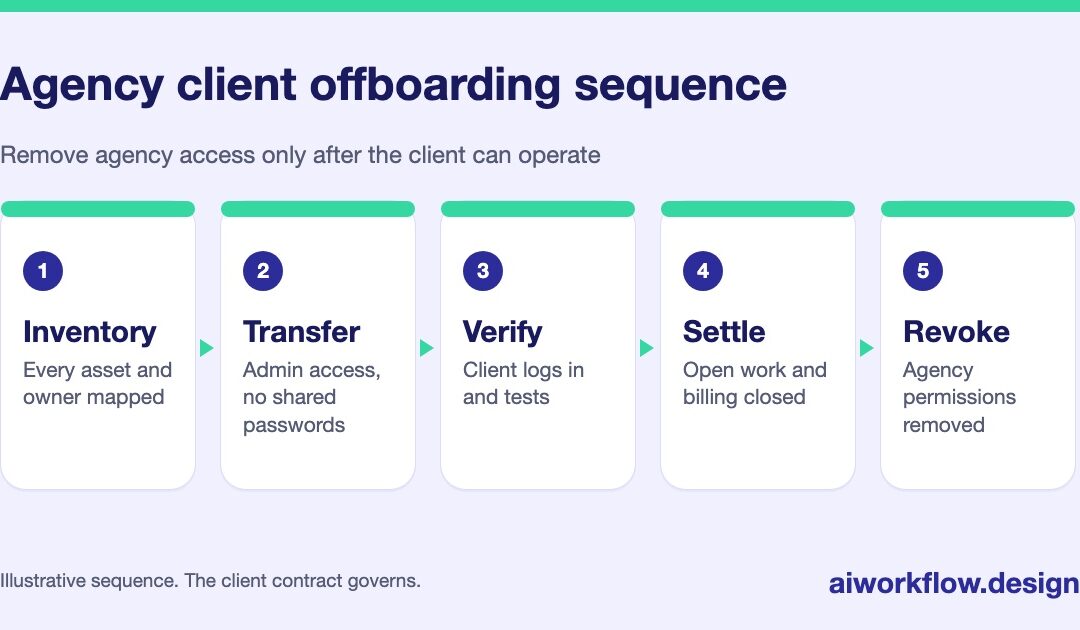
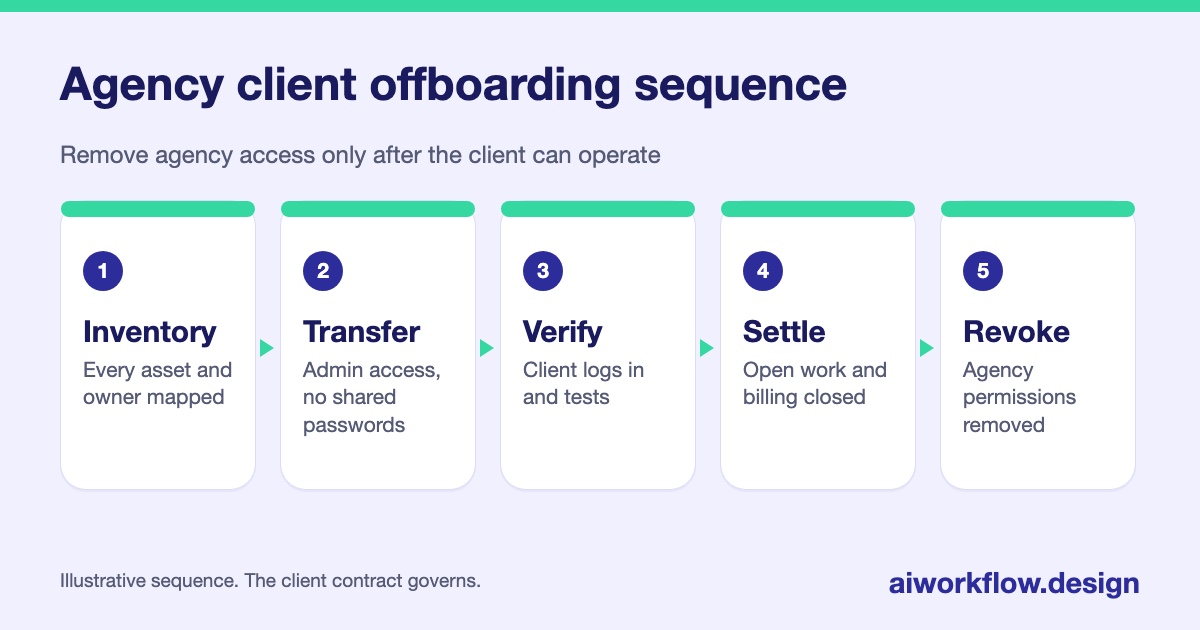
Quick answer: A sound agency client offboarding checklist establishes who owns each digital asset, transfers agreed deliverables and administrative access, verifies that the client can operate independently, settles open work and billing, and only then removes the departing agency’s permissions. It protects data, avoids shared-password handovers and preserves a dated record of what was transferred, retained or deleted under the contract.
A client decides to take marketing in-house. The final report is ready, but the person who created the analytics property is no longer on the account. The landing page is hosted in an employee’s workspace, ad access is connected through an agency manager account, and nobody knows who controls the domain registrar. Cancelling the retainer does not solve any of those problems. An orderly handover starts before the last campaign report, with an asset inventory and ownership decisions.
Start from the contract and map the assets
Read the agreement for intellectual-property ownership, licensed stock and fonts, source-file obligations, confidentiality, data-processing terms, notice periods, and retention requirements. These provisions determine which deliverables can be transferred and which working materials the agency is required or permitted to retain. Do not assume a paid invoice gives the client unrestricted rights to third-party creative, code or software licences. Ask the contract owner to resolve ambiguous rights.
Build an asset register with links and current administrators. Include domain and DNS; website hosting and CMS; analytics, Search Console and tag management; ad accounts and manager links; Meta business portfolio and pages; CRM and email marketing; call tracking; cloud storage; pixels and audiences; lead forms; product feeds; creative files; SEO research; source code and repositories; automation connectors; and billing or subscription contacts. Mark each asset as client-owned, agency-owned or third-party-managed according to evidence, not assumption.
Make a separate list of assets that must remain operational during the transition: lead forms, phone routing, conversion tags, published pages, automations and active campaigns. A correct but mistimed permission change can interrupt sales or erase visibility of conversion performance.
Decide the handover sequence before touching access
Create an agreed transition date, receiving team, named client owner, transfer method and validation checklist. If another agency is taking over, confirm its approved contact and permission level. Where the client plans to close accounts, decide which records must be exported for legitimate retention and which subscriptions should be cancelled by the authorised billing owner.
The order matters. First verify client-controlled administrative access. Then transfer contractually required files and configuration notes. Test live services and reporting access. Finally remove agency permissions, rotate relevant credentials or tokens through the appropriate owner and confirm that no obsolete scheduled jobs remain. Abruptly revoking access first can strand website updates, make analytics history harder to retrieve or interrupt customer enquiries.
Document outstanding campaigns and change-freeze dates. A paused campaign, active experiment, scheduled email and unpublished landing page all need clear decisions. For related launch and content sequencing, see the website relaunch content-freeze workflow.
Transfer advertising and analytics accounts without sharing passwords
Most platforms provide role-based access controls. Prefer granting the client’s approved administrator the required role through the platform interface and verifying acceptance. Google Ads provides methods to grant, modify and remove account access. Google Analytics 4 likewise has account- and property-level user management. Account ownership structures differ; the person with technical access should check the platform’s current process rather than claiming all accounts can be transferred with one email.
Record the exact account ID, business portfolio, property or container. Check whether the client’s existing identity is an administrator or merely a viewer. Verify payment profile responsibility, manager-account links, API credentials, service accounts and third-party tool access separately. Removing a former employee from Google Ads does not necessarily remove a CRM integration, an offline conversion upload or a separately shared dashboard.
Never place passwords, access tokens or recovery codes into a monday.com update, AI voice transcript or general handover email. Use the destination system’s secure identity and secrets-management processes. If an agency-created login must be replaced, the client should own the recovery address and multifactor authentication method before the agency departs.
Preserve the information the receiving team actually needs
A useful deliverables bundle is not a dump of every folder the agency has ever created. Provide the agreed final assets with filenames, versions, usage restrictions and context. For paid media, include campaign structure, audiences where contractually transferable, budgets, conversion definitions, approved creative and open testing notes. For SEO, include technical priorities, key access references, redirect and indexation changes, content inventory and unresolved site issues. For email, include live flows, sending-domain configurations and suppression-management responsibilities without copying unnecessary contact data.
Where reporting sources disagree, label the definitions, date ranges and caveats; don’t silently convert an exploratory spreadsheet into an official final KPI. Keep a written list of outstanding risks such as a pending domain renewal, unstable tracking consent configuration, expiring API token or unsubscribed lead integration.
Personal data handling requires special care. Export or delete data only as the contract and applicable law permit, using authorised client instructions and minimum necessary access. A transfer of campaign assets is not permission to copy audiences, customer lists or tracking data into a personal drive. Agree who will perform and verify any required deletion or retention steps.
Build a monday.com transition board with evidence-based gates
Use one item per asset or deliverable, with columns for asset name and ID; category; owner; legal or contractual basis; current administrator; client receiving owner; transfer method; due date; acceptance evidence; access-removal owner; removal confirmation; and residual risk. Link to authoritative documentation rather than copying secrets into task text.
Practical statuses are inventory verified → transfer prepared → client access provisioned → receipt confirmed → operational validation → agency access removal approved → revoked → archived. Add disputed ownership and blocked by vendor outcomes. Receipt and validation should not be conflated: a client may receive a spreadsheet but still lack the access required to keep the conversion tracking live.
Automations can remind owners when a handover is overdue, while the client or designated account owner confirms acceptance. monday.com supports task and date reminders, but these are record-keeping aids rather than proof of legal or operational transfer. A custom workflow automation engagement can be scoped to standardise the evidence requests and sign-off gates where a team handles frequent transitions.
Give AI check-ins a narrow, privacy-conscious role
A check-in agent could ask an authorised agency contact whether a non-sensitive deliverables list has been uploaded, whether the client has accepted an invitation or whether an outstanding migration task has a new owner. It should never ask for passwords, dictate who legally owns creative, approve data deletion, or remove access based solely on a spoken “yes.”
AI Workflow Design’s products describe scheduled calls and integrations for routine task updates. Their applicability to client offboarding would require a specifically configured process with contact consent, correct access permissions and a human review gate. Any automated action involving credentials, payment methods or personally identifiable data deserves a much tighter security review than an ordinary status reminder.
Test business continuity before the final goodbye
Have the receiving team demonstrate that it can log in, retrieve reports, publish or edit approved site content, receive leads, access billing statements and update the relevant recovery channels. Confirm live form submissions and tracked events using legitimate test procedures and without exposing personal data. Make sure clients know which recurring tools will be billed after the agency’s work ends.
After agreed validation, revoke access in the relevant systems, disable unnecessary integrations, close shared invitation links and remove unused tokens according to the approved security plan. Where the client owns an asset but cannot yet accept control, escalate that blockage and document the temporary arrangements. Do not present an incomplete transfer as finished just because the contract end date has passed.
Complete the final handover with an acceptance record, a list of continuing risks, the location of contractually retained records and the responsible contact for post-transition questions. A mature exit experience is a business asset: it protects the client, the departing agency and the incoming team from months of avoidable confusion.
Next step
Want these follow-ups handled consistently? Explore Autoza AI for monday.com or talk to AI Workflow Design about scheduled, permissioned status follow-ups that leave approvals and decisions with the right people. For a companion workflow, read Campaign Budget Reallocation: A Client Approval and Change-Control Workflow.
Frequently asked questions
What belongs on an agency client offboarding checklist?
Ownership and access inventory, contract deliverables, website and domain control, analytics and advertising access, tracking integrations, data handling, billing ownership, final reporting, operational validation and permission revocation.
Should the agency delete all campaign data when a contract ends?
Not automatically. Retention, export and deletion depend on the contract, client instructions and applicable laws. A data owner should approve actions, with unnecessary copies handled securely.
How do you transfer Google Ads and GA4 access safely?
Grant the receiving client’s named users appropriate native platform roles, confirm acceptance and administrator control, then remove departing users or manager links through the relevant system. Avoid shared passwords.
When should agency access be revoked?
After the agreed deliverables and business-critical access are transferred and verified, unless a security incident or contractual requirement demands a different urgent sequence. Document exceptions and authorised decisions.
Can an AI agent perform the offboarding on its own?
It can assist with administrative reminders and factual check-ins in a designed workflow. Ownership interpretation, credential changes, data deletion and final acceptance require authorised human oversight.