
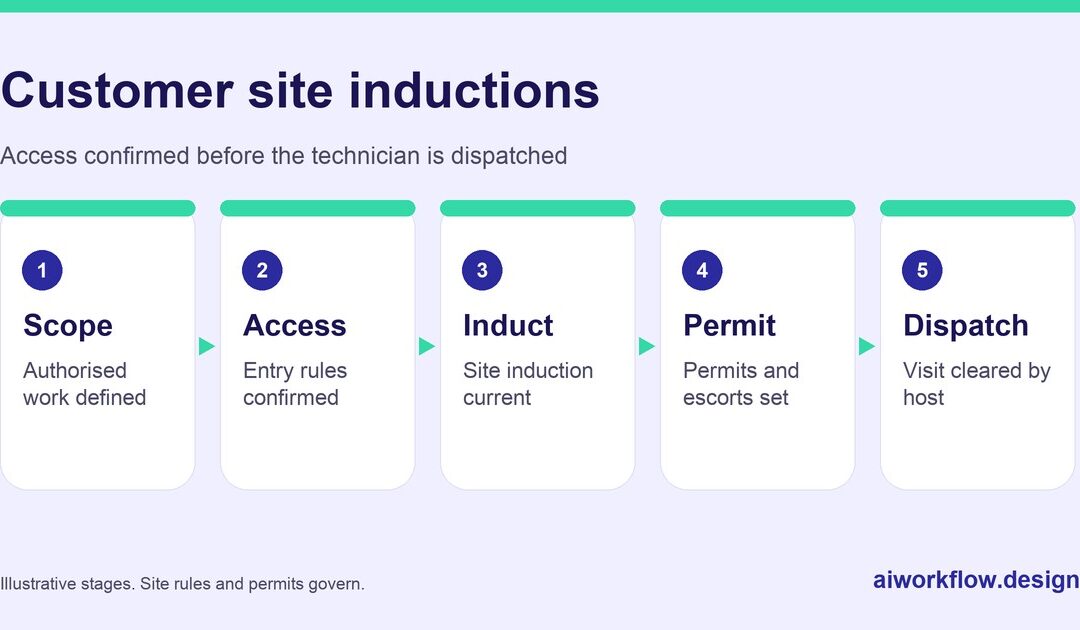
Quick answer: A field service site induction checklist should establish what work is authorized, where the technician may enter, the host’s site-specific hazards and orientation requirements, required credentials and permits, who provides escorts or isolations, and how changes or emergencies are escalated. A dispatch scheduler can confirm administrative readiness, but only the responsible site and employer personnel can accept safety arrangements or permit work to start.
A refrigeration technician has a two-hour repair slot at a distribution center. The customer has approved the visit, but the site now requires a new contractor orientation and an escort for the plant room. The technician arrives at the gate without the correct booking reference. The job is not delayed by the repair itself; it is delayed because dispatch treated a confirmed appointment as confirmed access. A proper induction workflow makes those different commitments visible.
Start by distinguishing access, induction and work authorization
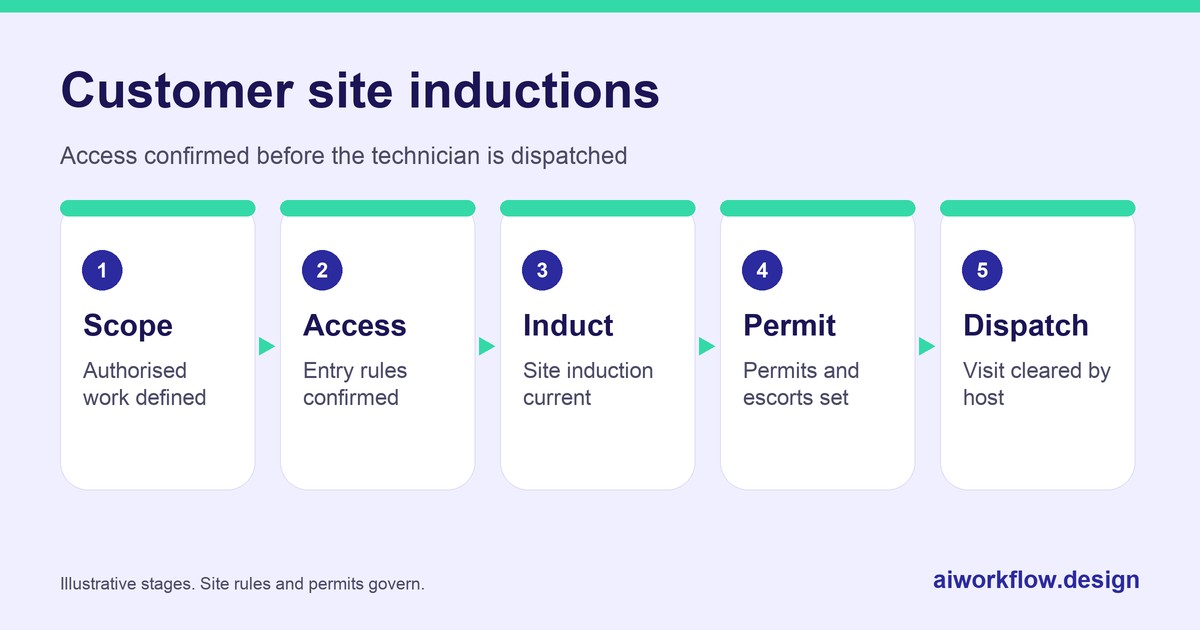
A visitor pass does not prove an employee is competent for a task. Completing a site induction does not automatically authorize energized electrical work, a confined-space entry or a permit-to-work activity. An approved work order does not mean hazards have been assessed for the day’s actual conditions. These are related but separate gates with different owners and records.
OSHA’s communication and coordination guidance emphasizes exchanging hazard and control information between host employers and contractors. The requirements and responsibilities vary with the work environment and applicable laws. Build your induction checklist from the actual host site and job hazards—not from a single companywide form that implies all facilities are equivalent.
What the dispatch team should confirm in advance
Begin with an accurate service scope: work order, equipment identifiers, task description, estimated duration, number of workers and planned tools or vehicles. Identify the exact location and check-in point; a campus or industrial site may have several entrances. Confirm a current customer sponsor, contact number, approved arrival window and emergency notification route.
Ask the host contact which induction or credentialing steps apply to this crew and role. These may include employer verification, approved training, visitor orientation, access restrictions, background requirements, insurance documentation, a site-specific method statement, permitted parking, personal protective equipment, or designated escorts. Record the host’s actual instruction and governing source. Avoid collecting private worker credentials or personal data in an open monday.com board when a restricted system is required.
Subcontracted crews add another layer of checks; see subcontractor credential checks before dispatch.
A practical pre-dispatch workflow
- Scope verified. The service coordinator confirms the approved work order, site, equipment and purpose of the visit. Unknown task changes create a new review.
- Site requirements requested. The host provides the applicable induction instructions, access route, booking rules, emergency contacts and any permit or supervision requirements.
- Crew requirements matched. The contractor’s authorized personnel check competence, training and role-specific requirements. The scheduler records only approved confirmation or expiry status where appropriate.
- Access provisionally confirmed. The host confirms the planned window, check-in contact and whether escorts, shutdowns or permits will be available. This is not a guarantee that work can start under all conditions.
- Day-of-work briefing completed. Workers receive the necessary site information and hazard controls through the responsible employer and host personnel. Changes are reassessed before work.
- Work authorization checked. A competent supervisor or permit issuer supplies any required sign-off. Keep a reference and issuing authority separate from the arrival confirmation.
- Job and site release recorded. After work, capture agreed operational evidence and site check-out; if a safety concern or new work is identified, preserve the exception for human review.
Using a state called “Ready for Dispatch” should mean the scheduling prerequisites are complete, not that safety has been certified remotely. A technician still needs authority to stop work when site conditions differ from the instructions received.
Scenario: a changed plant-room access rule
Imagine a service contractor booked to inspect an HVAC unit at a hospital. The work order was approved last week. Overnight, the facility restricts access to a corridor and now requires the technician to be escorted through an alternative route. The correct response is not to ask the technician to improvise or to pressure a security guard into granting entry. The dispatcher should hold the visit, contact the facility sponsor, obtain the revised access instruction and inform the customer of the schedule impact.
If the job also needs an electrical isolation, that control belongs to the site’s designated authorization process. A receptionist’s assurance that “maintenance knows you’re coming” is useful logistical context but not proof of isolation. A good board shows the exact unresolved gate and the person who can resolve it.
Roof access brings its own prerequisites; see rooftop HVAC visit access and safety checks.
Build a monday.com induction readiness board
Use an item per scheduled job with columns for Site, Customer Sponsor, Work Order, Equipment, Crew Lead, Planned Arrival, Induction Required, Induction Confirmation, Site Briefing Owner, Credential Status, Escort Required, Permit Required, Permit Issuer, Access Window, Restricted Information Link, Dispatch Decision and Exception. Keep the supporting certificate or sensitive document in the appropriate access-controlled repository.
Suggested statuses are Requirements Unknown, Awaiting Host Information, Crew Requirements Checking, Access Confirmed, Dispatch Ready, On Site Awaiting Authorization, Working Under Site Controls, Visit Complete and Held / Escalated. Use separate dates for the appointment and any prerequisite induction booking. A single overdue task should not automatically convert the visit to “complete” when the service slot expires.
The board is most valuable when it identifies the next decision-maker. If an escort is not assigned, the host sponsor is the owner. If training evidence is incomplete, the contractor’s supervisor or compliance lead must resolve it. If a permit is missing, the authorized permit issuer must act. This prevents dispatch from chasing the same person for three unrelated issues.
Where AI check-ins are useful
For teams already using monday.com, Autoza AI is presented as a scheduled calling and board-update option. A narrowly configured call can ask an approved customer contact, “Is the induction booking confirmed for Thursday?” or “Who will meet the engineer at reception?” It can record that a response is pending and alert the dispatcher before the technician leaves the depot.
The agent should not solicit confidential medical or screening information, interpret permits, certify training, decide a plant room is safe, or override a host’s restrictions. It also should not represent a recorded “yes” as an occupational-safety sign-off. Ensure contact permissions, disclosures and data handling fit the applicable rules and client agreement.
Manage exception paths instead of hiding them
Common exceptions include a missing escort, an expired induction, an equipment change, a new access restriction, a permit that covers a different work area, or an unplanned additional technician. Each needs its own escalation: rebook, change the crew, seek a different permitted work window, or stop the affected work pending responsible review. Preserve the original request and the new instruction.
Track the business impact, too. If a failed induction creates a chargeable site revisit, route the question through the contract owner; do not assume the customer owes a callout fee simply because the technician arrived. Give the customer a concise factual update distinguishing arrival from authorized commencement.
Measures that improve first-visit readiness
Useful indicators include visits held because site requirements were not obtained, inductions confirmed before dispatch, gate refusals by cause, lost hours from missing escorts, and visits requiring a second appointment for administrative reasons. Segment by customer location, not just technician. A cluster of failures at one plant may indicate a site-specific onboarding gap rather than poor workforce performance.
Review repeated issues with the customer and contractor safety leads. Update the site profile when requirements change, but retain the date and source of the prior instruction. The goal is fewer wasted trips without weakening the host’s legitimate access and safety controls.
Clean access records also make billing easier to defend; see field service callout invoice checks.
Next step
Want these follow-ups handled consistently? Explore Autoza AI for monday.com or talk to AI Workflow Design about scheduled, permissioned status follow-ups that leave approvals and decisions with the right people.
Related guides:
- Subcontractor Credential Checks: A Dispatch Readiness Workflow
- Rooftop HVAC Visits: Confirm Access and Safety Prerequisites Before Dispatch
- Field Service Callout Invoices: Match Visit Evidence, Rates and Customer Approvals
More guides: browse our field service workflow guides or see all industries we support.
Frequently asked questions
What should a field service site induction checklist include?
At minimum: approved work scope, exact site and check-in point, host contact, access rules, hazard information, role-specific credentials, required permits, escorts, emergency arrangements and the responsible authorization contacts.
Is a confirmed appointment the same as permission to start work?
No. A scheduled visit confirms an intended time. Site orientation, safety controls, equipment isolations and required permits may still need separate authorization.
Who is responsible for site-specific hazard information?
The host and contractor have responsibilities under applicable rules and agreements. OSHA recommends that employers coordinate and share information about hazards and control measures at multiemployer worksites.
What should dispatch do if an induction has expired?
Hold the affected visit, confirm the host’s current requirements and arrange the necessary refresh or replacement personnel. Do not silently change the expiry date or treat prior access as continuing approval.
Can an AI check-in clear a technician for site entry?
No. It can collect administrative readiness updates and identify missing confirmations. The host, employer and authorized site personnel make access, competence, permit and safety decisions.