
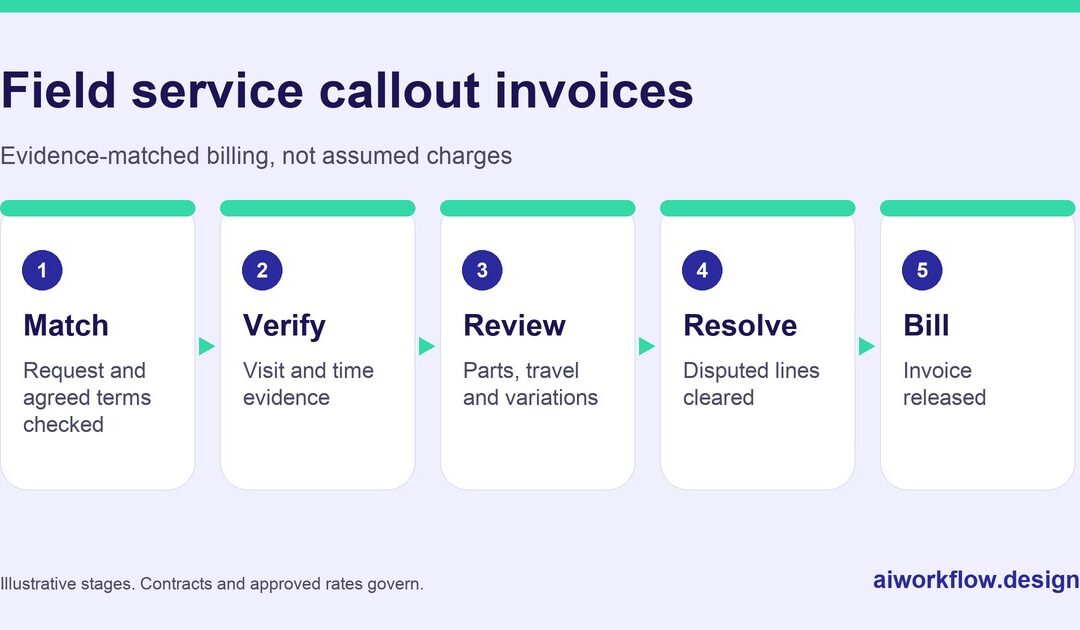
Quick answer: A field service callout invoice checklist should match the service request, agreed pricing terms, dispatch and arrival record, technician work evidence, parts and travel charges, approved variations, and customer-facing invoice. The aim is not to automate payment decisions but to resolve disputed or incomplete lines before billing. A visit marked complete in a field app does not automatically make every charge payable.
A contractor sends an invoice for an emergency HVAC callout: two technicians, a minimum attendance charge, three hours of labor, a replacement component and a travel surcharge. The customer argues that only one engineer entered the building and that the component was never installed. Without a connected work order, time records, parts issue and pricing agreement, the account manager is left debating recollections. An invoice evidence workflow makes the dispute specific and actionable.
Why callout invoices are hard to reconcile
Field service work is often sold through a mixture of recurring service contracts, hourly rates, minimum charges, emergency premiums and separately approved work. A call may begin as diagnosis but turn into a repair requiring a customer decision. Travel, parking, permits, waiting time, consumables and return visits can be treated differently by each contract. Billing teams cannot infer chargeability from the fact that a cost was incurred.
Before designing any workflow, document which signed terms control each account. Confirm the service coverage, after-hours definitions, rate schedule and authority for changes. Consumer repair, commercial maintenance and government work may have different disclosure and documentation obligations. For example, the FTC advises consumers to obtain written information about work, price and timing for home improvements; that advice is not a uniform legal tariff for every field-service contract.
Keep five evidence types separate
The first record is the customer’s service request: who asked for help, when, for which asset and under what priority. The second is the commercial basis: contract, quote, callout schedule or approved purchase order. The third is dispatch evidence: assigned technician, response time, actual arrival and departure, and site-access constraints. The fourth is service evidence: observations, repairs, parts installed, test results and customer acknowledgement where required. The fifth is the billing record: invoice line items with quantities, units, rates and credits.
A technician’s timesheet is a claim of time worked, not necessarily proof that all time is billable. A customer signature may acknowledge attendance rather than acceptance of the repair or price. A parts pick confirms warehouse movement, not successful installation. Use distinct fields and reviewer gates instead of compressing all five into “Job closed.”
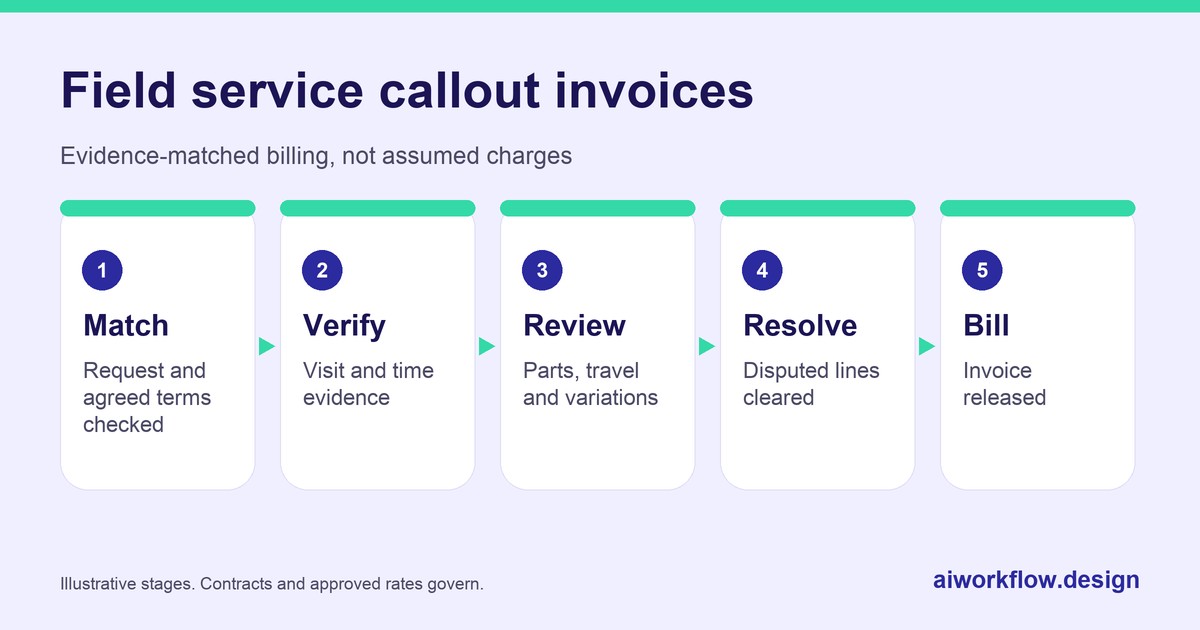
A step-by-step callout invoice QA process
- Capture the original request. Keep the time, channel, site, contact, asset and customer instruction linked to a stable work-order ID.
- Identify the commercial rules. Confirm whether the job is covered by warranty, a service plan, a fixed quotation or time-and-materials terms. Flag uncertain coverage for a contract owner.
- Reconcile attendance. Compare dispatch schedule, technician service log and site acknowledgement. Investigate material differences rather than rounding them away.
- Validate parts and subcontract charges. Match each invoiced component to stock issue, service use, return or supplier evidence. Record substituted parts and the approval route if the change required one.
- Check variations and customer approval. For out-of-scope repairs or exceeding an agreed price limit, find the specific authorization required by contract or law. A phone conversation may need an approved written record.
- Review taxes, surcharges and credits. Check applicable rate, minimum charge, travel zones, deposits, waived fees and prior service credits. Do not add a charge merely because the software offers a field for it.
- Release or hold the invoice. An authorized billing reviewer decides whether to issue, revise or dispute a line. Preserve the original evidence and approval history.
A good exception state says why an invoice is on hold. “Time mismatch,” “rate not found,” “parts evidence missing” and “variation approval disputed” require different resolutions and owners.
Return visits under warranty are covered in warranty callback scheduling.
Example: a return visit under the same fault reference
Consider a hypothetical plumbing service contract that promises a no-charge return when the same defect remains unresolved within an agreed period. The engineer visits on Tuesday, replaces a valve and signs out. The customer calls again on Friday about continued leakage. The new visit may be a warranty revisit, a different fault or a separate issue; no single timestamp proves which category applies.
Link both visits to the asset, original symptom, first repair evidence and contract provision. Ask the technical service manager to assess whether the work is related and the commercial owner to determine coverage under the agreement. Do not let the invoicing algorithm automatically bill the second minimum charge or automatically waive it. Either outcome requires a defensible basis.
Make monday.com a reconciliation queue
A useful board contains Work Order, Site, Customer, Contract/Rate Card, Callout Category, Requested At, Dispatched At, Arrived At, Departed At, Technician, Service Report Link, Parts Used, Variation Approval Reference, Customer Acknowledgement, Proposed Invoice Amount, Exception Type, Billing Reviewer and Release Decision. Sensitive customer or payment information belongs in restricted finance systems, not a general operations board.
An ideal status flow is Service Logged, Evidence Pending, Ready for Rate Review, Billing Exception, Waiting for Customer Clarification, Approved for Invoicing, Issued, Disputed and Reconciled. These statuses should reflect the real stage; an invoice being emailed is not the same as the customer paying or accepting the charges.
Use automations for missing-document reminders and owner assignments. A status field can calculate how long a case has waited for evidence. It should not approve a disputed charge because a deadline passed or because a customer failed to answer one attempted call. Where an account uses an ERP or accounting system, define which platform is authoritative for prices, invoices and tax calculations before integrating it with the task board.
When automated check-ins are appropriate
AI Workflow Design’s field-services overview describes Autoza AI for monday.com, which can collect scheduled administrative status updates. A configured call could ask whether a signed service sheet has been uploaded, whether the customer confirmed an appointment, or who will review a disputed work-order reference. The result can prompt the billing reviewer to examine the actual documents.
It should not collect payment-card data over an unauthorized channel, interpret a legal contract, promise a refund, declare fault or coverage, create an unapproved invoice line, or settle a disputed claim. Escalate complaints requiring judgment to an identified account manager. Any call recording and customer outreach must comply with applicable consent, privacy and contact rules.
Explain disputes clearly to customers
A useful customer update states the work-order reference, the charge being questioned, the evidence under review, the assigned contact and the next expected communication. Avoid defensive responses such as “the system says it’s billable.” Where a correction is approved, issue a traceable revised document or credit under accounting controls rather than silently editing the original invoice.
Also record what happened operationally. Repeat discrepancies may point to technicians forgetting arrival times, unclear quote limits, service sheets that omit parts, or inconsistent definitions of after-hours windows. Improving the source process reduces disputes more effectively than chasing each one after invoice issuance.
When the customer disputes completion rather than a price, use the job sign-off dispute workflow.
KPI checks without punishing legitimate holds
Track first-pass invoice accuracy, percentage with complete service evidence before issue, average resolution time by exception type, credit notes arising from data errors, and repeated claims by customer contract. Compare disputed amounts separately from total invoice aging. An invoice awaiting lawful customer clarification should not be labeled employee underperformance merely because it remains open.
The objective is fair, contract-grounded billing supported by a transparent record of attendance, scope and authorized changes. That improves customer trust while reducing finance rework.
Next step
Want these follow-ups handled consistently? Explore Autoza AI for monday.com or talk to AI Workflow Design about scheduled, permissioned status follow-ups that leave approvals and decisions with the right people.
Related guides:
- Customer Job Sign-Off: Handle Disputed Completion Without Auto-Closing
- Warranty Callback Scheduling: Confirm Coverage Before Dispatch
More guides: browse our field service workflow guides or see all industries we support.
Frequently asked questions
What should a field service callout invoice include?
It should describe the service, dates, asset or site reference, billable labor and units, parts, applicable charges, taxes and the contractual or approved basis for the total. Exact legal requirements vary by jurisdiction and service type.
Does a signed job sheet prove the customer approved every charge?
Not necessarily. A signature may confirm attendance or work performed. Review the wording of the form, the agreement and any separate required authorization for added work or fees.
How should a disputed travel surcharge be handled?
Put the line in a billing-exception state, check the applicable rate card and travel-zone terms, preserve the job record and send the matter to the commercial reviewer rather than changing the charge without evidence.
Can an AI agent determine whether a second visit is covered by warranty?
No. It may gather the related work-order references and alert the service manager. Coverage, fault cause, legal rights and invoice decisions require authorized human review.
What is the best way to reduce callout billing disputes?
Capture the job request, contract terms, verified attendance, parts use and variation approvals before invoicing, then measure the recurring exceptions and fix their source.