
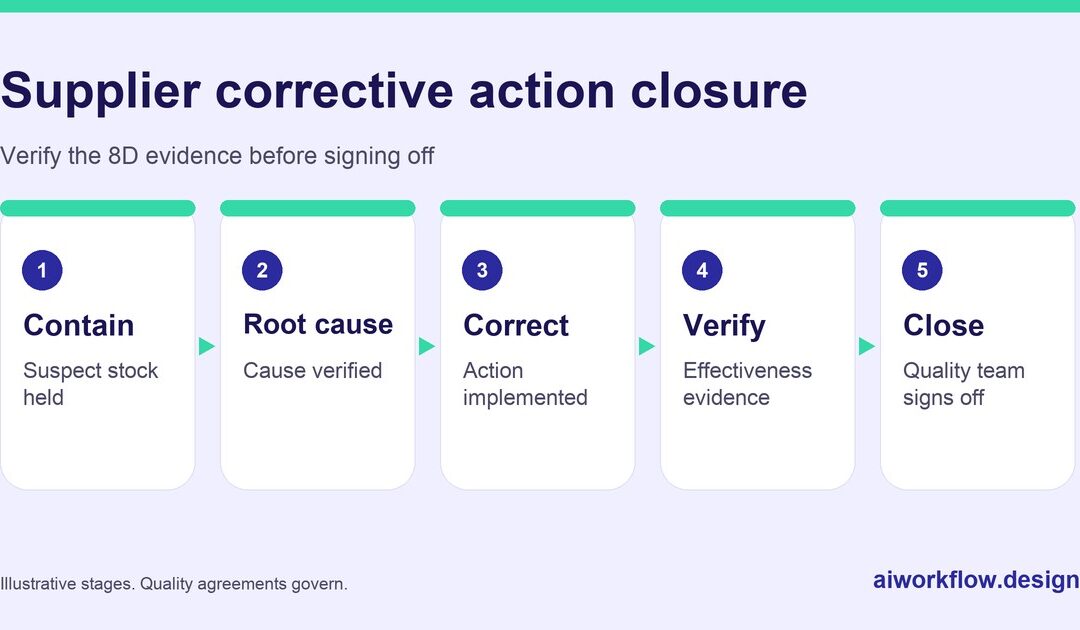
Quick answer: A supplier corrective action request (SCAR) should not close merely because a supplier emailed an 8D report or promised a new procedure. A reliable supplier corrective action closure workflow checks containment, verified root cause, implemented corrective action, objective effectiveness evidence, approval authority and remaining product or customer risks. monday.com can coordinate deadlines and follow-ups; the buyer’s qualified quality team must decide whether evidence is sufficient to close the request.
When a supplier ships a part that does not meet requirements, the immediate response is often fast: material is placed on hold and a replacement shipment is arranged. Yet the defect may recur if the supplier has not found why the process failed. The customer has solved the shortage but not the underlying quality problem. That is why a supplier corrective action request needs a clear path from containment through proof that the corrective measure works.
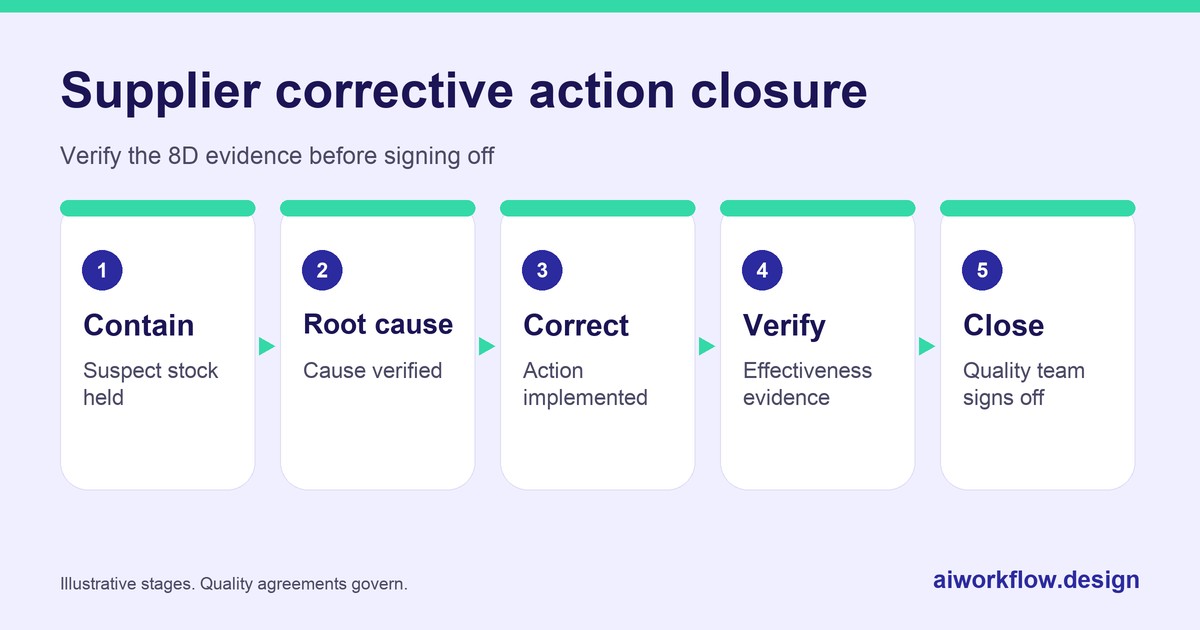
The American Society for Quality describes phases of SCAR work including entry, containment, root cause, implementation, effectiveness and closure. An eight-discipline (8D) report is one common format for structuring the investigation; exact requirements vary by industry, purchase contract, quality agreement and risk. A checklist helps keep evidence organized, but it cannot substitute for competent engineering or supplier-quality judgment.
Separate a replacement shipment from a corrective action
A replacement meets an urgent supply need. Containment prevents more suspect parts from being used or shipped while the problem is investigated. A corrective action addresses the cause that allowed the failure to occur or escape detection. These activities overlap but should not be marked complete through one status checkbox.
For example, a supplier may sort inventory and ship conforming replacements within two days. The buyer can accept those particular parts after the appropriate inspections while keeping the systemic corrective action open. Conversely, the supplier may have documented a plausible root cause but still lack enough production cycles to demonstrate effectiveness. A strong workflow keeps affected product disposition, delivery recovery and SCAR closure distinct.
Incoming material problems often start at receipt; see incoming material quality holds.
What evidence is needed for each SCAR stage?
Problem definition: Link the complaint or nonconformance ID, part number, drawing revision, affected lots, defect description and objective evidence. Avoid writing “poor quality” as the problem statement. The supplier must know exactly what failed and the standard against which it failed.
Containment: Record suspect stock identification, segregation actions, shipments checked, sorting instructions, inspection criteria and who confirmed the temporary measures. Identify whether customer sites or already-shipped inventory require a separate notification or disposition process.
Root-cause analysis: Ask for a documented method that connects the physical or process cause to evidence. Distinguish the occurrence cause from the escape cause: why the defect was created and why the supplier’s existing controls did not prevent shipment. Reject explanations such as “operator error” when the investigation does not examine process design, training, error-proofing and detection controls.
Permanent corrective action: Capture the specific process, tooling, software, material, inspection or training change, its implementation date, responsible owner and updated controlled documents. A revised procedure that has not been deployed on the relevant shift is not an implemented control.
Effectiveness verification: Specify what data will demonstrate sustained improvement, over what observation period, under which production conditions and who will review it. Use evidence relevant to the failure mechanism; an attractive 8D slide deck is not performance evidence.
Closure: The authorized buyer or supplier-quality reviewer records whether the SCAR meets agreed conditions, what residual issues remain and why the case can close. Close only the corrective-action request, not unrelated open material holds or customer claims.
For new parts or changed processes, first article inspection documents are the earlier control.
A seven-step follow-up schedule that works in practice
- Open one traceable SCAR. Link it to the original nonconformance and use a unique ID that stays consistent through emails, portals and reports.
- Set containment deadlines according to risk. A safety-critical or production-stopping defect may need immediate escalation; administrative convenience should not set the response priority.
- Agree the required response format. Confirm whether the supplier must provide 8D, a different structured report or additional industry-specific evidence. Avoid demanding reports that the contract does not require without a decision.
- Review the causal logic before implementation. The buyer’s qualified reviewer checks whether the explanation addresses the observed defect and its escape path.
- Track each corrective step separately. Assign responsible owner, document revision, target completion and evidence link, distinguishing planned from implemented actions.
- Check effectiveness after sufficient exposure. Use suitable production history, inspections or verification tests, and explain any limitations in the observation window.
- Close or return with precise gaps. If evidence fails, request a defined correction, name the reviewer and set a new response date without resetting history or hiding previous findings.
The supplier should not be asked to guess what the customer wants. Clarifying the acceptance criteria early saves several rounds of vague requests and response decks that say everything except whether the failure has been prevented.
Example: the new inspection catches defects, but the process still makes them
Consider a hypothetical manufacturer receiving stamped brackets with an incorrect hole position. The supplier adds a final inspection and sends a report showing that the next shipment was sorted. That may improve the chance of detecting a bad bracket, but it does not necessarily prevent the stamping process from producing defects.
A stronger investigation examines fixture wear, setup validation, drawing revision control and shift-to-shift variation. The corrective plan may include fixture maintenance and a validated setup check, with inspection retained as a layered control. The buyer then reviews evidence from relevant production conditions and evaluates whether the identified occurrence and escape causes have both been addressed.
There are no fabricated defect rates or customer results in this example. The point is the distinction between evidence that protects a single shipment and evidence that supports sustainable corrective action. If a safety or regulatory issue is involved, the required escalation and effectiveness standard may be more stringent.
A supplier-quality board in monday.com
Create a parent item for each SCAR, with stage-specific subitems. Recommended fields include SCAR ID, Supplier, Part and revision, Defect category, Risk level, Affected lots, Containment status, Root cause review, Permanent action implementation, Effectiveness check, Supplier owner, Buyer quality owner, Due date, Evidence link and Closure decision.
Separate supplier-submitted claims from buyer-reviewed outcomes. A supplier can say “8D submitted”; the buyer can say “review pending” or “revision required.” This prevents an automatic green status from appearing when a document arrives. Use review comments that cite the missing proof—for example, “Provide evidence of the revised setup check from the second shift”—rather than a generic “needs more detail.”
Security and commercial access matter. A general operations board may be an appropriate place for due dates and responsibilities, while drawings, process parameters, supplier pricing and proprietary 8D attachments may belong in a restricted quality system. Link to authorized records instead of copying sensitive files into broad call summaries.
Where AI calls can save time—and where they cannot
AI Workflow Design’s products page describes scheduled status-checking tools, including Autoza AI for monday.com. With an appropriately approved configuration, a routine call can ask the supplier liaison whether containment evidence was submitted, whether an 8D revision is expected or whether the agreed verification review is booked. It can update an administrative task or raise a follow-up for the buyer.
It should not decide that root cause is valid, accept a nonconforming shipment, waive customer requirements or close the SCAR after hearing “done.” Those actions belong to competent authorized reviewers working within the quality-management system. If a custom workflow automation links a supplier portal to a task board, it should check source identity and event type and retain the buyer’s explicit approval gate.
Close only after verification, not after a polite response
An acceptable closure record identifies the nonconformance, affected product handling, verified root cause, completed corrective steps, effectiveness method, observation evidence, decision-maker and closure date. If the supplier has not yet accumulated enough process evidence, keep the effectiveness stage open or use a documented conditional process authorized by the applicable quality system. Do not silently close to improve monthly scorecards.
Retain lessons for supplier development. A repeat defect can indicate that the prior action was ineffective, that the failure mechanism changed or that the original scope was incomplete. Review supplier performance trends with appropriate context rather than counting SCARs in isolation. A supplier who transparently reports and fixes a serious issue may represent lower long-term risk than one whose reports always look perfect but lack traceable evidence.
Next step
Want these follow-ups handled consistently? Explore Autoza AI for monday.com or talk to AI Workflow Design about scheduled, permissioned status follow-ups that leave approvals and decisions with the right people.
Related guides:
- Supplier First Article Inspection: Track Documents Before Quality Approval
- Incoming Material Quality Holds: Supplier Evidence and Disposition
More guides: browse our manufacturing workflow guides or see all industries we support.
Frequently asked questions
What is a supplier corrective action request?
A SCAR is a formal request for a supplier to investigate a nonconformity, contain risk, identify causes, implement corrective action and provide evidence for buyer review.
Does submitting an 8D report mean the SCAR is closed?
No. An 8D report is documentation. Closure should follow review of the actual corrective actions, evidence of implementation, effectiveness and authorized acceptance.
What is the difference between containment and corrective action?
Containment limits immediate exposure to suspect product. Corrective action addresses the causes of the problem to reduce the likelihood of recurrence.
Can a project board automatically approve supplier quality closure?
A project board can track the stages and preserve references. Closure needs a qualified approval within the buyer’s quality process and should not be inferred from a generic complete status.
What if a supplier cannot yet prove effectiveness?
Keep the effectiveness review open, document the reason and observation plan, and apply appropriate interim controls. Any conditional decision requires the authorization specified in the quality agreement.