
An incoming material inspection hold workflow protects production by making a simple distinction: material can be physically received without being accepted for use. When a shipment fails inspection or required documentation is missing, purchasing, receiving, quality and production need an accurate status. Supplier calls can help obtain certificates or corrective-action responses, but they must never release quarantined material or authorise a concession.
Why “received” and “available” cannot share one status
A purchase order may show delivery complete while the receiving inspector still needs to verify lot identity, drawing revision, quantities or required test reports. Stock can be unloaded, counted and placed in a controlled area without being approved for manufacturing. A project board that marks the purchase order “done” at dock arrival hides downstream risks, such as a shortage of usable material on a planned production order.
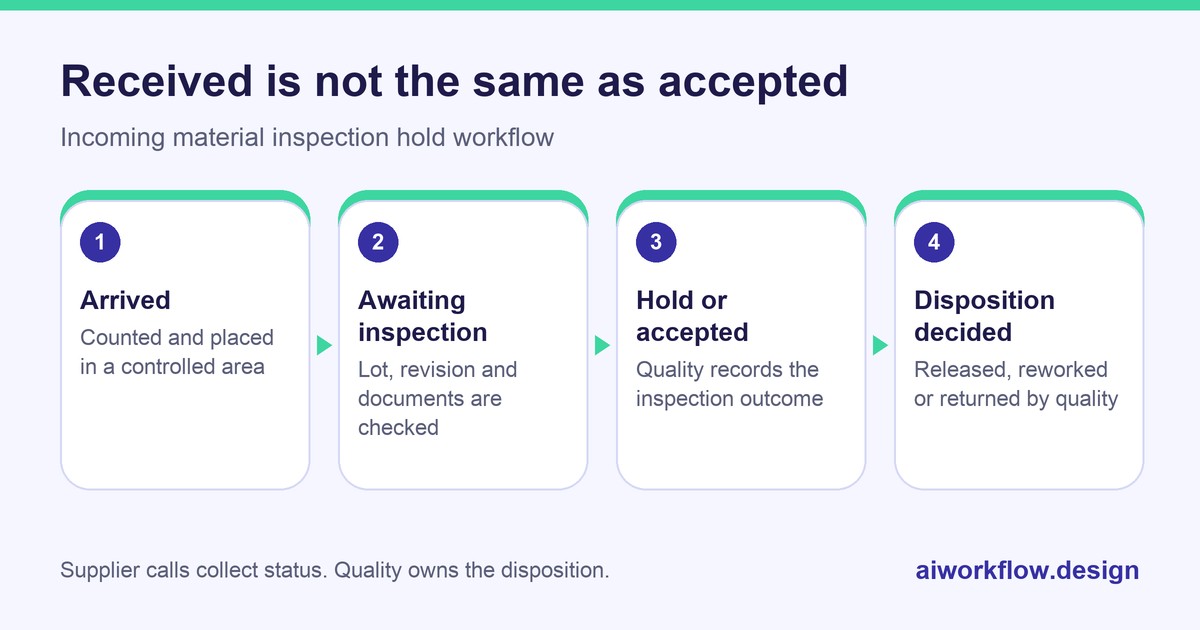
Make the workflow explicit: arrived → awaiting inspection → hold/accepted → disposition decision → released or returned. Exact steps depend on the company’s quality system and product. The project coordinator reports facts about those steps; quality staff own the decision that changes what may be consumed in production.
Open a hold with a traceable identity
An effective hold record identifies internal part number, supplier, purchase-order reference, batch or lot reference as permitted, quantity affected, receiving date, nonconformance or missing-document category, physical or system hold location, quality owner, supplier-contact owner, required response and decision status. Keep detailed drawings, prices, regulated characteristics or confidential evidence in controlled systems when required.
For material requiring special handling, isolation and labelling need to follow site procedures. A telephone message that “the boxes are set aside” does not verify correct physical segregation. The responsible receiving or quality employee should record the actual control transaction and location. If mixed lots or traceability breaks are suspected, escalate promptly to the quality function.
Distinguish four kinds of supplier responses
“Document sent” means the supplier reports having provided a certificate; the receiving team still has to locate the file. “Replacement planned” is a proposed action with a date, not goods received. “Carrier collected return” is transport progress, not approved credit or quality closure. “We believe it meets specification” is the supplier’s assertion, not the manufacturer’s acceptance decision.
Record these responses with timestamps, the named supplier contact and a restricted reference to evidence. Avoid free-text fields that inadvertently repeat sensitive product designs or confidential commercial terms. If a supplier challenges the inspection result, direct technical discussion through the approved supplier-quality process.
Create a disposition ownership matrix
Purchasing may own supplier communications and replacement dates. Receiving controls the actual stock location and inventory transaction. Quality evaluates nonconformity and chooses or approves the permitted disposition according to policy. Engineering may be required for a technically justified deviation or concession. Production planning decides how approved stock availability affects the schedule. These roles should not be collapsed into “vendor says OK”.
Possible outcomes include return to supplier, rework under approved instructions, further evaluation, authorised concession or rejection and scrap. The exact permissions depend on the organisation, contract and regulation. A voice agent should never select a disposition, issue a concession or move material to available stock based on a verbal statement.
Sample low-risk vendor check-in
A receiving coordinator may schedule an approved status call to ask:
- Are you the designated contact for the open supplier response related to this neutral work reference?
- Has the requested certificate or test report been sent through the agreed secure channel?
- Is additional evidence or a revised shipment required from your team?
- What is the confirmed date for the next supplier response or replacement milestone?
- Who should the buyer or supplier-quality engineer contact about an unresolved blocker?
The call should not ask the supplier to approve a defect on behalf of the manufacturer. Use “supplier reports evidence submitted” until quality confirms receipt and adequacy. “No answer” means a contact attempt failed, not that the batch is unsuitable or approved.
An illustrative planning conflict
Imagine a manufacturer receives cast components for an upcoming build. The components are counted but held because the required material report is missing. The supplier says the report will be sent that afternoon; the planner asks if the line can start. The board should show received, quality hold active, supplier evidence pending. A line supervisor or project manager must not interpret the supplier’s promise as a release. If the production schedule cannot absorb the wait, the authorised planning and quality teams decide the next action using approved alternatives.
The earlier guide on supplier part shortages covers delivery risks; this guide addresses a different problem—material that has arrived but is not yet qualified for use. That distinction gives each article a separate search intent and helps prevent operational confusion.
Schedule by decision milestone, not by daily call quota
A useful follow-up may happen shortly before a supplier response is due, when an inspection report is expected, or before a planning meeting that requires an authorised disposition update. Repeated calls that do not change the next decision create noise for both parties. For urgent quality concerns, follow the immediate site escalation route instead of waiting for an automated call schedule.
Review outcomes such as elapsed hold time, evidence completeness, percentage of records with clear ownership and frequency of late supplier responses. Do not reward premature closure. A well-managed hold can legitimately remain open when technical evidence is insufficient; the goal is transparent status and controlled decision-making, not a green dashboard.
Where voice automation may assist
AI Workflow Design describes scheduled calls, summaries and updates to selected work fields. A manufacturing buyer could evaluate a pilot for collecting supplier acknowledgment, response dates and administrative blockers while preserving the official quality management system for disposition. Before deployment, obtain appropriate consent, minimise shared data, restrict call recipients and verify that no automatic status mapping can change material availability or quality approval.
Incoming material hold checklist
Confirm receiving identity and quantity; establish system and physical hold controls; assign supplier and quality owners; request and securely store required evidence; document the next supplier checkpoint; obtain authorised technical disposition; complete the appropriate inventory transaction; and review downstream planning impacts. Every stage should have a named responsible person and a visible evidence requirement.
Next step
Request a workflow review focused on supplier-status collection rather than automated material-release decisions. Explore Autoza AI for monday.com or browse more workflow guides.
Frequently asked questions
Can a supplier’s verbal assurance release quarantined material?
No. The manufacturer’s authorised quality or engineering process must evaluate the evidence and approve disposition under its documented procedures.
What information belongs in an incoming material inspection hold record?
Include supplier, part and lot references, receiving date, affected quantity, hold reason, controlled location, quality owner, required supplier evidence and disposition status.
What is the difference between received and accepted stock?
Received stock has physically arrived and been recorded. Accepted stock has passed applicable verification and has been released by the authorised process for its permitted use.
Can AI calling manage nonconforming material?
It may help chase approved administrative updates and supplier responses. It must not assess conformity, grant a concession, authorise rework or change inventory to usable stock.
How should a late supplier certificate be escalated?
Record the promised evidence date, contact the purchasing and supplier-quality owners, and have planning assess schedule impact while quality maintains the hold until the approved review is complete.
Related reading
- Supplier Part Shortages: A Manufacturing Follow-Up Matrix for Planners
- Corrective Action Ownership: Following Up on Manufacturing CAPA Tasks
- Engineering Change Orders: Tracking Manufacturing Approval Dependencies
- Production Changeovers: How to Track Each Owner Before the Next Shift
- AI Calls in Manufacturing: Where Human Safety Approval Must Stay in Control
- Missing Batch Records: Track Evidence Before Production Release