
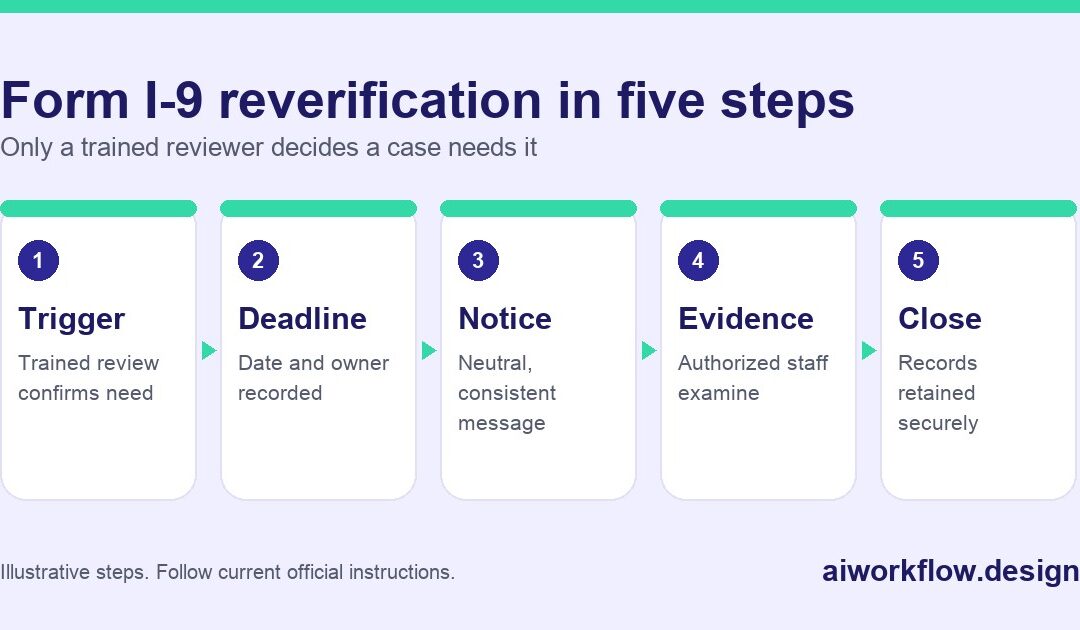
Quick answer: A staffing Form I-9 reverification workflow should identify cases in which employment authorization actually requires reverification, set a documented follow-up date, provide employees with neutral instructions, and route documents to trained, authorized personnel. It must not demand a specific document, assume every expiring identification card triggers reverification, or let an AI agent decide whether someone remains eligible to work. The goal is a timely, fair administrative process that follows current official Form I-9 instructions and applicable anti-discrimination rules.
Staffing agencies manage a changing workforce, short assignments and periodic rehires. That complexity makes work authorization reverification a tempting target for automatic reminders. Yet an indiscriminate “your document expires soon” campaign can create a compliance problem if it targets workers who do not need reverification, demands the wrong document, or treats citizenship status differently. The correct workflow begins with a trained reviewer deciding whether a legitimate reverification event exists.
Do not confuse document expiration with mandatory reverification
The Form I-9 process has specific rules about when employment authorization is reverified. An employee’s identity document expiring does not by itself mean Section 2 needs to be redone. Some documentation and statuses are not subject to reverification in the way an ordinary calendar might imply. Use those sources and any current regulatory updates, not a spreadsheet rule designed years ago. Professional credentials are a different case; see staffing credential expiration tracking.
This is especially important for staffing teams handling people with different authorizations or receipt scenarios. The employer must allow employees to choose acceptable documentation within the rules, rather than instructing a worker to supply a particular card because an automated workflow thinks it is easier. If a case involves extensions, receipts, status-specific provisions, remote verification procedures or a rehire, a trained I-9 specialist should review the applicable instructions before scheduling a deadline.
Establish a minimal, access-controlled case register
The administrative record needs an internal employee ID, employer entity, original Form I-9 reference, authorized review owner, whether reverification is required, applicable deadline, source of the deadline, employee notice status, secure appointment or upload path, case review status and completion reference. Do not place passport scans, immigration details or Social Security numbers in a shared operations board or a general AI call transcript. Keep documents in the designated compliant I-9 repository under role-based access and retention controls. Assignment changes affect records too; see assignment end follow-ups.
When a case is not yet clear, use the status Specialist review needed, not Unauthorized or Failed. An uncertainty flag is a prompt for human assessment, not a finding about employment eligibility. Preserve who set each date and why. That audit trail becomes critical if a policy changes, an extension applies or a worker disputes being treated differently from colleagues.
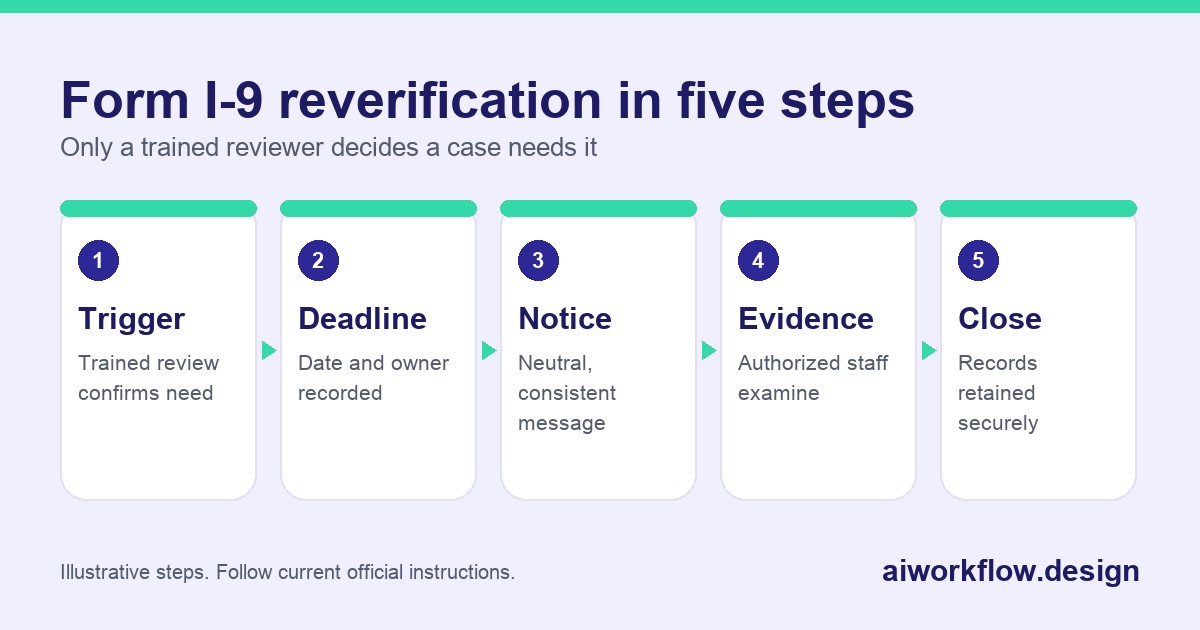
A six-stage Form I-9 reverification follow-up process
1. Identify a valid trigger through trained review
Begin with an authorized HR or compliance review of the existing Form I-9 and governing instructions. Confirm whether reverification is required for the particular employee and, if so, the correct basis and timing. A general “document expires” feed should generate a review queue rather than automatically generating a legal conclusion. Rehires have separate instructions, including when Supplement B may be used; they should not simply be grouped with expiring authorization cases.
2. Record the deadline and any review dependencies
Once a valid obligation is established, enter the deadline, instruction version and review owner in the restricted register. Flag cases needing specialist advice because of receipts, pending extensions or other nuances. Avoid interpreting uncertain eligibility through a rigid countdown color. A red deadline indicator may help staff prioritize a task, but it does not determine legal status.
3. Send neutral, consistent employee communications
Use approved language that explains the process and how employees can contact an authorized reviewer. Do not ask only workers of a particular nationality or citizenship status for extra documents. Do not tell the employee that they must produce a particular document when the Form I-9 rules allow a choice. Make the communication accessible and offer an appropriate private channel for questions; responses should not appear on a recruiter-visible assignment board.
4. Receive and examine evidence through authorized personnel
An approved HR specialist reviews original or otherwise permitted documents and determines completion in line with current rules. The staffing coordinator can monitor whether an appointment is scheduled or a secure request is pending, but should not inspect an identity document in a chat thread or ask an AI voice agent to classify immigration status. Document acceptance is a human compliance step in the authoritative record.
5. Complete Supplement B or other required records correctly
When reverification is required, use the current Form I-9 instructions for Supplement B, Reverification and Rehire. Record the necessary action and reviewer signature in the designated system. Do not use an auto-generated “compliant” status merely because a document was uploaded. Where an employee’s circumstances require additional interpretation, obtain qualified legal or specialized compliance guidance rather than improvising rules in automation logic.
6. Close the workflow with appropriate access and retention
Mark the administrative item completed only after the authorized reviewer has finalized the required record and linked a non-sensitive completion reference. Confirm that duplicate reminders stop and access rights remain limited. Retention of Forms I-9 and associated records follows specific legal requirements; apply the organization’s established retention schedule as reviewed by HR or counsel. Do not delete records simply because an assignment ended.
How to implement a safe monday.com workflow
Use a restricted HR board or task integration with fields such as Employee ID, Case type, Review owner, Reverification required?, Deadline source, Notice date, Secure review scheduled, Specialist exception, Form completion confirmed, and Final reviewer. Set a status route of Needs triage, No reverification required, Employee notice due, Review scheduled, Specialist review, and Closed by HR. The “No reverification required” outcome is important; it prevents unnecessary repeat contact. Schedule changes need their own notices; see staffing shift cancellation workflows.
An AI status caller should not ask for a worker’s immigration category, visa number, document photograph or detailed explanation of citizenship. If privacy and legal reviews allow a call, it might simply ask whether the employee received the HR appointment notice and offer to connect them with the authorized team. Use the Daily Check-in Agent for bounded administrative status conversations only where appropriate and configure any custom workflow with HR-approved field-level permissions. The I-9 record remains in the employer’s approved system. See AI Workflow Design’s product overview, Autoza AI for monday.com and the workflow automation service for what can be configured; availability depends on your setup.
Three failure modes to design out
First, unnecessary reverification: a workflow triggers because a resident card, passport or identity document has an expiration date even when reverification is not required. Second, document steering: the reminder asks for one named document instead of explaining the employee’s choice under the rules. Third, automatic employment consequences: an unreviewed status changes a roster or terminates a placement. Each design can create risks beyond an ordinary missed deadline. Set explicit human approvals before any work-assignment or employment action.
Review metrics should focus on timely, accurate processing: percentage of cases triaged by trained staff, avoidable notices stopped at triage, cases awaiting private HR review and complete audit references. Do not use workers’ immigration categories as a public dashboard segmentation method. Make fairness and information minimization measurable aspects of workflow quality.
Next step
Have the HR or immigration-compliance owner review a sample of open records and classify which cases genuinely require reverification. Build the reminder process only after that rule set is approved. A well-designed automated workflow reduces missed administrative tasks while preserving employee choice, privacy and the human decisions required by law.
Want these follow-ups handled consistently? Explore Autoza AI for monday.com or talk to AI Workflow Design about scheduled, permissioned status follow-ups that leave approvals and decisions with the right people.
Related guides:
- Staffing Shift Cancellations: Coordinate Worker Notices and Payroll Review
- Staffing Credential Expiration Tracking: Renew Evidence Before a Worker Is Assigned
- Staffing Timesheet Disputes: Resolve Missing Approvals Without Delaying Wage Review
More guides: browse our recruiting and staffing workflow guides or see all industries we support.
Frequently asked questions
Must every employee’s expiring identity document be reverified?
No. Form I-9 rules distinguish identity documentation from employment authorization reverification. A trained reviewer should determine whether reverification is required under current official Form I-9 instructions before any reminder is sent.
Can a staffing agency demand a specific replacement document?
Generally, the employee must be allowed to choose acceptable documents consistent with Form I-9 requirements. Demanding more or different documents or steering based on citizenship or immigration status can create unfair documentary practice concerns. Seek qualified advice for special circumstances.
What is Supplement B of Form I-9?
Supplement B is used for reverification and certain rehiring situations as explained in the official Form I-9 instructions. It replaced the former Section 3 designation. Which action is appropriate depends on the employee’s record and circumstances.
Should identity documents be saved on a general monday.com board?
No. Store sensitive documents only in an approved, restricted I-9 record system. A workflow board should contain a minimum case identifier, dates, assignment to trained staff and a secure completion reference.
Can an AI agent suspend a worker when a deadline is reached?
No. An AI assistant can flag a pending administrative task if authorized, but employment eligibility interpretation and any resulting employment action require qualified human review under applicable law and policy.