
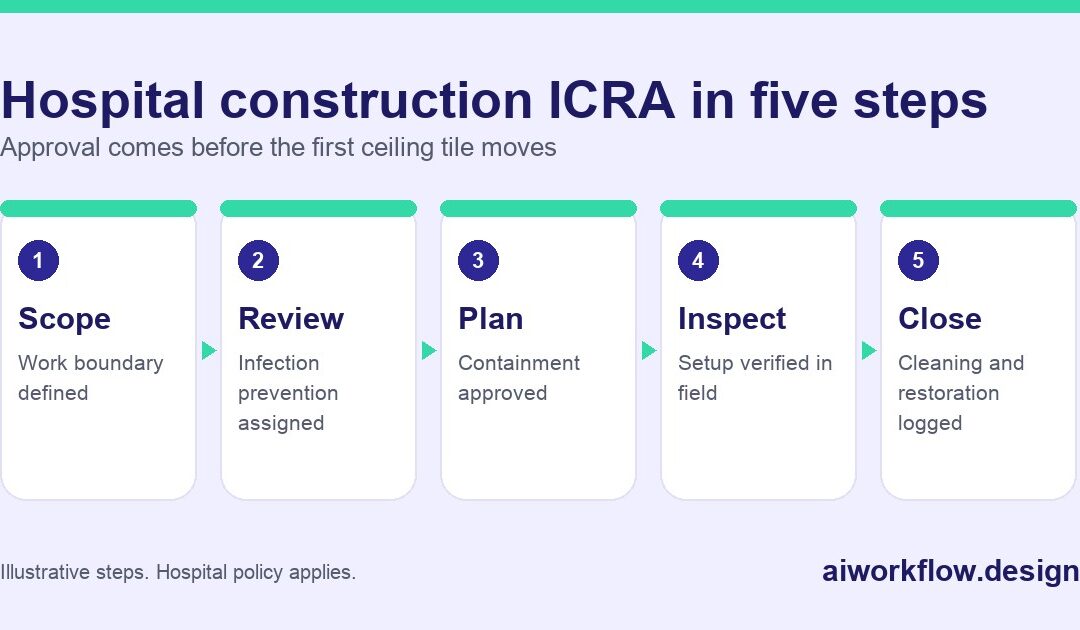
Quick answer: A hospital construction ICRA tracking workflow should identify the project and affected clinical areas, record the infection control risk assessment, confirm required containment and circulation measures, route the proposed work to authorized infection prevention and facilities reviewers, and document inspections before and during construction. The board can follow up on missing evidence but must not interpret clinical risk, approve patient-area access or release work based only on a contractor’s verbal “ready” status.
Replacing a ceiling above a hospital corridor can involve much more than an ordinary facilities work order. Opening a ceiling may disturb dust, change airflow or create an exposure path near patients. Work that appears minor to a contractor can require formal risk assessment, barriers, cleaning, traffic controls and infection prevention involvement. A hospital construction ICRA checklist turns these multidisciplinary dependencies into an auditable coordination process rather than a last-minute exchange of emails outside the patient-care plan.
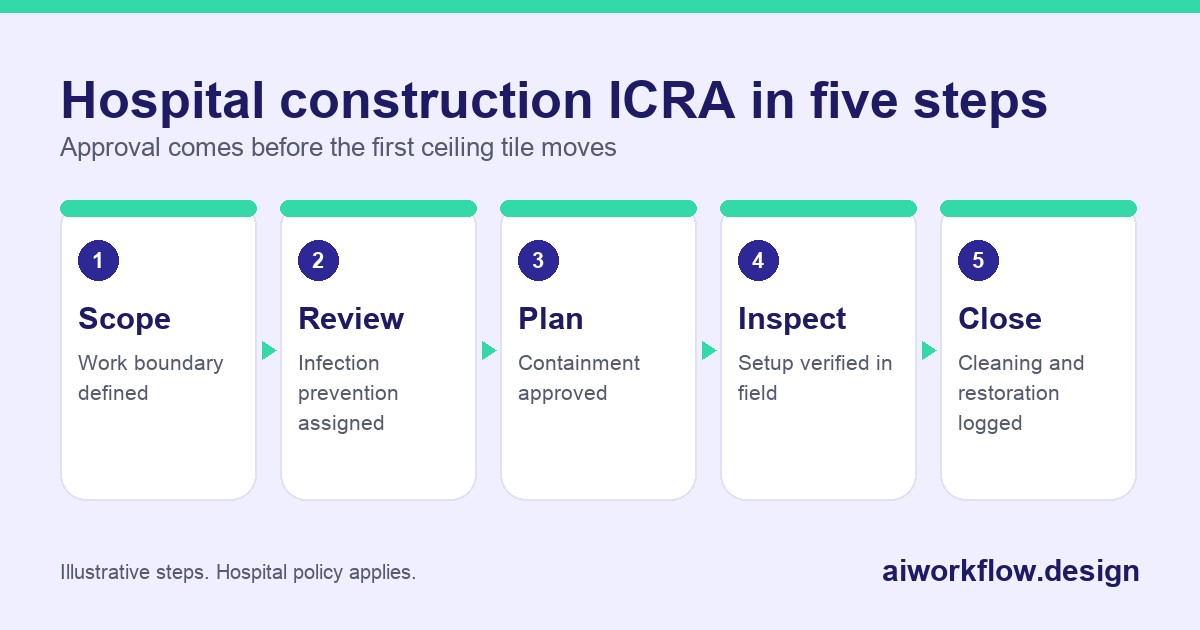
Why infection control belongs at the start of a construction job
In many facilities, the ICRA process is integrated with permit-to-work, facilities, life safety and clinical operations procedures. Follow the hospital’s actual policy and local requirements; a generic external template is not a substitute for the approved project-specific ICRA. Post-work cleaning is audited separately; see environmental cleaning audit tracking.
An ICRA is not a one-time checkbox for the entire project. Changes to a partition, scope, patient population, mechanical system or access route may alter the precautions required. Track revisions and approvals rather than assuming that a signed initial assessment covers any later work. A coordinator can help ensure all required people have responded; the infection prevention professional decides which controls are necessary and whether they have been met.
Keep three records distinct
The project record identifies scope, location, schedule and accountable manager. The ICRA and permit record contains the risk assessment, control requirements and signatures in the hospital’s designated system. The field verification record contains barriers, pressure or airflow checks where required, cleaning logs, worksite walk-throughs and observed deficiencies. Linking the three makes a ready-to-work decision traceable. Merging them into one status value such as “ICRA done” hides whether documentation, setup and field conditions agree. Building systems evidence follows the same discipline; see emergency generator test records.
For privacy, use room codes or approved project area labels rather than patient names in a general contractor-facing board. Do not put immunocompromised patient details, clinical schedules or protected health information into an AI status transcript. Only approved infection prevention personnel should handle any clinical sensitivity that affects the assessment.
A seven-stage hospital ICRA coordination workflow
1. Open the project with a defined work boundary
Describe the task, contractor, exact construction zone, adjacent rooms, ceiling or wall penetrations, potential dust generation, planned hours, utility interruptions and expected traffic routes. Confirm who is the hospital sponsor. Where appropriate, obtain drawings or a marked floor plan in the secured project record. “Replace two lights” is an inadequate scope if the work also requires opening a ceiling in an occupied clinical corridor.
2. Assign the clinical and technical reviewers
Identify the infection prevention lead, facilities or engineering representative, affected department manager, safety or life-safety officer, and other reviewers required by hospital policy. Use separate review tasks so a contractor’s quote approval cannot masquerade as infection-control approval. The ICRA authority should determine patient risk considerations and applicable precautions. A procurement manager cannot waive those controls simply because the work is urgent.
3. Capture the approved containment and circulation plan
The assessment may specify physical barriers, dust containment, negative-air arrangements, cleaning, transport and waste routes, worker movement, equipment staging, and monitoring. Do not prescribe a pressure target or a barrier type from a generic automation script. Follow the hospital’s qualified assessment and applicable guidance. The coordinator should check whether the approved plan exists and whether each responsible trade has acknowledged its instructions.
4. Verify pre-work setup in the field
Before the work release, the authorized inspectors confirm barriers, signage, access limitations, any required airflow checks, construction materials, cleaning provisions, equipment placement and emergency access. Use timestamped inspection evidence and a field verification owner. A contractor’s “barriers are up” text is a useful progress update, not the same as the hospital’s required inspection or permission to begin.
5. Control active-work changes and exceptions
During the work, schedule the inspections and monitoring required by the hospital’s ICRA. If a barrier is breached, water leaks appear, ventilation changes, dust escapes or an adjacent clinical area changes use, the incident must go to the hospital’s emergency or risk escalation path as appropriate. The status board can notify designated personnel and preserve the event sequence, but should not instruct clinical staff on patient relocation or assert that exposure risk is acceptable.
6. Document cleaning, reinspection and restoration
At physical completion, verify waste removal, cleaning and any required environmental or facilities checks. The hospital may require a final walk-through, a barrier-removal sequence or additional authorizations before the space returns to its previous function. Track the completion evidence and named reviewers. A subcontractor invoice or a technician’s statement that the area looks clean is not evidence that all hospital criteria have been met.
7. Close the permit and lessons learned
Record final permission to close the project, remaining punch-list items, permit status, updated drawings and records retention locations. Note repeat problems such as access route conflicts or late barrier inspections so future jobs can be scoped more accurately. Preserve approvals and inspection dates; do not backdate missing records to make a project appear ready at a particular time.
How to structure a monday.com ICRA follow-up board
A restricted project board might contain Project ID, Zone, Work type, Planned start, ICRA owner, Risk assessment reference, Permit reference, Barrier plan accepted, Pre-work inspection owner, Inspection due, Open deficiency, Clinical coordination, Current gate, and Final clearance reference. Useful statuses are Scope review, ICRA pending, Controls approved, Setup verification, Work permitted, Active monitoring, Final inspection and Closed. A separate exception register captures unresolved conditions without overwriting the permit decision. Water systems often need construction-related checks too; see hospital water management follow-ups.
Automated reminders can help when an ICRA reviewer has not received plans, a contractor has not supplied barrier materials information, or a scheduled inspection report is missing. If an authorized nonclinical contact agrees to a structured call, an AI agent might ask, “Has the barrier inspection been scheduled?” or “Where can the completed checklist be found?” It should never ask for patient diagnoses, approve construction work, change airflow requirements or clear a clinical area. See AI Workflow Design’s services for mapping a workflow with explicit human sign-off, and Daily Check-in Agent for appropriate status-only communications. See AI Workflow Design’s product overview, Autoza AI for monday.com and the workflow automation service for what can be configured; availability depends on your setup.
What to measure without making false compliance claims
Review days from scope submission to ICRA assessment, percentage of projects with an approved plan before mobilization, number of missed required field checks, unresolved barriers or airflow exceptions, and days between physical work completion and formal permit closure. Report gaps transparently, not as “100% compliant” merely because board statuses have turned green. Clinical risk and code compliance still require the designated experts’ assessment.
A useful closeout report explains which controls were required, what evidence was received, any deviations and who accepted each gate. This is more valuable than a generic task list because it shows how patient-care dependencies were protected throughout construction.
Next step
Choose one small but real renovation project and draw the gates between work request, infection control review, field setup, construction activity and final restoration. Then build reminders around missing evidence. The result should make it easier for authorized reviewers to make timely decisions, not attempt to replace those decisions with automated status changes.
Want these follow-ups handled consistently? Explore Autoza AI for monday.com or talk to AI Workflow Design about scheduled, permissioned status follow-ups that leave approvals and decisions with the right people.
Related guides:
- Hospital Environmental Cleaning Audits: Track Findings and Corrective Actions
- Emergency Generator Test Records: A Facilities Evidence Follow-Up Plan
- Hospital Loaner Equipment Returns: Confirm Decontamination and Vendor Pickup
More guides: browse our healthcare admin workflow guides or see all industries we support.
Frequently asked questions
What is an ICRA in hospital construction?
An infection control risk assessment is a structured process used to identify infection-related risks from construction, renovation, demolition or repair work and determine appropriate safeguards. The hospital’s authorized clinical and facilities personnel apply its specific policy and requirements.
Can a contractor start when the ICRA form has been submitted?
Not necessarily. Submission does not mean approval, and approval of a plan may still require field setup verification and a separate authorization to begin. Use the facility’s permit and inspection process.
Does every minor facilities repair need identical ICRA controls?
No. Controls depend on the work, location, patient population and hospital policy. The qualified infection prevention team determines the requirements; a generic workflow should not prescribe one containment standard for every task.
Can AI calls confirm that hospital construction barriers are safe?
No. AI can collect an administrative update, such as whether an inspection was scheduled or evidence was submitted. Authorized personnel must inspect the installation, interpret findings and approve work under the hospital’s process.
What happens when the construction scope changes after approval?
Record the new scope, route it for ICRA and permit review, update the barrier or control plan where directed, and withhold affected work until required approvals are obtained. Do not assume the prior sign-off automatically applies to the changed conditions.