
Quick answer: A hospital water management task tracker should show the approved water management programme, the building system and monitoring point, responsible team member, scheduled activity, evidence received, exception status, escalation recipient and authorised corrective-action closure. It can prompt people to complete tasks and locate missing records. It must not interpret a microbiology result, set a control limit, decide a patient area is safe or replace the facility’s infection-prevention and engineering leadership.
A hospital plumbing system includes more than hot and cold water at taps. Storage, recirculation, equipment, temperature and disinfectant controls, cooling systems and patient exposure routes all affect risk management. When a scheduled monitoring record is late or a laboratory result needs attention, facilities personnel, infection prevention staff, external laboratories and contractors may each hold part of the information. An uncoordinated inbox can obscure who owns the next action.
The purpose of a tracking workflow is to connect those parties while preserving the specialised plan that governs the system. CDC guidance recognises that water management programmes must be tailored to building systems and their occupants. It also identifies healthcare-specific concerns and the need to consider vulnerable patients. An administrative project tracker should support that programme, never become the programme itself.
Start from the approved water management programme
The hospital’s water management team should establish the scope, systems, control points, monitoring procedures, acceptable limits, intervention actions, verification and documentation rules. CDC describes a seven-step approach including team formation, system description, hazard identification, control measures, interventions, verification and communication. None of those decisions should be inferred from a generic software template.
Ask the programme owner which records actually need coordination. Examples may include scheduled temperature or disinfectant checks, maintenance records, contractor reports, flushing or other control activities under the approved plan, water system changes, laboratory submission and result reviews. Different water systems and monitoring points may require very different methods and frequencies.
The tracker should contain a reference to the authoritative WMP version, not an unreviewed copy of thresholds pasted into a general project board. Where thresholds or response times must be visible to operators, they should come from controlled approved documentation maintained by the responsible team. Avoid using a sample value, a website table or a chatbot-generated number as if it were the hospital’s own accepted limit.
Organise the register by system, location and responsibility
A task item can record: facility or building identifier; controlled system or outlet reference; approved monitoring activity; due date as assigned by the programme; task owner; qualified reviewer; evidence location; actual completion date; laboratory or contractor case reference if applicable; exception ID; and the decision owner. Use secure links to records that require restricted access.
Avoid mixing patient identifiers with routine environmental work orders. A hospital might need patient-related information in an infection-prevention investigation, but that belongs in controlled clinical and public-health processes. An automatic status call to a plumber should not ask whether a specific patient has developed symptoms or to disclose medical details.
Distinguish Task scheduled, Sampling performed, Lab receipt confirmed, Result available, Technical review pending, Action open and Authorised closure. An on-time sample collection does not mean a result was acceptable. A laboratory result being uploaded does not mean the water management team has interpreted it. This separation is essential when the consequence of a misleading green status may be significant.
Treat laboratory results as a separate technical pathway
When sampling is part of the programme, record who authorised it, why and where sampling was performed, the approved sampling plan, chain-of-custody reference where applicable, laboratory, collection time and expected reporting route. The lab controls its own analysis and reporting. Facilities coordination can remind the owner that a result is expected but should not reinterpret raw values.
CDC’s routine Legionella testing guidance distinguishes routine assessment from testing related to disease investigations. It explains that testing is only one source of evidence about a WMP and that responses need to consider the wider control system. This is important because a single number, viewed without the site conditions and analytical method, is not a complete risk assessment.
If an unexpected result arrives, the reviewer applies the facility-specific plan and any applicable public-health requirements. The tracker can record that a result was referred urgently and that a corrective-action case was opened. It should not independently determine whether an outlet is suitable for use or whether retesting is enough to close the concern.
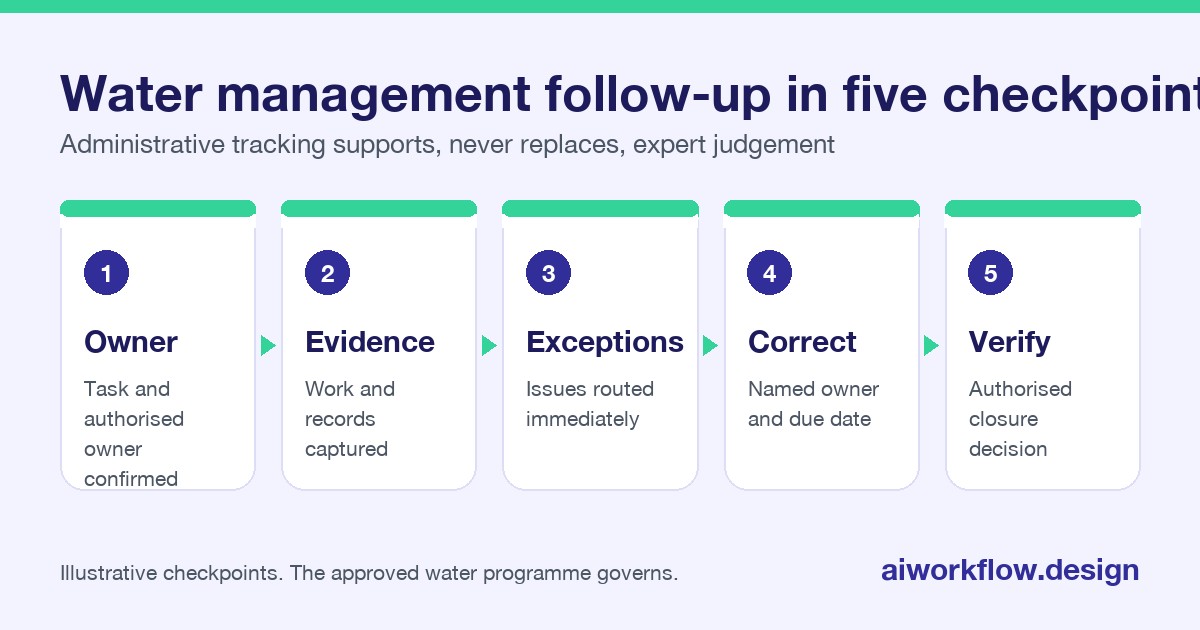
Build the follow-up workflow around five checkpoints
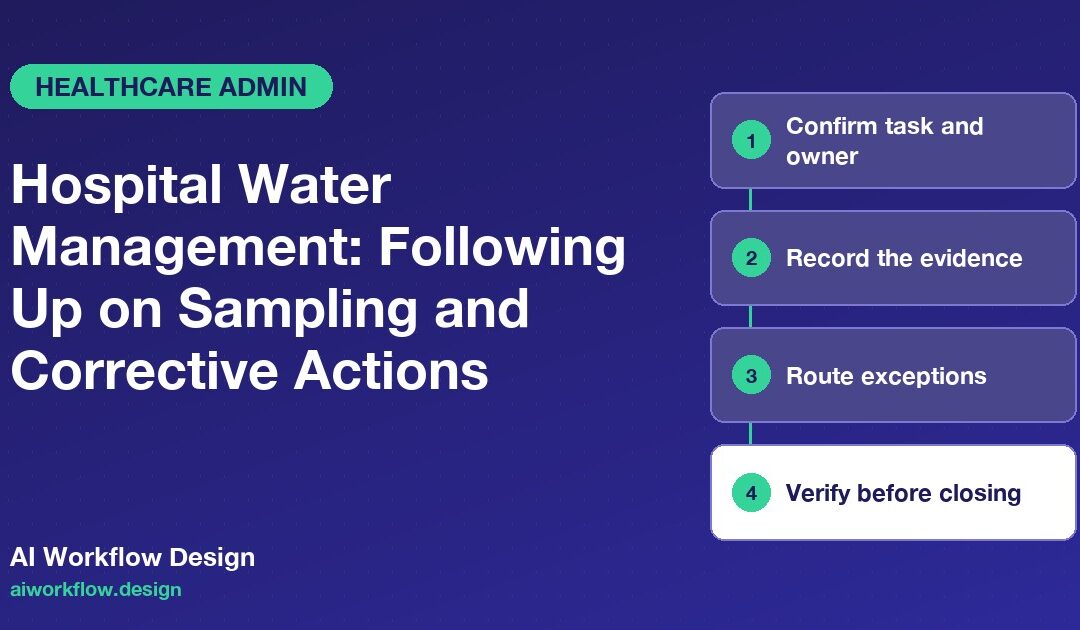
1. Confirm the task and its authorised owner
Before a planned monitoring event, the team verifies the correct point, current procedure, access requirements and assigned person. If a room is temporarily closed or an outlet has been changed, the environmental or engineering lead decides how the approved plan applies. A reminder cannot substitute a new sampling design.
2. Confirm that work occurred and evidence was recorded
Log completion time and the evidence reference. If a technician reports “done” but the approved log is absent, the state should remain Evidence missing, not complete. The assigned reviewer decides whether repeat work or follow-up is necessary.
3. Route exceptions immediately
An out-of-control parameter, missing critical check or unexpected laboratory communication must follow the WMP’s escalation instructions, not wait for a periodic AI recap. Distinguish urgent technical notifications from ordinary overdue-document chases. The team should know which situations require direct calls, incident channels or leadership involvement.
4. Record corrective action with a named owner
Once the authorised team defines an intervention, create an action task with the approved scope, responsible provider, expected evidence and review date. Keep the authority for changing water system controls, undertaking remediation or restricting use with the qualified programme owner. Contractors should not be asked to decide from a voicemail whether an area is safe.
5. Close only after appropriate verification
An intervention may be physically complete while follow-up monitoring, laboratory confirmation or a formal review is outstanding. Use separate Work performed and WMP verification accepted fields. The authorised reviewer closes the case according to the actual plan and documented findings.
Example: a contractor says the repair is finished
A hypothetical hospital has a water system task involving an underperforming control point. A service contractor replaces a component and tells facilities the job is finished. The tracker records the service report as received but leaves the corrective-action case open for the water management team. That team determines which approved readings, follow-up checks or other evidence are required and whether additional controls remain in place.
A coordinator may ask when the signed service report will be submitted and who is responsible for providing follow-up evidence. The coordinator must not conclude that the system is microbiologically safe because a repair ticket says “fixed.” The distinction also prevents a prematurely closed work order from disappearing from the next WMP review.
Use administrative AI with strict healthcare boundaries
A scheduled check-in can ask an authorised facilities contact: “Was the monitoring task completed? Has the approved record been filed? Is the report with the water management reviewer? Is any administrative blocker preventing the next step?” The questions must not solicit clinical histories, raw test details or instructions to override a control measure.
AI Workflow Design’s scheduled check-ins are designed for task updates. Its custom automation services may be assessed for a controlled facilities workflow, subject to security, privacy, escalation design and authorisation. A general-purpose voice agent is not an infection-control system, laboratory-information platform, clinical decision support tool or continuous water monitor. Urgent incidents require established immediate notification routes.
Build reports that show delays without making risk claims
Useful operational metrics include overdue assigned monitoring tasks, laboratory result turnaround as defined by the programme, days awaiting authorised review, open corrective actions by owner, repeat administrative failures and verification evidence that is still missing. Show whether the measure describes process timeliness or technical control; they are not interchangeable.
A dashboard with no overdue tasks may be well organised yet still have unresolved technical issues. Similarly, a flagged sample does not automatically prove a clinical case or outbreak. The WMP team must interpret patterns, review changes to building use and consider CDC guidance and local requirements with appropriately qualified professionals.
Make the record useful during a change in hospital operations
A renovation, fixture replacement, unusual occupancy pattern or change in water use may affect the WMP. Ensure the facilities project team routes those changes to the programme owner early enough to evaluate monitoring and control requirements. Do not automatically carry over last year’s schedule when a system has changed.
At monthly management review, ask whether each open case has a clear technical owner, whether evidence is accessible and whether corrective action has been independently accepted. The best tracker is not one with the fewest red cells; it is one that exposes the right follow-up at the right time while respecting clinical, environmental and engineering authority.
Next step
Want these follow-ups handled consistently? Explore Autoza AI for monday.com or talk to AI Workflow Design about scheduled, permissioned status follow-ups that leave approvals with the right people.
Frequently asked questions
What belongs in a hospital water management task tracker?
Approved system and control-point references, task ownership, dates, evidence links, laboratory or contractor case references, exceptions, escalation recipients and authorised verification status.
Does every hospital need the same Legionella sampling schedule?
No. Monitoring and sampling must be tailored to the facility’s approved water management programme, risk assessment and applicable guidance or requirements.
Can a water management dashboard interpret a laboratory result?
A project tracker should not independently interpret laboratory findings or set safety thresholds. Qualified water management, infection-prevention and public-health personnel must follow the approved procedure.
Is completing a corrective action enough to close the case?
Not necessarily. Physical work and technical verification are distinct steps; the authorised reviewer decides whether the WMP’s required evidence supports closure.
Can AI call staff about overdue monitoring?
Yes, where authorised and compliant with privacy and communications requirements. It should ask about task status and evidence, not clinical histories or decisions about water safety.
Related reading
- Emergency Generator Test Records: A Facilities Evidence Follow-Up Plan
- Medical Refrigeration Maintenance: A Non-Patient-Data Documentation Workflow
- Hospital Fire Drill Corrective Actions: Track Facilities Follow-Ups
- Hospital Contractor Badges: Confirm Restricted-Area Access Before Work
- Hospital Planned Shutdowns: Who Must Confirm Facility Communications?