

Quick answer: A sound healthcare refrigeration maintenance checklist tracks which equipment needs service, who is authorised to work on it, whether maintenance and calibration evidence was recorded, and which clinical or pharmacy owner must review the outcome. Status calls can chase administrative steps without collecting patient information. They cannot declare temperature-sensitive products usable, override a temperature excursion or release a refrigerator for service without the designated technical and product-quality decisions.
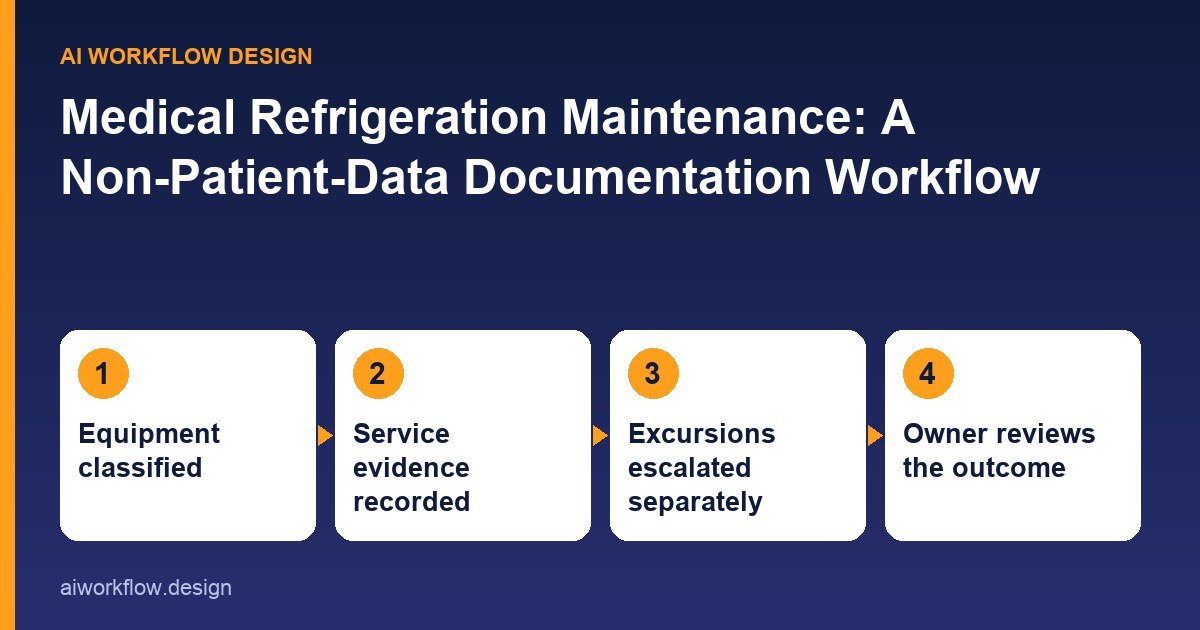
A hospital pharmacy refrigerator may look normal after a technician repairs a door gasket. But a completed service ticket does not answer every question: Did temperatures remain in range throughout the fault? Was the monitoring sensor functioning? Did a responsible clinician, pharmacist or vaccine coordinator review product storage impact? Is the unit stable enough to return to use under its specific procedure? Each question belongs to a different record and often a different person.
Classify the refrigeration equipment before creating a checklist
Healthcare facilities operate distinct cold-storage systems. A vaccine refrigerator, blood-bank unit, medication refrigerator, laboratory sample freezer and dietary cold room may be governed by different equipment standards, product labels, professional protocols, licensing rules and local procedures. Do not use one temperature setpoint or release rule for all of them. Start with an asset register that identifies the unit, service owner, storage programme, approved operating parameters, alarm destination and authoritative SOP.
The CDC’s July 2026 Vaccine Storage and Handling guidance is particularly relevant to vaccine storage. It addresses digital data loggers, calibration evidence, backup devices, excursion responses and coordinator responsibilities. It is not a substitute for the hospital’s blood-product, medication, food or laboratory requirements. A board may show “unit maintenance scheduled” but should not infer that every stored product has the same safe range.
Separate equipment upkeep from product custody. Facilities may own the mechanical service work; pharmacy or laboratory personnel own product-handling decisions. Biomedical engineering may manage certain specialised systems. Infection prevention, security and electrical maintenance may also be involved. The first design question is which qualified owner must decide each step, not which person answers the fastest.
Define a maintenance record that supports, but does not replace, the official log
An illustrative tracker can include Asset reference, Location code, Equipment category, Approved maintenance interval, Work-order ID, Responsible technician, Access arranged, Alarm or sensor check status, Parts required, Service report received, Monitoring evidence available, Deviation escalated, Qualified review pending and Return-to-service authoriser. These are proposed monday.com fields for task coordination, not supplied Autoza defaults or a claim that Autoza is validated for clinical recordkeeping.
Keep exact setpoints, calibration documents, temperature trends, product inventories and excursion records within the hospital’s approved equipment and clinical quality systems. The project board should store only minimal administrative statuses and secure references. An asset ID is often sufficient for a call; patients, medication recipients or research participants do not need to be named at all.
For planned maintenance, verify approved access windows, temporary storage arrangements where needed, trained personnel and an authorised shutdown plan. A contractor cannot assume a refrigerator may be unplugged because a work order is open. The responsible storage programme must approve product handling and contingency arrangements before maintenance affects the unit.
Treat monitoring failures and temperature excursions as separate urgent events
An out-of-range alarm is not an ordinary documentation gap. The responsible clinical or storage coordinator should follow the unit’s emergency SOP immediately. For vaccines, CDC guidance describes actions including notification, separation and labelling of affected stock as not for use pending appropriate guidance, recording the incident and consultation with the relevant programme or manufacturer. Do not tell staff to discard or release products based on a generalised AI summary.
A failed thermometer or missing calibration certificate can undermine confidence in the temperature record even if the display looks reasonable. The technician can report mechanical findings, but the designated storage owner must decide which backup monitoring or inventory measures apply. Routine calls should never seek the full refrigerator inventory, vaccine lot details or clinical patient context when a secure designated record already exists.
If an urgent issue arises during a scheduled administrative check-in, stop the routine questions and instruct the responder to use the hospital’s immediate incident or on-call pathway. A message left for tomorrow’s project meeting is not a sufficient emergency response. The call system’s failure to reach someone is also not evidence that temperature limits were maintained.
Organise the follow-up sequence around controlled milestones
Before the visit, the facilities coordinator confirms the authorised service provider, work order, approved window, access requirements and whether the storage owner has accepted the proposed interruption. On arrival, the designated on-site contact records that the technician has checked in under hospital rules. After the work, the technician submits the authorised service note, parts record and applicable tests through the maintenance system. A separate programme owner reviews any temperature effects and decides whether additional monitoring or clearance is required.
The tracker should therefore show service scheduled, service performed, technical evidence uploaded, storage-programme review pending, and authorised return to service as distinct states. A unit may be mechanically repaired but still held out of use while a pharmacy lead reviews temperature logs. The coordinator should report that accurately rather than changing “repair complete” into “ready for vaccines.”
Imagine an illustrative lab refrigerator with a recurring high-temperature alarm. Facilities replaces a worn door seal and documents a satisfactory mechanical test. The lab still needs to examine its own monitoring history and any affected materials according to local SOP. A check-in caller can ask whether the service report has been filed; it should not conclude that all specimens are usable.
Use small, purposeful status questions
For an internal maintenance coordinator, ask: “Has the approved service slot been confirmed?” “Is access arranged?” “Has the technician filed the report in the approved system?” “Were any technical or monitoring exceptions referred to the responsible reviewer?” “Who owns the next administrative action?” Avoid asking staff to read temperature logs, clinical product inventories, patient names, medication details or alarm passwords into a recorded call.
The scheduling cadence should reflect each asset’s maintenance programme and actual outstanding work. A daily call to every clinical department is disruptive and rarely informative. Call the asset or facilities owner when a planned service is due, an approved repair is delayed or documentation needed for authorised review has not arrived. Respect department contact windows and escalation pathways.
The existing healthcare IT rollout guide illustrates the wider principle: administrative readiness can be coordinated without bringing protected health information into a generic status board. Refrigeration adds temperature-sensitive products and regulated equipment evidence, so the review boundary is even more important.
Make contractor and evidence handoffs auditable
Contractors should use approved hospital access processes, required work permits and infection-prevention controls. The service report should identify the correct asset, task performed, parts replaced, applicable test outcomes and technician credentials as required by the maintenance programme. The responsible reviewer should be able to locate the original evidence without relying on an AI paraphrase.
A missing certificate, unresolved alarm or contradictory report should produce “evidence incomplete; qualified review required,” not a blanket system-green state. Where a maintenance interval depends on the manufacturer’s instructions or a regulatory requirement, document the governing source. Do not invent a universal refrigeration inspection frequency for a healthcare site.
Useful measures include preventive maintenance scheduled versus documented, delayed contractor reports, repeat work orders, days with open equipment exceptions and time taken for qualified review. Avoid measuring “vaccine safety improved by X%” without clinical evidence. Operational visibility is useful precisely because it avoids guessing about product outcomes.
Evaluate Autoza for narrow facilities check-ins
The AI Workflow Design products page describes Autoza AI for monday.com as a scheduled calling and board-update tool. A hospital could evaluate a controlled pilot limited to non-patient administrative tasks, after appropriate procurement, security, privacy and facilities approvals. It should not be described as a temperature monitoring system, a validated quality management record or a clinical product-release authority.
Pilot with one noncritical administrative maintenance category and an isolated board. Test a scenario where someone says “the unit is out of range”; confirm the workflow sends the matter to the approved urgent human pathway rather than asking another scheduling question. Check that no patient or product data enters transcripts. Explore a scoped project-status pilot once the institution has approved the roles, permitted fields and escalation design.
Frequently asked questions
What records should a team retain for a healthcare refrigeration maintenance checklist?
Retain the official work order, asset identification, authorised maintenance schedule, technician service report, applicable calibration or test certificates, exception and excursion references, qualified review outcome and return-to-service decision. Store detailed temperature or product records within the programme’s approved systems.
When should healthcare refrigeration maintenance follow-up be escalated to an authorised human?
Escalate immediately for suspected temperature excursions, monitoring failures, unit power loss or circumstances that may affect stored materials. Also escalate unapproved service interruptions, missing critical evidence and any uncertainty about release to use to the responsible storage and technical specialists.
Can a completed refrigeration service ticket prove the stored medicines are safe?
No. A service ticket documents maintenance work, not necessarily product stability. The relevant pharmacy, laboratory or clinical owner must review any excursions, monitoring evidence and product-specific requirements before authorising use or disposition.
Does the CDC’s vaccine temperature range apply to every hospital refrigerator?
No. CDC vaccine guidance applies to vaccine storage and related programme requirements. Blood products, laboratory specimens, pharmaceuticals and food may have different rules and manufacturer requirements. Follow the specific unit’s authorised SOP and product instructions.
Is Autoza a replacement for a hospital temperature-monitoring system?
No. It can be considered for permitted administrative calls and mapped board updates. Continuous monitoring, alarming, calibration, incident management and product quality decisions belong to dedicated equipment and clinical systems and qualified personnel.