

In brief: Plan non-clinical hospital equipment installations with vendor milestones, access checks, facilities coordination, documented acceptance and privacy safeguards.
What does a safe equipment installation follow-up plan cover?
Hospital equipment installation project tracking coordinates the administrative tasks around delivery, contractor access, site readiness, installation windows, documentation and formal acceptance. It does not replace the work of facilities engineers, biomedical engineering, clinical users, infection prevention or authorised safety personnel. For an equipment move in a healthcare building, ‘delivered’ and ‘ready for use’ are very different states.
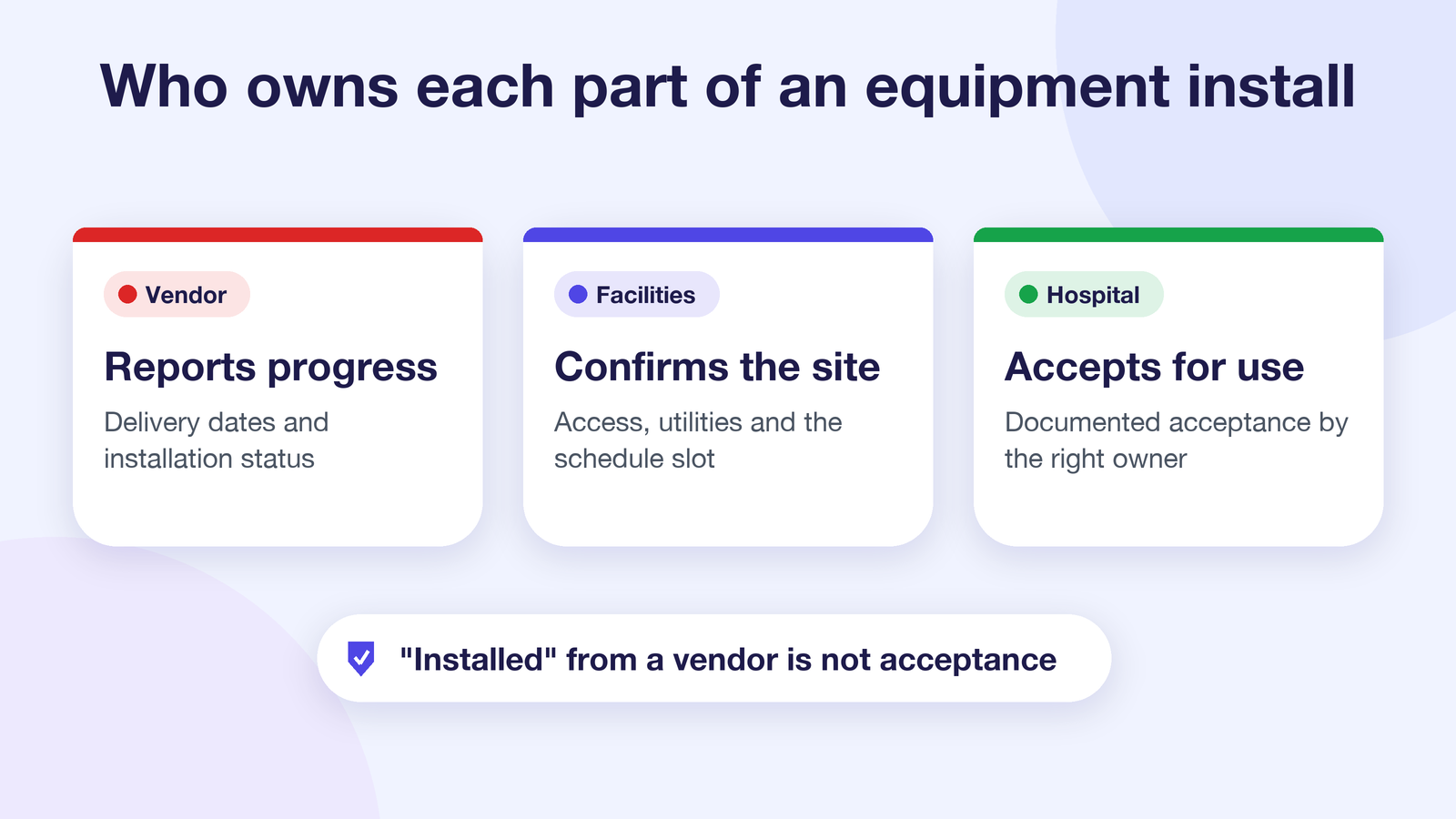
The strongest project plan identifies the people responsible for each gate, then limits routine follow-up to factual scheduling information. The hospital retains the authority to assess safety, technical performance, patient-care effects and the suitability of the installation area. An automated call can ask whether a vendor has submitted a report; it must never certify that equipment is operational or an area can reopen.
Begin with a defined equipment and site scope
Record the approved equipment category, destination department or facilities location, delivery window, route restrictions, installation contractor, facilities sponsor, acceptance owner and related outage or permit dependencies. Do not put patient identifiers into the project description. A hospital may use a work-order or project reference that tells a vendor what to do without exposing patient details or sensitive operational information.
Plan differently for a non-clinical storage rack, a mechanical pump and a patient-care device. Clinical or medical equipment can involve additional biomedical, manufacturer, infection-prevention and regulatory processes; this article does not offer a commissioning procedure for those systems. Its workflow is intended for project coordinators handling narrowly authorised administrative follow-up.
Map the six milestones and owners
- Order and delivery confirmed: Procurement validates the purchase and delivery conditions; the vendor provides a confirmed shipment and arrival slot.
- Site readiness reviewed: Facilities and affected department contacts check access, space allocation, lifting arrangements, utilities and approved work hours.
- Required risk assessment completed: The relevant specialists decide whether construction, infection-control, interruption or other reviews apply.
- Installation appointment completed: The contractor reports arrival, work status and outstanding items without claiming final acceptance.
- Documentation submitted: The approved system receives manuals, testing records, warranties and any evidence required by the hospital.
- Qualified acceptance recorded: The designated reviewer assesses the evidence and signs off using the formal hospital process.
A project manager can monitor every stage, but each milestone should have a specific acceptance rule. Work reported complete must not silently become approved for use. The Joint Commission’s risk-assessment guidance highlights air quality, infection control, utilities, noise and other hazards when construction or renovation affects patient care.
Design a simple non-clinical status board
A proposed monday.com board might include project reference, equipment category, facility zone, vendor contact role, approved delivery slot, access coordinator, utility dependency, risk-review owner, work status, documentation status, human acceptance status and next follow-up. Keep personally identifying clinical information and restricted layouts out of routine call scripts.
Useful status labels include Slot proposed, Slot confirmed, Access issue, Installation in progress, Vendor reports complete, Documents under review, Accepted by authorised owner, and Blocked / escalation. These are illustrative project-management choices, not built-in Autoza configurations. Separate vendor-reported events from internal verification, and preserve evidence rather than relying solely on a voice transcript.
Questions for the vendor check-in call
A narrow call might ask: ‘Is the approved delivery appointment still on schedule?’ ‘Is the assigned contractor ready for the agreed window?’ ‘Have you submitted the required documents through the hospital’s approved system?’ ‘Is there an access, shipment or staffing obstacle?’ and ‘Who should our facilities coordinator contact?’ The caller should identify itself as automated and use appropriate consent and disclosure controls.
The questions should never request patient names, diagnoses, clinical incidents, security passwords or details of restricted care areas. If a respondent volunteers such information, the process should stop collecting routine status and escalate to an authorised contact. The HHS minimum necessary guidance explains HIPAA requirements and exceptions; excluding protected information from a non-clinical pilot is a conservative operational design, not proof of product compliance.
Handle dependencies and exceptions before arrival
A delivery can be on time yet unsuitable if the approved dock, lift, loading route, escort or required utility has changed. Put dependency reviews ahead of the appointment, not at the moment the truck arrives. When a hospital facilities coordinator discovers a conflicting shutdown or an unavailable engineer, the right outcome is a named human decision to hold or reschedule—not a bot promising the installation can proceed.
If a work area requires infection-control measures, the team with that authority must review and approve them. The CDC construction and renovation guidance recommends multidisciplinary coordination and appropriate protective measures for affected healthcare spaces. Routine vendor calls may confirm whether a required review is scheduled; they cannot perform it.
Illustrative installation coordination example
A facilities team plans to install equipment in a back-of-house service room. Procurement confirms a delivery slot, while engineering reports that the proposed access route conflicts with other scheduled work. A check-in records the vendor’s shipment status and flags the access conflict. The facilities coordinator consults the relevant departments, agrees a revised authorised window and updates the master schedule. After installation, a qualified reviewer evaluates the required acceptance evidence before marking the project closed.
This example illustrates a safer status and decision separation; it does not assert a real installation, a verified product integration or a guaranteed outcome. It also shows why a single ‘Done’ column is inadequate for healthcare equipment projects.
Fit AI calls into the existing system—not around it
Autoza AI is advertised for scheduled project check-ins and writing results into monday.com boards. A hospital considering this pattern should conduct a dedicated security, privacy, legal and technical review before any use. The public product description does not establish permission to process protected health information or replace regulated hospital processes.
A narrow pilot can begin with non-clinical shipment and documentation milestones, specific approved recipient lists and human-approved updates. Read healthcare vendor follow-up without patient information for the related privacy focus.
What to measure after deployment
Measure late vendor arrivals, time from delivery to document submission, unplanned access conflicts, overdue human acceptance tasks and frequency of escalations. These show coordination quality without equating a status report to proof of installation safety. Audit for inappropriate information in calls or summaries and stop the pilot if the controls are insufficient.
Next step: Choose one non-clinical equipment category, document all acceptance gates and consider an AI Workflow Design project check-in review only after the hospital’s relevant teams approve the narrow use case.
If your team uses monday.com and wants dependable follow-up on narrow, well-governed tasks, explore Autoza AI or request a workflow discussion.
Frequently asked questions
Which equipment installation statuses can a caller collect?
Administrative facts such as delivery slot confirmation, reported arrival, document submission and a request for coordinator follow-up may be collected in an approved narrow workflow. The caller cannot certify equipment performance or safety.
Who accepts an installed item for hospital use?
The hospital’s designated qualified authority, following its technical, clinical, biomedical or facilities procedures as applicable. Vendor-reported completion is not formal acceptance.
When should infection-prevention staff be involved?
Where the installation or associated work may create construction, dust, air-handling, access or patient-care risks, the responsible hospital team should determine the required risk assessment and controls before work.
Does a project-board integration prove HIPAA compliance?
No. The organisation needs its own legal, privacy, security, contractual and technical assessment of the actual system and information flows. A product marketing page does not establish an approved PHI workflow.
Can an AI call approve a service interruption for installation?
No. It can record that a request is pending or that a named owner has been contacted. Formal outage, safety and operational approval remains with authorised hospital personnel.
Related reading
- What an AI Healthcare Project Caller Should Never Ask
- AI Calling Escalation Rules for Healthcare Administration Teams
- Healthcare Vendor Follow-Up Calls Without Sharing Patient Information
- Hospital Renovation Readiness: Track Contractor Tasks Around Infection Control
- Hospital Planned Shutdowns: Who Must Confirm Facility Communications?
- Autoza AI for monday.com: scheduled status calls
- Workflow automation services