

A missed call about a hospital maintenance task should not be treated the same way as a report that a safety-critical system may be unavailable. Healthcare administrative AI escalation needs a clear decision tree: what can remain in a routine follow-up queue, what requires a facilities manager, and what must bypass the AI workflow entirely for a trained emergency or clinical response team.
For non-clinical teams using monday.com, the most effective design is to classify the risk of the task and the reported exception, not simply the number of unanswered calls. This article sets out an escalation framework that hospitals can adapt with appropriate operational, clinical, privacy and legal oversight. It is a planning framework, not a validated clinical triage protocol.
Define the boundaries before defining the retry count
A scheduled project status call may be appropriate for document submissions, external-vendor arrival windows, nonurgent refurbishment milestones or routine maintenance paperwork. It is not an emergency-response channel. If a person reports fire, patient danger, security threats, active equipment failure affecting care or other immediate hazards, the organisation’s established emergency reporting and command process takes priority. The AI system must not become the sole path for communicating an urgent issue.
Have facilities, safety, clinical governance, compliance and information-security teams agree the permitted use cases and escalation recipients. Document a separate excluded list for clinical matters, protected patient details, emergency dispatch, safety release and regulated approvals. Distinguish what an automated tool may record from what an authorised manager may decide.
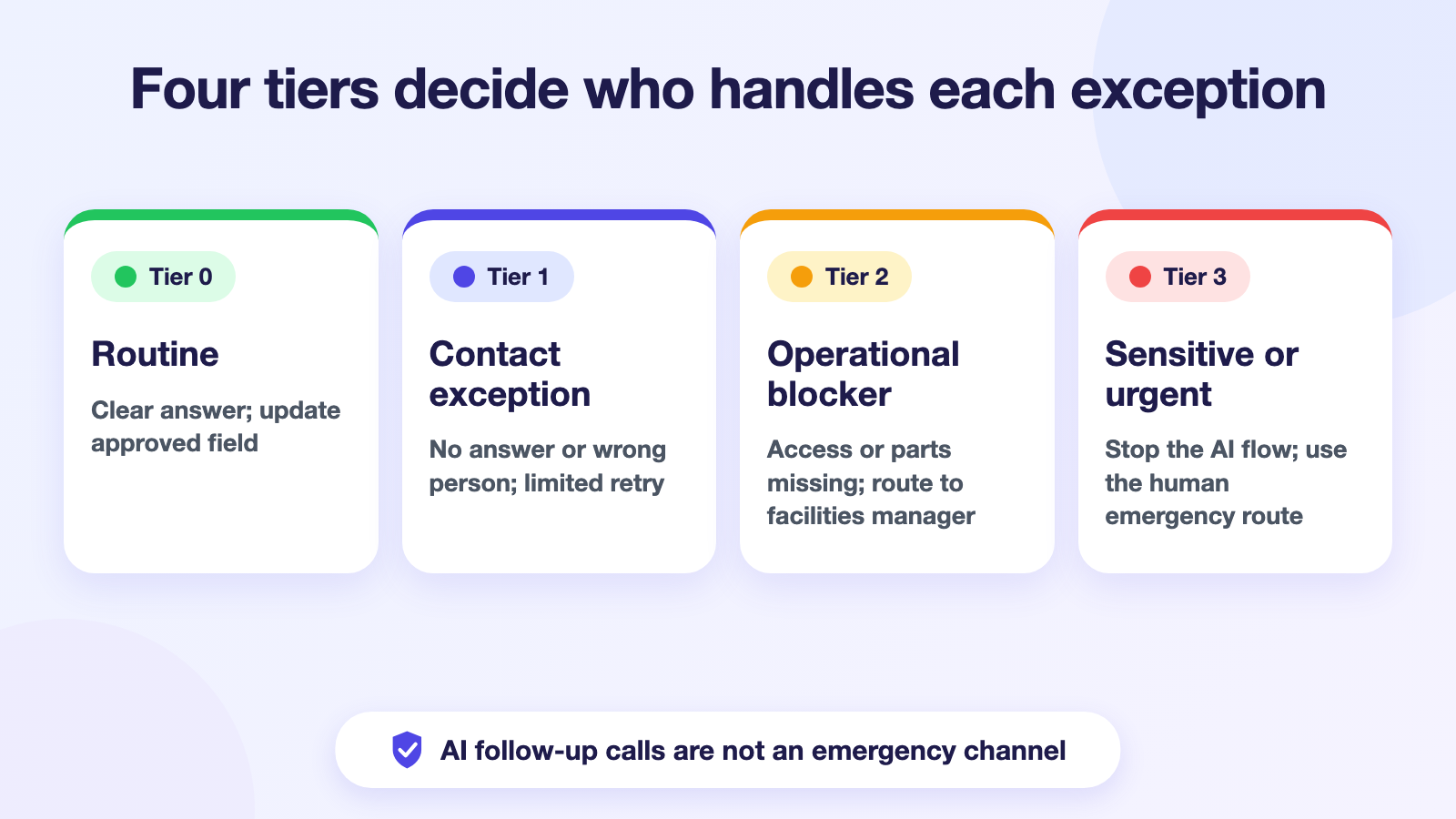
Use four tiers of administrative exceptions
- Tier 0 — routine: the owner supplied a clear answer, such as “planned inspection booked for Thursday”. Update the approved task field and follow the next scheduled checkpoint.
- Tier 1 — contact exception: no answer, wrong person, invalid number or unclear response on a low-risk task. Use a limited retry and notify the designated coordinator if unresolved.
- Tier 2 — operational blocker: a contractor cannot access an approved area, essential parts are missing, or a planned milestone is likely to slip. Route to the facilities or project manager under defined business-hour urgency.
- Tier 3 — sensitive or urgent: a patient-information disclosure, serious safety allegation, clinical impact or emergency condition. Stop normal collection and use the organisation’s documented human escalation or emergency route immediately, without allowing the bot to adjudicate the issue.
The exact labels, times and routing contacts must be adopted locally. “Tier 3” here is an illustrative operational category, not a universal healthcare emergency scale.
What should the caller do with an ambiguous answer?
Imagine a contractor says: “The generator test is mostly fine, but a warning appeared.” The system should not interpret “mostly fine” as a pass. It can report “technical concern raised; qualified review needed” and contact the named facilities lead through the approved route. Likewise, “someone has approved it” is not proof of documented acceptance. Require an authorised reviewer and evidence before changing a controlled completion field.
If a recipient says they are not authorised or does not recognise the task, end the call rather than persuading them to provide information. Wrong-number and identity errors should be treated as privacy concerns, not simple productivity problems. The system needs a mechanism to pause calls to the incorrect contact while a human fixes the record.
Separate reported progress from verified readiness
Set different board fields for reported task status, source of response, human verification status and escalation outcome. For instance, “Vendor says repaired” can coexist with “Facilities verification pending”. Avoid a single status that makes vendor self-reporting indistinguishable from technical approval. A timestamp records when the call occurred; it does not validate the content of the answer.
The Autoza AI for monday.com product page describes scheduled calls, retries, item status updates and summaries. Teams can assess whether the published features fit a permitted facilities use case, but no public product claim should be read as granting hospital emergency-response, clinical decision or patient-data compliance capabilities. Validate supported mappings, notifications and exception handling during a controlled trial.
Make the escalation roster work outside a spreadsheet
An escalation table is helpful only if the listed people can receive the alert. For each risk tier, record the primary human owner, backup contact, approved notification channel, business-hours policy, after-hours coverage and what happens if no one responds. Use the hospital’s existing on-call, help-desk or emergency processes where appropriate, rather than inventing a parallel critical-response workflow within a blog-based template.
Test scenarios should include the wrong person answering, a vendor reporting an immediate hazard, a silent voicemail, conflicting status reports, an unavailable duty manager, and an attempt to share patient information. Measure whether the system stops, records minimal data and routes to the correct human path. A successful escalation does not mean a problem is resolved; closure still requires the owner to act and verify.
Protect data while notifying the right people
The HHS minimum necessary guidance outlines limits that apply in specified HIPAA circumstances. A sensible non-clinical operating policy avoids PHI in automated calling and uses restricted channels for sensitive incidents. An escalation email should ideally contain a task reference, severity indicator and human contact instruction rather than reproducing clinical details or a complete transcript. Follow approved role-based access, logging, retention and incident response controls.
Confirm whether third-party voice systems store recordings, transcriptions or metadata and where they are processed. The presence of encryption claims alone cannot substitute for healthcare privacy assessment. If required agreements and protections are not established, keep the workflow out of patient-related data flows.
Monitor the reliability of the rules
Look at missed-call recovery, exception routing time, false “complete” updates, inappropriate sensitive-data capture and the share of escalations resolved by a qualified owner. Sample logs through authorised review channels and update scripts when ambiguous replies recur. Monitor caller burden as well; repeated nonurgent calls can distract staff and reduce trust in genuine escalation notices.
The responsible outcome is an auditable task follow-up flow with explicit human ownership. Begin with a single low-risk facilities project, perform scripted failure testing and let governance teams approve each escalation path. To discuss a narrow implementation, contact AI Workflow Design; also review its published privacy information during vendor due diligence. For related guidance, see our non-clinical healthcare project check-ins and hospital facilities status-update plan.
Frequently asked questions
Should an AI caller automatically mark a hospital task complete after a positive answer?
Not when technical verification or managerial approval is required. Capture the reported answer separately and route controlled completion to the authorised reviewer.
How many unanswered calls should trigger escalation?
There is no universal number. Set limited retries based on task risk, recipient preferences and operational deadlines. High-risk or emergency concerns must bypass ordinary retry queues.
Can the AI handle clinical emergencies or patient triage?
A routine administrative follow-up workflow should not be treated as a clinical or emergency-response tool. Use the hospital’s established trained-response processes immediately for urgent concerns.
What information should an escalation notification include?
Normally an approved work-order reference, the type of exception, its urgency classification and the responsible contact. Avoid patient details or complete transcripts in broadly distributed alerts.
How can a hospital test its escalation rules?
Use controlled, non-patient scenarios covering no answer, ambiguous claims, wrong contacts, vendor blockers, privacy disclosures and urgent hazards. Confirm that human routing, privacy safeguards and evidence-based closure work before production.
Related reading
- What an AI Healthcare Project Caller Should Never Ask
- Non-Clinical Healthcare Project Check-Ins: A Safer AI Calling Workflow
- Healthcare Vendor Follow-Up Calls Without Sharing Patient Information
- Hospital Facilities Projects: A Status-Update Plan for Maintenance Tasks
- Autoza AI for monday.com: scheduled status calls
- Workflow automation services
- Daily Check-in Agent