

Quick answer: A reliable hospital contractor access badge checklist confirms the approved work order, contractor identity and sponsor, training or credential evidence, site-specific risk controls, permitted area, escort requirements, valid access window and the security team’s formal authorisation. A routine call can chase missing paperwork. It cannot issue a badge, override an access restriction or decide that a contractor may enter a patient-care or other controlled area.
Hospitals depend on electricians, equipment vendors, HVAC technicians, construction teams and specialist service contractors. The maintenance visit may be approved commercially while site entry is still unresolved. The engineer arrives with tools, but the badge desk cannot find a sponsor’s approval; a room has changed its infection-prevention conditions; or the work is outside the authorised access window. The resulting delay is expensive and disruptive, yet the answer is not simply to hand every contractor a longer-lasting badge.
Decide access needs from the job, location and timing
Start with an authorised work order: which vendor is coming, what task is required, where it will happen, whether the area is patient-facing or controlled, and when the work may occur. The facilities sponsor and relevant department confirm the work scope. Security determines identity and badge requirements under the hospital’s policy. Infection prevention, occupational safety, clinical operations or IT security may need separate review depending on the activity.
A badge is one control within a wider work-authorisation process. A contractor might hold a valid site badge but still lack approval to enter a pharmacy, operating department, data centre or active construction zone. Conversely, a service appointment approved by facilities does not mean the security desk has the right identity evidence. Track those decisions separately rather than using a single “approved” checkbox.
The Joint Commission’s environment-of-care guidance identifies security of people entering the facility as part of the management-plan risk domains. The actual badge categories, access controls and approval hierarchy come from the hospital’s site rules and applicable regulatory requirements—not from a universal AI-generated access matrix.
Build the pre-visit evidence packet without oversharing
A coordinator should verify work-order reference, vendor company, designated contractor reference, sponsor, arrival date, assigned escort, requested access zone, permitted hours, required induction status, any mandated licence or insurance evidence, and approval ownership. For a hospital contractor access badge checklist, the ideal board displays administrative readiness and points to the official security system. It should not copy passport scans, government IDs, biometric data, private medical details or security access codes into general monday.com fields.
An illustrative board might use Visit ID, Vendor, Sponsor, Scope category, Work area code, Risk review requested, Training record status, Credential review owner, Access request submitted, Security decision reference, Escort confirmed, Permit status, Visit window and Exit confirmation. These are proposed fields for a configured workflow, not existing Autoza badge-management functions.
Separate a document being uploaded, a document being verified, and access being authorised. A vendor can self-report that a certificate is current; an authorised hospital reviewer decides whether it meets the relevant requirement. A training completion statement does not substitute for site-specific competence, and a confirmed appointment does not equal permission to enter a restricted room.
Check infection-prevention prerequisites before construction or maintenance
Hospital maintenance can create dust, water disruption, ceiling access or other conditions affecting infection control. Where relevant, the hospital’s infection prevention risk assessment and barrier procedures must be evaluated before work begins. CMS’s infection-control survey material references construction, renovation, maintenance and repair risk assessments and protective measures. A badge process cannot bypass those controls because the contractor is already on the premises.
Practical pre-visit questions include whether the work scope has changed, whether the department has accepted the access window, who is responsible for barricades or environmental controls, and whether any permits or escorts are required. Avoid treating these questions as technical clearance. If work may affect patient safety or protected operations, the appropriate clinical, infection-prevention, safety or engineering authority must review and authorise the plan.
Do not allow an automated system to announce “safe to work” because it received yes/no answers about a training course. The correct administrative state is “required review recorded by approved owner.” When an unplanned scope change arises on site, the supervisor should stop or modify the visit under the local safety and change-control procedure rather than letting the badge stay active for unrelated work.
Use a three-stage access workflow
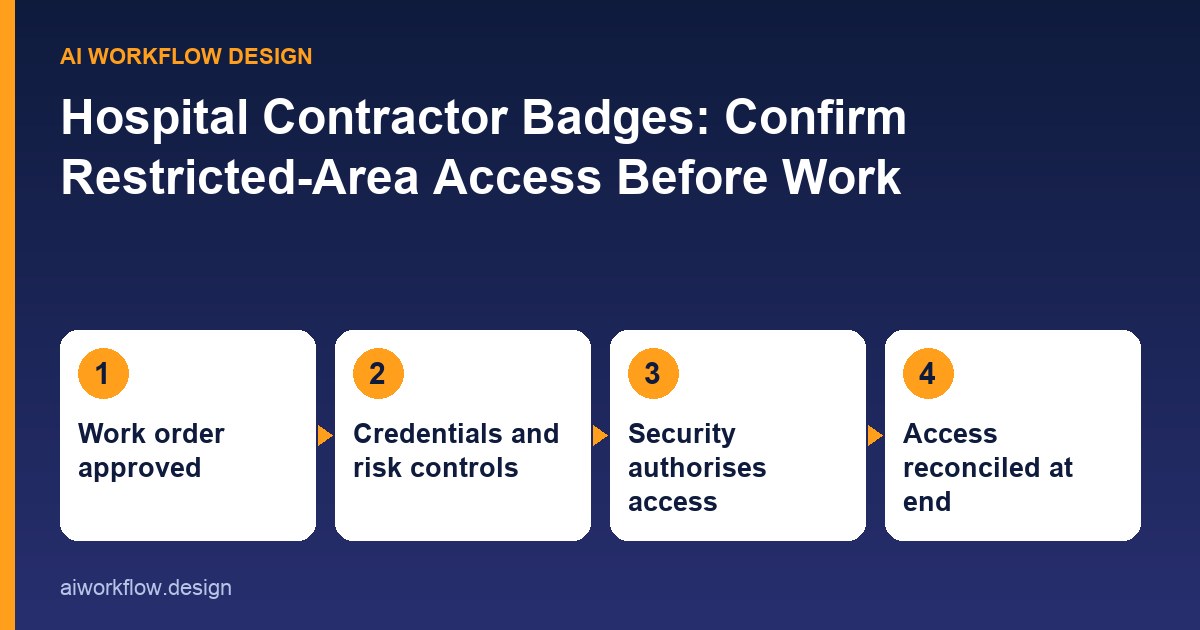
Before arrival, the vendor sponsor sends the authorised request, the contractor completes required submissions and the designated reviewers determine which gates are necessary. Security records the access decision. At check-in, identity and badge issuance follow the hospital’s approved procedure; the person receives only the permitted area, time and escort conditions. At exit, the badge is returned or disabled as required, the visit is documented, and any follow-up service or new visit is scheduled separately.
For an emergency repair, policy may define an expedited route, but expedited does not mean unapproved. A named duty officer or on-call specialist may have authority to grant temporary escorted access or require other controls. The call workflow can reach that person and record that their decision is pending. It cannot manufacture an exception by changing a field from amber to green.
Consider an illustrative contractor arriving to inspect an air-handling unit above an occupied department. The work order and vendor induction are complete, but the facilities coordinator has not confirmed the required escort and infection-prevention clearance for ceiling access. The correct outcome is “work visit pending authorised site controls.” The contractor may be redirected to a permitted waiting area; the system must not create or extend badge access on its own.
Use administrative check-ins that do not collect secrets
An internal pre-visit call may ask: “Has the sponsor submitted the request through the official system?” “Have all required certificates been received?” “Who is reviewing the site-specific risk assessment?” “Is the escort named and scheduled?” “Has security issued a formal access decision?” A staff member can answer what administrative step remains without revealing restricted floor maps or access credentials.
Do not ask contractors to read access codes, badge numbers, identity-document numbers, passwords or confidential unit details into a voice recording. If a person reports an expired permit, denied access, infection-control concern or unexpected scope, create a human review task. A missed call remains an unconfirmed coordination item, not a denial or an authorisation.
Keep calls within the site’s approved contact hours. A hospital is not an ordinary office: calls may reach people performing clinical work, who should not be interrupted for vendor paperwork. Use designated facilities, procurement or security contacts wherever possible. If the institution has strict rules on recordings or third-party AI, follow them rather than assuming general commercial calling consent is sufficient.
Reconcile access at the end, not just at the front desk
Temporary credentials must have an end condition. Track the approved expiry and ensure security has a reliable way to deactivate or recover badges, keys and temporary tokens according to policy. A maintenance ticket’s completion is not proof that a badge was collected. Similarly, the contractor leaving the site does not mean the work passed technical acceptance or that a system can return to operation.
An exit review can record badge returned, escort release completed, area check performed by authorised personnel and work-order evidence pending. If the visit is rescheduled, ask whether a new access approval is required rather than silently extending yesterday’s permission. Audit recurring exceptions such as badges issued without sponsor confirmation, expired vendor credentials, unclosed visits and repeat visits caused by missing access controls.
For related controls, the existing facilities training follow-up guide explains why a course attendance record should not be mistaken for competence or access clearance. This article adds the operational handoff between vendor scheduling, hospital sponsors and site security.
Where Autoza can support a safe pilot
Autoza AI for monday.com is promoted as a scheduled check-in and board-update system. A hospital could evaluate it for internal contractor-visit preparation, restricted to non-patient task statuses with approved scripts, access-control review, privacy controls, recording rules and human escalation. It should not be described as directly issuing badges, checking identities, granting door access or providing clinical safety approval.
Start with one low-risk vendor category and synthetic visit IDs. Test no-answer outcomes, missing evidence, denied access and last-minute work-scope changes. Confirm the board makes approval ownership visible without exposing the physical security system or patient-care details. The goal is fewer failed visits and clearer authorisation handoffs, not bypassing checks to speed up entry. Explore a carefully scoped Autoza pilot after security and facilities leaders agree on the boundaries.
Frequently asked questions
What records should a team retain for a hospital contractor access badge checklist?
Retain the authorised work order, named sponsor, verified training or credential references, site-specific safety and infection-prevention review status where applicable, formal access authorisation, badge issue and return records, escort arrangements, visit window and documented exceptions. Keep identity and access-security details in restricted official systems.
When should hospital contractor access follow-up be escalated to an authorised human?
Escalate when identity or credential verification is incomplete, a controlled area is involved, infection-prevention or permit conditions change, an escort is unavailable, badge access is denied or work scope expands. The relevant security, facilities, clinical or safety authority must decide next steps.
Does a contractor with a valid badge have permission to enter every hospital area?
No. A badge can be limited by role, area, time, sponsor or escort. Additional work-specific permissions may be necessary, and the hospital’s official access-control system is authoritative. Never treat badge possession alone as permission for restricted work.
Can a scheduled AI call issue a contractor badge or approve entry?
No. It may collect administrative status from permitted contacts after review of the deployment. Identity verification, badge issuance, access permissions and exception authorisation remain under the hospital’s designated security and facilities procedures.
What happens if a contractor needs to return after the original access window?
Treat the return as a new or amended visit according to site policy. Reconfirm the work order, sponsor, access window, escort and any relevant risk or permit review, and let the official security process decide whether new or extended credentials are allowed.
Related reading
- Medical Refrigeration Maintenance: A Non-Patient-Data Documentation Workflow
- Hospital Fire Drill Corrective Actions: Track Facilities Follow-Ups
- Facilities Compliance Training: Following Up on Administrative Task Completion
- Hospital Renovation Readiness: Track Contractor Tasks Around Infection Control
- More AI workflow guides