
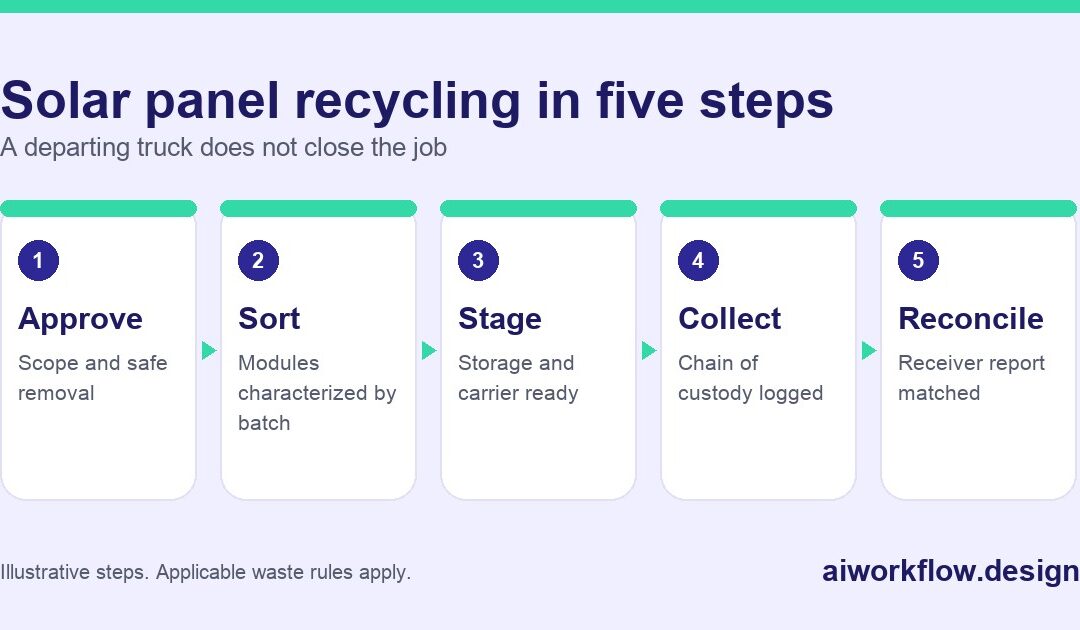
Quick answer: A solar panel recycling logistics checklist should establish which modules have been removed, who approved the electrical work, how panels were characterized for disposal or recycling, where they are temporarily stored, which transporter collected them, and which receiving facility acknowledged delivery. Do not mark a solar recycling project complete when a truck departs. Track the evidence through receipt, reconcile quantities and exceptions, and let the environmental or compliance owner confirm that the selected management route meets the rules applicable in the project’s state.
When a commercial photovoltaic array is repowered, a handful of modules may be replaced or thousands may be removed. The field crew sees a physical job: isolate equipment, unmount modules, stack them, and arrange a pickup. The asset owner sees a very different obligation: prove what left the property, where it went, and whether the disposition matched the approved plan. A solar panel recycling workflow connects these views without asking the scheduler to make hazardous-waste determinations or promising that every panel is recyclable.
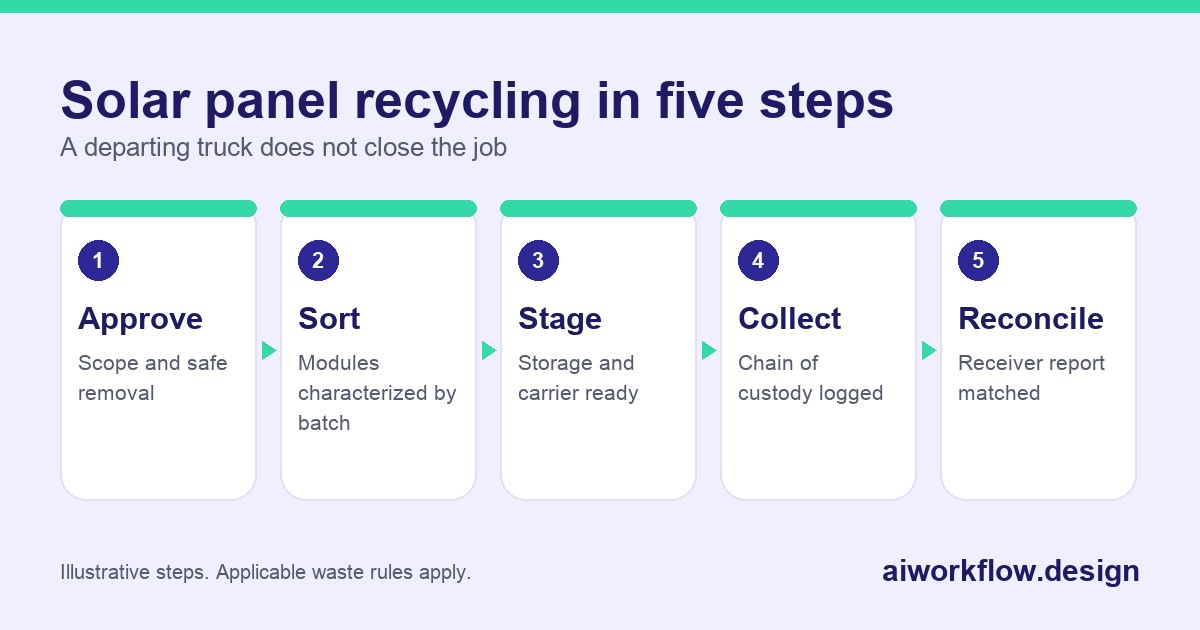
Why the pickup ticket is not the end of the job
A dispatch confirmation demonstrates that somebody was booked. A bill of lading may demonstrate that a load was tendered. A scale ticket or receiving report may establish what arrived, but it does not necessarily prove that the material was recycled. The distinction matters when the collection includes intact panels for reuse, broken glass, frames, associated electronics or other material streams. Record the type of evidence and the conclusion it supports. If the owner requires downstream recycling evidence, request that separately under the contract rather than treating the transporter’s signature as a recycling certificate. Removed modules may also be spares; see solar PV spare parts inventory.
State requirements can differ, including state universal-waste approaches. Do not apply a blanket rule that all retired panels are nonhazardous, or that they automatically qualify for a particular recycling exemption. The project’s designated environmental professional should determine the applicable management route before material is shipped. The operations board should track that decision’s status and supporting reference, not reproduce sensitive or incomplete legal advice in a free-text comment.
Build a register around batches, not vague tasks
Create one project-level item for the decommissioning campaign and separate batch records for shipments or staging groups. Useful fields include site and array identifier, module manufacturer and model if available, removal work-order ID, estimated and counted units, condition category, approved disposition route, storage location, transporter, scheduled pickup, carrier reference, receiving facility, receipt date, reconciliation status and exception owner. Add an evidence link instead of uploading large photo collections directly into an unprotected status board. Crew access preparation resembles solar O&M site visit prerequisites.
A module count is not always the same as an accepted count. For example, the crew may record 120 removed panels; the carrier may collect 118 because two broken modules require alternative packaging; the facility may report 118 received. The correct status is not “120 recycled.” It is “118 received; two segregated on site; downstream handling evidence pending.” A discrepancy field and a named owner prevent those two panels from disappearing from the record. Never invent quantities to fill missing tickets: leave them unresolved until validated.
A six-stage solar panel recycling follow-up workflow
1. Approve the scope and safe removal method
Before scheduling a collection, identify the owner of the decommissioning plan, the qualified electrical contractor and the person responsible for safety controls. Confirm the asset list, required permits or site access, lockout and testing arrangements, weather restrictions, fall-protection needs and emergency contacts according to the site-specific work plan. An administrative status call can ask whether the authorised plan has been signed. It cannot authorize work on energized equipment or decide that a roof is safe to access.
2. Characterize and segregate the materials
Ask the compliance owner to record the applicable waste evaluation and disposition route. Separate modules set aside for potential reuse from those being managed as waste; distinguish broken or damaged items that need protective packaging and special handling. Track associated inverters, batteries and cabling as separate streams where necessary because they may be subject to different requirements. A single “solar recycling” label should not obscure those differences.
3. Prepare storage and transporter readiness
Confirm the approved staging area, weather protection, stacking or container instructions and access for collection vehicles. Validate the transporter and receiving facility against the owner’s procurement and compliance requirements; store the approved contract reference. Collect pickup window, contact details, packaging count and any needed manifests or shipping records. If a vendor changes its receiving destination, move the task to review rather than automatically updating the destination and proceeding.
4. Capture collection and chain-of-custody events
At pickup, record actual load count, time, carrier reference, condition exceptions, photographs where approved, and the person who witnessed transfer. Capture any partial loads immediately. When the carrier later provides proof of delivery, associate the receipt with the correct batch. Never confuse a planned appointment, a scanned pickup note and verified receipt as if they mean the same thing.
5. Reconcile receiving reports and recycling claims
Compare removed, collected, received and dispositioned totals. If the receiving facility supplies weight rather than units, retain the original measure and an approved conversion method only if reconciliation genuinely requires one. Ask the recycler whether the agreement includes a downstream processing statement, commodity recovery report or exception notification. Only the responsible environmental or procurement owner should accept closure against the contract and local rules.
6. Close remaining on-site and contractual exceptions
Check that no pallets, broken panels, packaging or ancillary electronics remain unaccounted for. Confirm that vendor invoices align with authorized loads and change orders. Archive linked evidence according to the organization’s retention schedule. Close the work order only after both field completion and documentation acceptance have distinct dates; the last scheduled phone call is not proof of project closeout.
Example monday.com workflow and status design
A practical board can use groups named Planned, Removal approved, Staged, Collected, Receipt pending, Reconciliation review, and Closed by owner. Each item needs a single accountable owner, a next-action due date, a batch ID and a document link. Use an exception category such as quantity mismatch, facility change, damage, missing document, or regulatory review. Maintain a separate approval field with the approver’s name and timestamp; an automatically changed task status should not populate that field. Site clearing is another field task; see solar vegetation management tracking.
Automations can notify a coordinator when the pickup window approaches, remind a vendor to send a receipt or escalate a mismatch after an internal deadline. An AI check-in could ask a permitted vendor contact: “Was batch PV-024 collected? What is the transport reference? When will the receiving acknowledgment be available?” It should not request hazardous-waste legal conclusions, authorize an alternate disposal location or assert recycling completion based on a verbal statement. For specialized integrations and exception routing, scope a workflow with AI Workflow Design’s automation service; for structured status conversations, review the Daily Check-in Agent. See AI Workflow Design’s product overview, Autoza AI for monday.com and the workflow automation service for what can be configured; availability depends on your setup.
Exceptions that deserve immediate human attention
A broken panel discovered after the approved shipment has been staged requires the site lead to determine safe containment and the compliance lead to confirm the appropriate routing. An unapproved recycler substitution requires procurement and environmental review. A missing receiving ticket is a documentation problem, not evidence that a delivery failed, but it still prevents evidence-based closure. A count mismatch becomes a traceability issue when no one can identify the missing items. Escalate by issue category and contractual risk, not solely by how many days a status is overdue.
A good escalation message is precise: “Batch PV-024: 118 units received against 120 units removed. Two damaged units remain in approved storage; site supervisor assigned to resolve handling by Friday. Receiving receipt filed.” The message identifies what is known, what is not known and who must decide. An unhelpful message says only “Recycling delayed.”
Measures worth reviewing monthly
Review the percentage of batches with matched removal, pickup and receiving counts; median days from collection to receiving evidence; the number of open damage or handling exceptions; and the percentage of batches accepted for closure by the authorized reviewer. Segment by site and transporter to identify repeated paperwork problems. Avoid measuring recycling success by scheduled pickups alone. The useful question is whether a batch is traceable and its disposition has been documented to the standard the owner actually requires.
Next step
Start with one solar replacement or repowering project and follow every shipment from removal to evidence-based closeout. If the team already uses monday.com, keep safety and compliance approvals in their authoritative systems and use the board to prevent follow-ups from going missing. AI Workflow Design can help map a bounded status workflow without turning a transport update into an environmental decision.
Want these follow-ups handled consistently? Explore Autoza AI for monday.com or talk to AI Workflow Design about scheduled, permissioned status follow-ups that leave approvals and decisions with the right people.
Related guides:
- Solar Meter Data Gaps: Resolve Missing Readings Before Performance Reporting
- Solar PV Spare Parts Inventory: Coordinate Critical Stock and Approved Replacements
- Solar Vegetation Management: Track Shading, Site Access and Safe Remediation
More guides: browse our solar and renewable workflow guides or see all industries we support.
Frequently asked questions
Is every retired solar panel automatically hazardous waste?
No. Classification depends on the panel’s characteristics and applicable law. Have a qualified environmental owner assess the appropriate route under federal and state requirements before shipping.
Does a carrier pickup confirmation prove solar panel recycling?
No. Pickup confirms an upstream transfer event. Receiving confirmation and downstream treatment or recycling evidence, where required by the agreement, must be tracked separately. Do not label the batch “recycled” without the evidence supporting that claim.
Can a monday.com board replace waste shipping documentation?
No. It can index documents, owners, timestamps and exceptions. Any official manifests, recordkeeping or approved waste documentation must be maintained in the required form and system, with the appropriate authorized reviewers.
What should happen when the recycler reports fewer panels than the crew removed?
Leave the batch in reconciliation review, compare the field count, carrier records and receiving report, and identify where the difference arose. Assign an owner to confirm any items remaining on site or rerouted through an approved process.
Can an AI agent choose a recycler or authorize a new disposal route?
No. An agent can request a pickup ETA or missing receipt from an approved vendor. Vendor eligibility, material classification, contract changes and lawful waste disposition require competent human review and approval.