
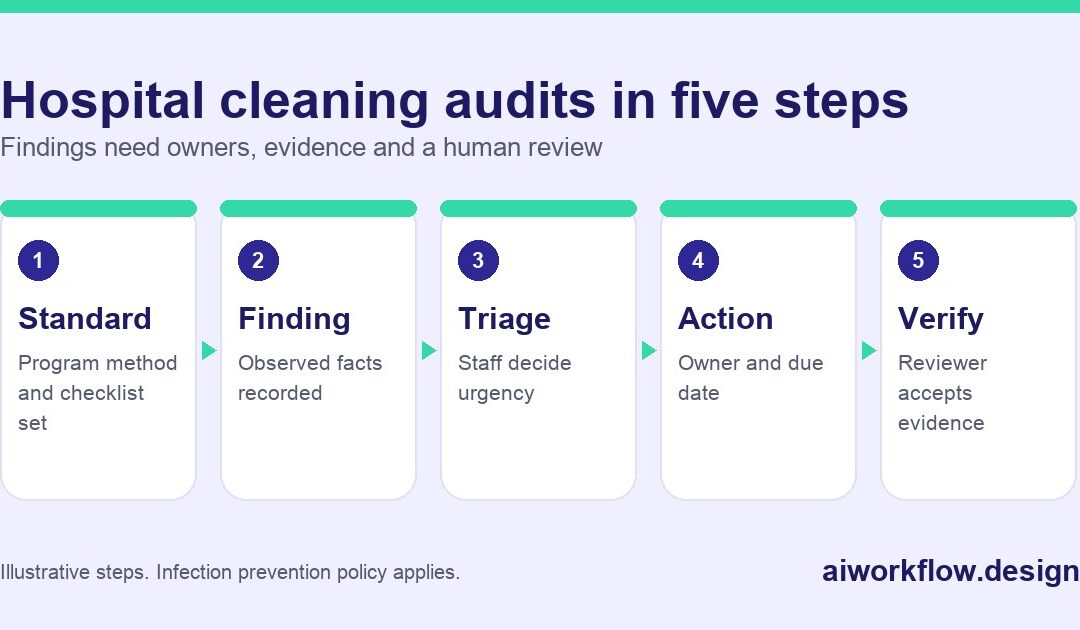
Quick answer: A hospital environmental cleaning audit tracker should record the audited area and method, link the observation to the approved cleaning program, assign a responsible supervisor, document retraining or process corrections, and obtain an independent follow-up review where required. The workflow can chase actions and evidence, but an AI agent must not decide whether a room is safe for patient use, interpret infection risks or substitute for a trained environmental services and infection prevention team.
Environmental services staff clean busy clinical spaces under tight turnaround expectations. A hospital may collect inspection findings from direct observation, fluorescent markers, adenosine triphosphate methods, process checks or other program-approved approaches. Yet the value of an audit does not come from a spreadsheet full of pass/fail cells. It comes from a clear feedback loop: what was observed, whether the assessment method is appropriate, what action was assigned and how the responsible team verified improvement.
Start with the program standard, not a generic score
Cleaning methods, frequency, products and responsibilities depend on the surface, care setting, facility policies and infection prevention guidance. A routine score should not be treated as a direct measure of whether pathogens are present or whether patient harm will occur. The audit tool must distinguish a process observation from a clinical conclusion. Construction work has its own infection-control gates; see hospital construction ICRA tracking.
For example, a missed high-touch surface may require retraining or clarification of a room checklist. An unexpected inspection result may require the environmental services supervisor to examine the method used and circumstances of the check. A known outbreak or urgent contamination concern belongs in the hospital’s established infection prevention and emergency procedures, not in an ordinary weekly reminder queue. The system should support both paths without mixing them.
Design an audit record that can be acted on
A record needs the facility, zone or room category, audit date, method used, approved checklist version, auditor role, non-sensitive finding, priority assigned by authorized staff, corrective-action owner, due date, evidence location, follow-up reviewer and closure decision. Use room or work-order IDs rather than patient identifiers. Restrict access to infection-related findings when appropriate and keep any clinical context in the designated hospital system. Equipment repairs follow a similar evidence pattern; see sterilizer maintenance record follow-ups.
The method matters as much as the score. Direct observation can reveal whether a procedure was followed; fluorescent-marker review assesses whether a marked surface was wiped; an ATP result is not automatically a direct microbiological risk measure. Report the method and limitations. A dashboard that merges different audit methods into one unqualified percentage can create the appearance of precision without meaning.
A six-stage cleaning audit and corrective-action workflow
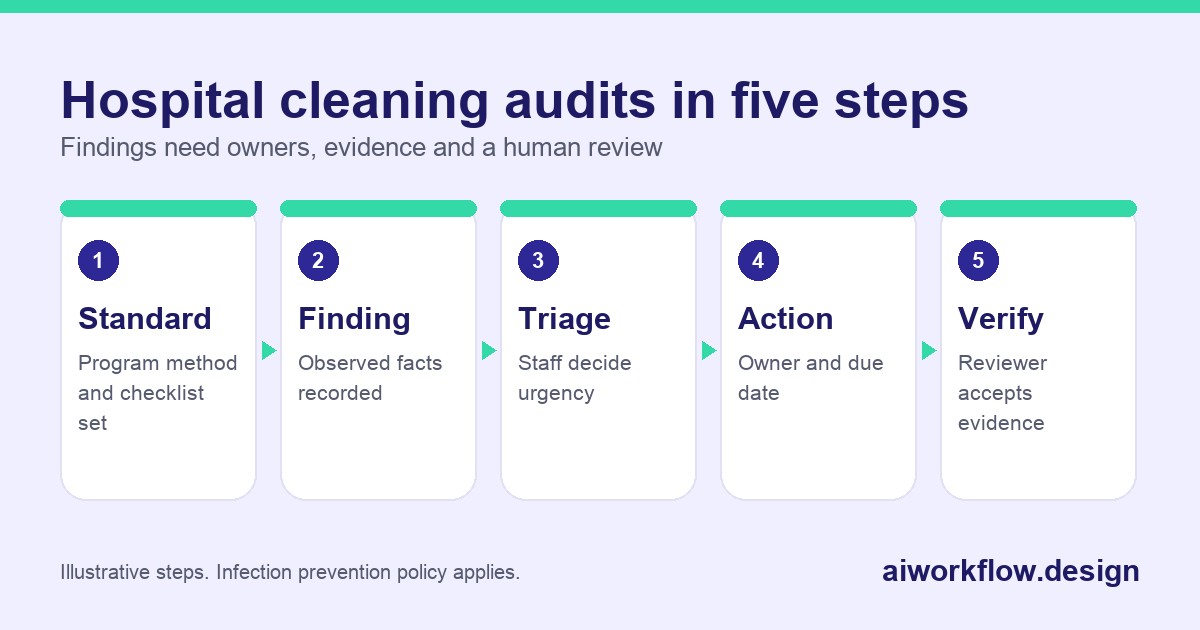
1. Define what is being monitored
The environmental services and infection prevention program owners specify the audit purpose, eligible areas, sample selection, frequency, approved method and required documentation. Decide whether the audit checks cleaning processes, surface coverage, availability of supplies or broader program controls. Keep a version of the checklist with every finding. If the standard changes midmonth, do not compare earlier scores without describing the difference.
2. Capture findings clearly and respectfully
Record the observed issue, location category, date, evidence reference and whether an immediate risk pathway was triggered. Avoid naming a worker in a widely shared deficiency board when coaching or personnel matters should be handled confidentially. Findings should describe observable facts rather than assumptions about intent or skill. “Approved process was not documented for shared equipment after use” is more actionable than “Staff were careless.”
3. Triage urgent risks using human judgment
The designated supervisor and infection prevention team decide whether a finding needs immediate response, additional cleaning, equipment isolation, infection-control escalation or a routine corrective action. Do not let an automated “low score” categorization release a room for service or assign a clinical risk class. If the issue could affect patient safety, use the hospital’s urgent communication procedures rather than waiting for a scheduled AI call.
4. Assign the corrective action and support needed
Choose the smallest correction that addresses the finding. It may be a job-aid update, restocking supplies, cleaning schedule revision, an approved disinfectant availability check, equipment maintenance, targeted training or a contract-vendor review. Assign a supervisor with authority to make the change and a completion date. When the finding stems from understaffing or an unsuitable process, a generic instruction to “retrain the cleaner” may miss the actual cause.
5. Verify completion with appropriate evidence
A worker or vendor may report that retraining occurred or a supplies cabinet was replenished. Track those updates, but let the designated reviewer determine whether evidence meets the program standard. The reviewer may repeat an observation, inspect the new procedure or review records. Separate action completed from effectiveness checked. A signed training attendance sheet shows that training took place; it does not prove the operational weakness is resolved.
6. Review recurring findings and adjust the program
Group observations by surface type, location, time period, supply constraint, contractor and checklist version. Look for repeated failures or conditions that warrant redesign. Report trends with the sample size and method attached. When the audit process itself has inconsistent results, investigate auditor training and scoring before attributing changes to cleaner performance. Record any policy changes so future audits can be interpreted fairly.
monday.com board configuration and secure handoffs
A board can use Audit ID, Area type, Method, Checklist version, Date, Finding category, Urgency review, Action owner, Correction due, Evidence link, Follow-up audit, Reviewer decision, and Closure date. Statuses can be Finding recorded, Triage pending, Action assigned, Action done, Independent check, Escalation, and Accepted closed. For sensitive clinical incidents, store only a reference to the hospital’s protected system, not patient information in routine task comments. Waste handling uses separate records; see regulated medical waste collection tracking.
Automations should remind supervisors to submit evidence and notify the audit coordinator when a follow-up is overdue. If approved for nonclinical administrative contacts, an AI call could ask, “Has the requested training record been submitted?” or “When will the supervisor’s follow-up inspection be completed?” It must not determine if a patient room should be occupied, interpret ATP measurements as disease risk, invent a pass result, or override infection prevention policy. AI Workflow Design’s automation services can help create this restricted status layer; the Daily Check-in Agent is relevant only for approved routine follow-ups. See AI Workflow Design’s product overview, Autoza AI for monday.com and the workflow automation service for what can be configured; availability depends on your setup.
Reporting that makes quality improvement credible
Track percent of findings assigned within the program’s timeline, median days to action, percentage independently reviewed, recurrence by category and supply or process blockers that persist. Show the numerator, denominator and audit method when reporting rates. Don’t compare two departments without considering differences in care settings, sampling and observation methods. The most useful trend is often the proportion of corrective actions shown to be effective over multiple observations, rather than the number of items staff marked complete.
A monthly review should include notable unresolved findings, barriers requiring management support and changes proposed to the audit plan. This helps leadership see whether the organization is learning from repeated observations rather than simply increasing the volume of inspection paperwork. Documenting the limits of what an audit can prove strengthens the report instead of weakening it.
Next step
Start with one audit method and a small set of environmental services areas. Define what a documented finding looks like, who triages it and what evidence closes it. Keep clinical decisions inside the hospital’s infection prevention process. Once the feedback loop is reliable, scheduling and status reminders can reduce administrative delay without weakening the safeguards the cleaning program exists to maintain.
Want these follow-ups handled consistently? Explore Autoza AI for monday.com or talk to AI Workflow Design about scheduled, permissioned status follow-ups that leave approvals and decisions with the right people.
Related guides:
- Hospital Construction ICRA: Track Pre-Work Controls and Approvals
- Hospital Sterilizer Maintenance Records: Track Repairs Without Approving Clinical Release
- Regulated Medical Waste Collections: Track Pickup Records and Exceptions
More guides: browse our healthcare admin workflow guides or see all industries we support.
Frequently asked questions
What should a hospital environmental cleaning audit include?
It should use a program-approved method, identify the audited area and checklist version, record objective observations, assign corrective actions, and define appropriate feedback and verification. The method and clinical setting determine how results are interpreted.
Does a passing cleaning score prove an area is free of infection risk?
No. Cleaning audits assess selected process or surface indicators; they do not guarantee a space is free of pathogens or suitable for patient use in every circumstance. Clinical and infection prevention decisions require qualified review.
Can AI score fluorescent-marker or ATP audit results automatically?
AI should not independently establish clinical acceptability or override the facility’s validated interpretation process. A system may organize approved results and flag missing review, but experts define methods, thresholds and decisions.
Should the board name the employee associated with every finding?
Limit personal information to what is necessary and authorized. Operational lessons can often be recorded by area and process category, while individual coaching belongs in a restricted supervisory process.
When is a cleaning corrective action truly closed?
When the assigned correction has documented evidence and the designated reviewer has accepted the outcome under the facility’s program. If an effectiveness check is required, completion of the task alone should not close the finding.