
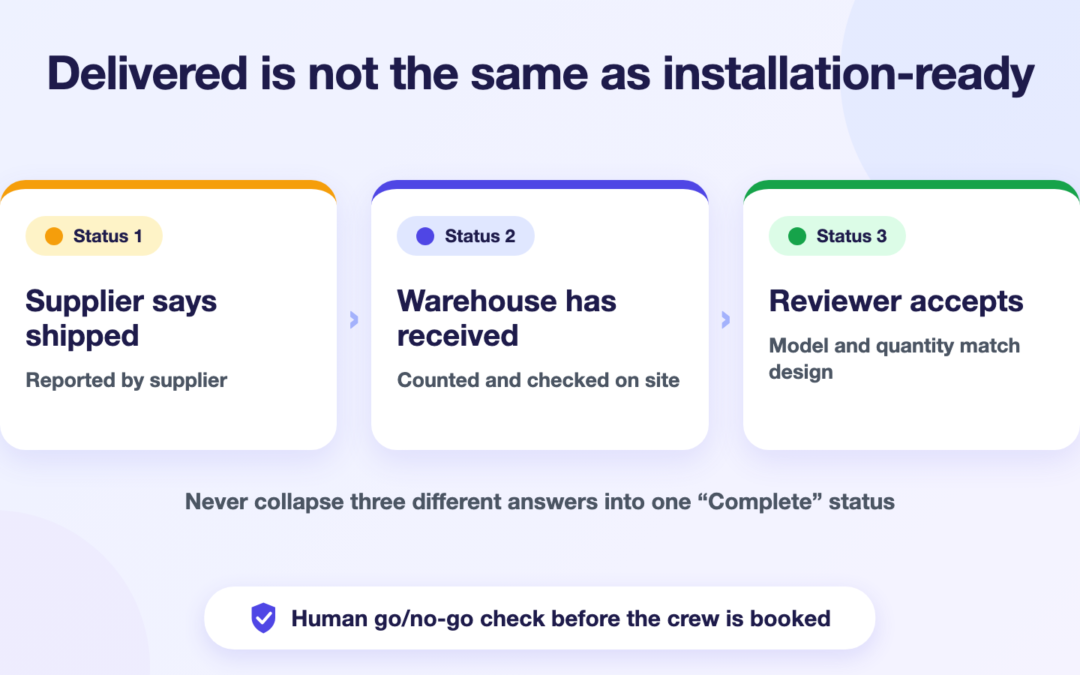
A solar installation can have a crew, an approved design and a confirmed site date yet still stall when a shipment is late, incomplete or unsuitable. The purpose of solar equipment delivery follow-up is to uncover that problem before installers arrive. Project managers should verify what has shipped, what is physically received, what remains disputed and who must resolve each discrepancy. A carrier’s “delivered” notification alone does not mean the right panels and inverters are ready for installation.
For contractors running projects in monday.com, the most useful approach is a short sequence of supplier, logistics and site-receiver check-ins tied to specific project tasks. An approved automated calling workflow may gather narrowly defined status answers and update mapped fields. It should not independently approve substitutions, certify equipment condition or instruct an unsafe installation.
Why delivery readiness is more than a tracking number
A purchase order can cover modules, inverters, mounting components, rapid shutdown devices, connectors and replacement spares. Those lines may travel in different consignments. The lead installer might need the inverter on site for cable routing, while a warehouse team is waiting for an incomplete pallet count. A shipment marked “on the way” is not actionable unless the manager knows which material it contains, where it is going and whether arrival precedes the installation milestone.
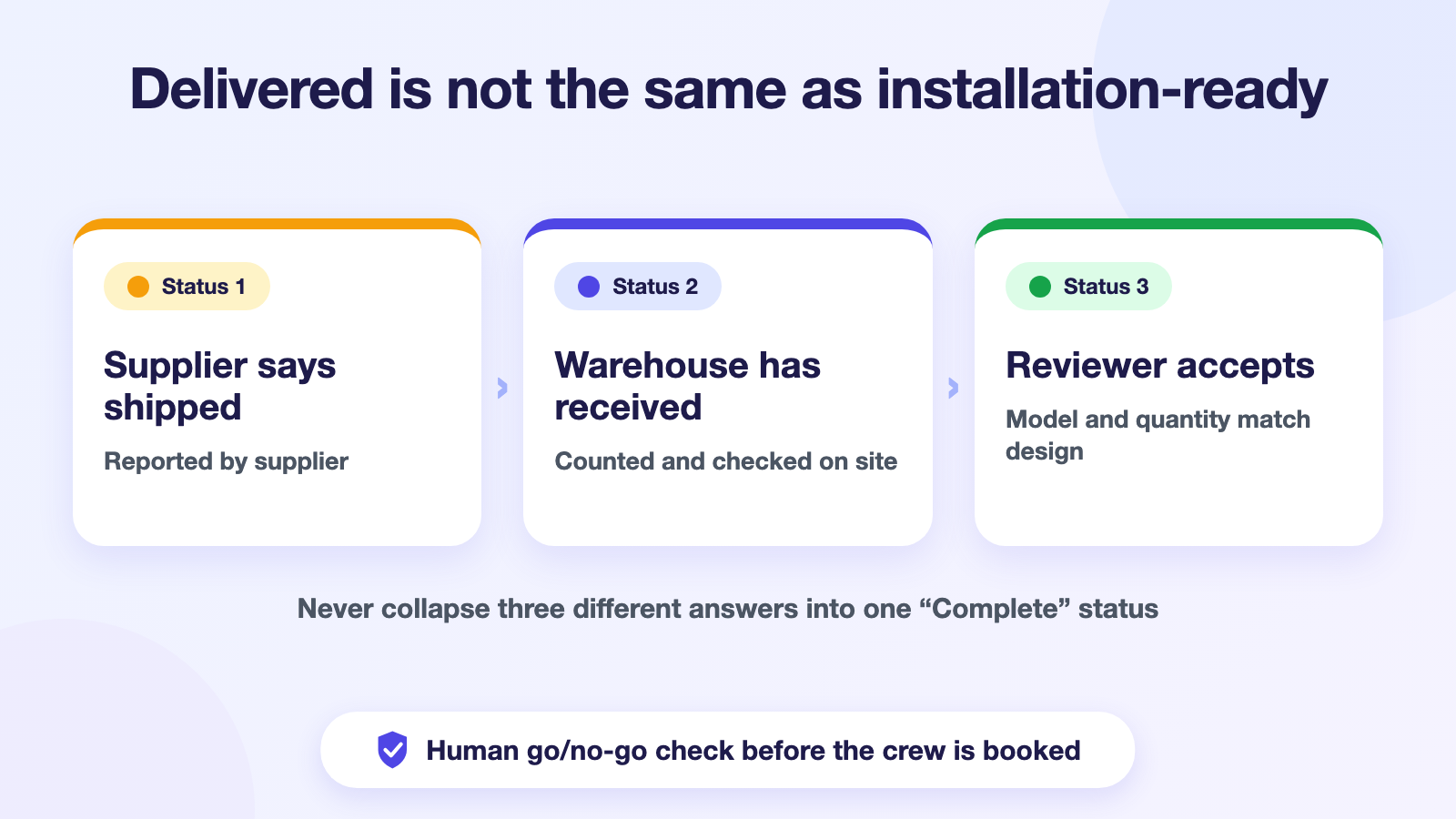
The U.S. Department of Energy’s photovoltaic procurement lifecycle guidance places equipment delivery between technical procurement and commissioning review. That sequence is a reminder to check equipment against specifications, not simply count boxes. A proper status process identifies procurement, transit, receiving and technical acceptance as separate states.
Build a monday.com equipment-readiness board
Use one parent item for the installation site and individual tasks or subitems for each material group. For example, “Site 14 — equipment readiness” could include panel modules, inverter, racking, DC protection, monitoring hardware and commissioning documents. Assign the person with direct knowledge of each dependency, not everybody attached to the project.
- Purchase-order reference and promised arrival date: maintained by the procurement owner.
- Supplier confirmation: confirmed quantity, model and dispatch commitment.
- Carrier milestone: collected, in transit, delivery window or exception reported.
- Site receipt: quantity physically counted, packaging condition and missing items.
- Technical review: pending, accepted by authorised reviewer or discrepancy escalated.
- Next action: named owner, due date and the relevant installation dependency.
A useful field model separates “supplier says shipped”, “warehouse has received”, and “technical reviewer accepts”. If those answers collapse into a single “Complete” status, managers can misinterpret an unverified delivery as installation-ready inventory.
Schedule the right calls at the right hand-offs
A project may need four checkpoints rather than continuous supplier chasing. First, confirm the order before the shipping deadline. Second, check the dispatch commitment when the carrier booking should exist. Third, confirm arrival with the receiver, not only the vendor. Fourth, hold a short readiness review before crew mobilisation. These are planning examples; timing should fit supplier lead times, access arrangements and project criticality.
The supplier call might ask: “Which approved panel and inverter models will be shipped, in what quantities, and against which purchase-order lines?” The logistics call asks for the confirmed delivery window and a contact for site access. The receiving call asks whether the shipment has arrived, whether quantities match and whether any packaging damage needs inspection. Avoid asking an untrained recipient to certify electrical safety or suitability.
Teams evaluating Autoza AI for monday.com can use scheduled start-of-day or status calls to collect progress, blockers and next steps. Its published product description includes updates to board items, notes, timestamps, retries and call summaries. Exact field mappings and scripts must be confirmed during configuration; the following board design is a recommended workflow, not a default built-in solar template.
Make exception handling more useful than extra reminders
Create four practical exception categories. “Shipment slipped” goes to procurement for a new confirmed ETA. “Wrong or short-delivered item” goes to receiving and a technical owner for reconciliation. “Damage or specification uncertainty” blocks technical acceptance until the designated reviewer decides. “No contact” remains unverified and triggers a different authorised channel, rather than being silently treated as “on schedule”.
Illustrative case: three 20-module pallets reach the site, but the receiving team counts one pallet at 18. The status call captures “58 of 60 modules received” and the purchase-order reference. The project manager identifies the two-module gap, requests a supplier resolution and decides whether to move the installation date. AI can record the report; it cannot decide that the crew should proceed with a design variation.
Installation-day go/no-go checklist
Before allocating a crew, have the appropriate owners confirm that the planned quantities are physically on site, approved equipment models match the design, access and lifting arrangements are known, essential balance-of-system components are available, and any damage or substitutions have been reviewed. Confirm that permits and safety prerequisites are handled in their separate authorised workflows. Never use a shipping update as evidence that electrical inspection or commissioning is complete.
Review the result as a concise readiness report: required equipment, confirmed inventory, outstanding exceptions, affected tasks and the human decision owner. For projects with multiple deliveries, a same-day summary of the exception rows is more valuable than a long raw transcript.
What to measure and improve
Track the percentage of material tasks confirmed before crew mobilisation, delivery discrepancies detected before the workday, supplier response time, and installation rescheduling attributable to missing equipment. Interpret these alongside actual project records, not as guaranteed performance gains. Where a repeated failure involves a particular supplier or product category, fix the purchasing checkpoint and receiving procedure rather than increasing call volume without purpose.
A reliable solar equipment delivery follow-up workflow keeps procurement facts connected to installation decisions. The immediate next step is to map one real site’s critical components, appoint the actual receiving and technical owners, and test a small set of authorised questions. For help designing the check-in flow, request a guided workflow review. For related guidance, see our daily solar installation crew check-ins and solar permitting and inspection checklist.
Frequently asked questions
When should solar equipment delivery calls begin?
Begin before the supplier’s committed dispatch milestone, then call at material hand-offs such as carrier booking, arrival and site receipt. Select timing from project lead times rather than an arbitrary daily schedule.
Can an AI caller approve alternative inverters or modules?
No. An AI status caller should record a proposed substitution and route it to the authorised design, engineering, procurement or customer approval process. Technical acceptance must remain with qualified people.
What happens when the supplier does not answer?
Record the result as unconfirmed, follow the approved retry and escalation process, and contact the designated supplier representative through another channel if the delay threatens installation. An unanswered call is not a delivery confirmation.
Can monday.com hold both logistics and acceptance statuses?
Yes, a team can design distinct board columns or items for shipment progress, physical receipt and human technical acceptance. Verify the product’s exact supported configuration before automating any updates.
Which delivery metrics matter most?
Measure verified readiness before mobilisation, unresolved shortage or damage exceptions, supplier response times and installation delays caused by equipment gaps. Use those figures to improve purchasing and site-receiving procedures.
Related reading
- Solar Project Handover: Who Confirms Final Tasks and Documentation?
- Daily Solar Installation Crew Check-Ins: What Should Managers Ask?
- Solar Permitting and Inspection Follow-Up: A Project Manager Checklist
- Interconnection Delays: How to Follow Up on Outstanding Solar Project Tasks
- Autoza AI for monday.com: scheduled status calls
- Workflow automation services
- Daily Check-in Agent