
A solar roof warranty coordination checklist is a pre-installation evidence plan, not a promise that a panel mounting system cannot cause leaks. On a commercial or residential roof, solar work changes the relationship between the building owner, roof manufacturer, roofing contractor and PV installer. If those parties have not agreed on the mounting method, inspection responsibilities and warranty process, a well-scheduled installation can create a costly dispute later.
The project manager’s job is to surface unanswered questions before crews drill, clamp, ballast or move materials onto the roof. Qualified designers and authorised warranty representatives decide whether the proposed solution is acceptable. An automated status call can ask if an approval record has arrived; it cannot approve roof penetrations or certify structural safety.
Identify the roof and the exact warranty at risk
Start with the building address, roof area, roof type, age, known repair history and existing roof-warranty documents. Record the membrane or covering manufacturer, installing roofer, warranty holder, warranty term and the procedures required for alterations. A general statement that “the building has a 20-year roof warranty” is not enough if that warranty has exclusions or work-approval requirements.
Check whether the planned PV array overlaps areas with recent repairs, drainage constraints, skylights, existing mechanical equipment or restricted maintenance access. For commercial buildings, the Department of Energy’s rooftop solar and roofing guide highlights coordinating with roof manufacturers so the mounting system does not undermine the existing roof-warranty arrangement. Requirements remain specific to the roof and contract.
Do not treat solar module, inverter, workmanship and roof warranties as one instrument. They cover different risks, parties and periods. Keep them as separate records in the project handover pack so a future property manager knows whom to contact for an equipment issue versus a roof leak.
Coordinate the approved design before mobilisation
Ask the PV designer and structural professional to identify the proposed attachment or ballast method, roof loading assumptions, wind and snow requirements where relevant, drainage implications, access pathways and equipment locations. Roof-mounted systems may use different approaches depending on the covering and structure. The design is a qualified technical decision, not something a task coordinator should select from a generic online checklist.
The U.S. Department of Energy’s guidance for homebuilders urges builders to consider roof suitability, structural capacity, roof shape and certified installers early. The Building America technical guide also describes the importance of coordinating flashing and penetration work with roofers. Specific materials and installation procedures must follow approved drawings and current manufacturer instructions, not an old illustrative detail.
Before any irreversible work, get clear answers: Which drawings govern the mounting layout? Who reviewed roof loading? Are penetrations proposed and, if so, who authorises the detailing? Does the roofing contractor or manufacturer require notification, attendance or post-installation inspection? Which roof warranty conditions apply to this installation?
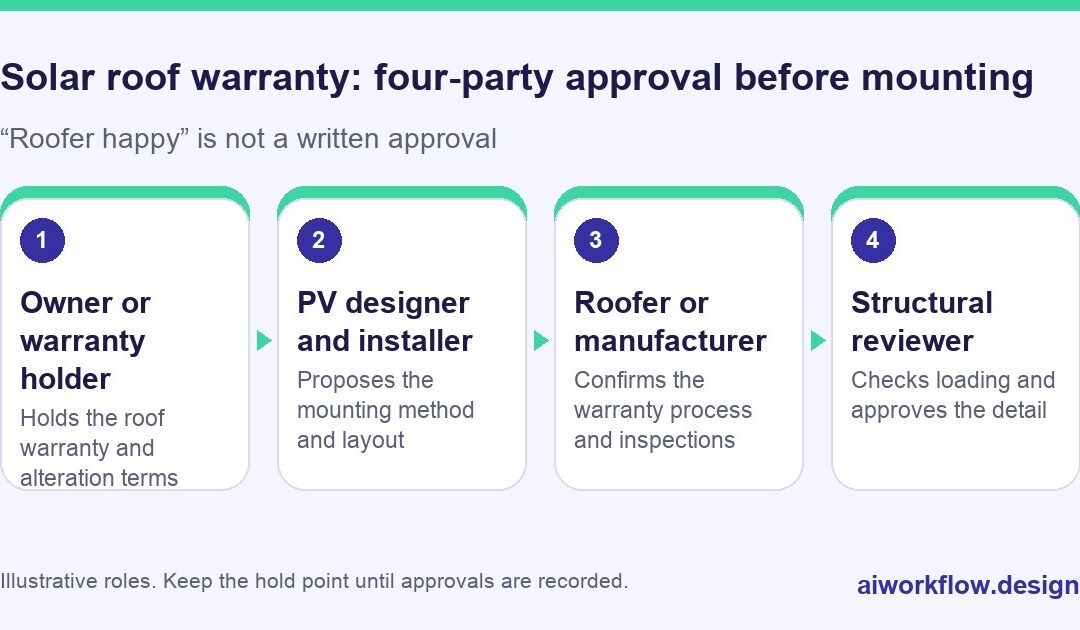
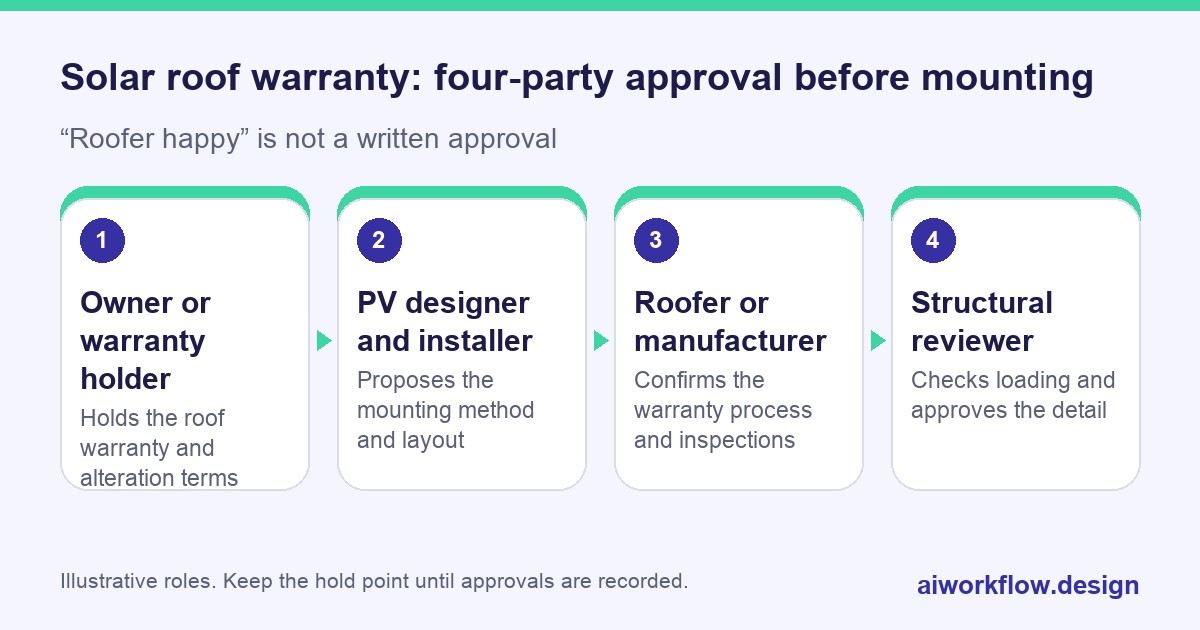
Build a four-party approval matrix
A useful register assigns a distinct role to the owner or warranty holder, PV design/installation team, roofing contractor or manufacturer representative, and building or structural reviewer as applicable. Record what each party can confirm and who must formally approve the relevant work. A site supervisor’s text saying “roofer happy” should not substitute for a required written approval.
Suggested monday.com fields include Roof section, Existing warranty record, Proposed mounting detail revision, Structural reviewer, Roofing contact, Manufacturer response, Installation hold point, Approved-document link, Post-work inspection owner and Open exception. These are recommended fields, not native Autoza templates. Separate status types such as requested, under review, accepted by named authority and verified in the controlled document register.
For multi-building portfolios, tie every record to a specific roof area. Otherwise a warranty acknowledgement for Building A may accidentally be attached to Building B. A photograph of a similar roof is not a structural report, and a warranty booklet is not evidence that the proposed penetrations were approved.
Follow up at the moments where decisions matter
The most valuable check-ins occur when the survey is complete, the mounting design is being finalised, roofing approval is required, the installation date is about to be confirmed and a post-installation inspection must be scheduled. During survey, ask about visible defects and records needed by the technical team. Before procurement, check whether approved mounting details change the material list. Before mobilisation, verify written releases and safe access arrangements.
A short administrative call to the roofing coordinator might ask: “Have you received revision C of the mounting layout?” “Does the warranty process require your attendance?” “What written response is outstanding?” “When will the manufacturer contact confirm its review?” and “Who will supply the post-work inspection record?” Avoid technical yes/no questions such as “Will this definitely not leak?” that can be mistaken for engineering certification.
Once roof work begins, use formal installation quality-control records, inspections and appropriate safety procedures. Scheduled calls are poor substitutes for observing flashing, attachments or water-tightness details. Any unexpected substrate damage, structural uncertainty, unsafe access or waterproofing defect should trigger the competent team’s stop-and-review procedure.
Handle conflicts before they become change orders
Imagine an illustrative warehouse roof where the PV designer plans a mounting route across a manufacturer’s restricted zone. The roofer says the proposed detail may require a warranty variation. The proper tracker outcome is “design/warranty conflict; installation hold pending review”. Assign the technical designer and roof warranty representative to resolve the issue, then arrange commercial approval for any cost or programme change. Do not instruct crews to proceed because the panel delivery is already booked.
A second common conflict is roof age. If the covering may need replacement before the PV equipment reaches the end of its useful life, the building owner must consider the financial and access implications. The DOE homeowner solar guidance explicitly raises roof age and replacement timing as installation considerations. That does not give an AI system the authority to estimate remaining structural or waterproofing life.
Connect installation readiness to the existing solar equipment delivery follow-up article so material arrivals and roof permission appear as separate prerequisites. A pallet on site is not a release to work on the roof.
Keep the final warranty record usable by the property team
After installation, collect the required completion photographs, as-built drawings, roofing inspection notes, approved alterations, workmanship warranty and any manufacturer correspondence. Confirm which party is responsible for routine roof access, future equipment removal, leak investigation and emergency contacts. The exact handover contents should follow the contract, warranties and local requirements.
Do not close the warranty task merely because the PV system is generating electricity. Generation proves neither leak-free installation nor continuation of warranty coverage. For broader closeout, link to the solar project handover documentation guide, where design and acceptance evidence are tracked independently.
Use AI only for coordination, never engineering or warranty authority
AI Workflow Design’s scheduled check-in products can collect short authorised status updates and write summaries back to configured trackers. A carefully approved script could ask whether a roof manufacturer letter has been received, when a roofer can attend, or who owns an unanswered documentation request. Human reviewers must verify every important source and retain approval rights. Voice logs should avoid access codes, detailed security plans and sensitive customer information.
Start with one active installation, map the four-party approval chain and introduce a clear pre-mounting hold point. If roofing and PV teams repeatedly lose time chasing administrative updates, consider a controlled check-in workflow that improves handoffs without pretending to approve roof safety. You can also browse more workflow guides.
Frequently asked questions
What should a solar roof warranty coordination checklist contain?
Include the current roof warranty, roof type and condition records, manufacturer or roofer contact, approved mounting design, structural review status, installation method, any required pre-work consent, inspection responsibilities, and the final warranty document handover.
Will installing solar panels automatically void a roof warranty?
Not automatically in every case. Coverage depends on the warranty wording, roof system, installation work and any required manufacturer or contractor process. The owner should obtain specific written guidance before work begins rather than relying on a general claim.
Who approves solar roof penetrations and flashing details?
The qualified design, structural, roofing and other authorised parties required by the project and local rules must approve the applicable details. A project coordinator or AI status caller can track their responses but cannot certify a connection or waterproofing method.
Should the roofer inspect the roof after panel mounting?
Follow the roof manufacturer, roofer, contract and local requirements. A post-installation inspection may be an important condition of warranty management, but the scope, timing and authority for it should be explicitly agreed before mobilisation.
Can AI calling automate solar warranty follow-ups?
It can collect permitted administrative updates from the owner, roofing coordinator or PV project manager, such as whether a letter or appointment is pending. Technical acceptance, warranty interpretation and safety or structural approvals stay with qualified people.
Related reading
- Solar Project Handover: Who Confirms Final Tasks and Documentation?
- Panel and Inverter Deliveries: Follow-Up Calls Before Installation Day
- Solar Site Surveys: Check Roof, Shade and Access Readiness Before Design
- PV Monitoring Activation: Confirm Alerts and Owner Access After Installation
- Solar Net-Metering Applications: A Data-Completeness Follow-Up Checklist