

A solar net metering application checklist should stop a project from being delayed by preventable information gaps, while keeping utility approval separate from the installer’s paperwork. Contractors often talk about a single “solar application”, but customer tariff eligibility, local electrical permits, interconnection agreements, inspections, meter arrangements and permission to operate can involve different decisions. Treating them as one status invites inaccurate promises to customers.
This guide is for US solar installers and project administrators who coordinate distributed PV projects. Net metering rules, terminology and availability vary by utility, state and rate programme. A well-run administrative workflow uses the actual utility instructions and does not imply that net metering is universally available.
Establish exactly which application the utility requires
Before gathering signatures, confirm the utility service territory, current programme, system type, project capacity, meter arrangement and whether there is storage, export limiting or another special configuration. Ask the utility or its official published materials for the correct current forms and submission method. Some utilities treat interconnection and compensation-rate enrolment together; others use separate steps or have moved to different export-credit arrangements.
The DOE solar guide for homebuilders notes that a solar installation needs an interconnection agreement with the relevant utility and that requirements vary by utility and authority having jurisdiction. It also distinguishes local construction, inspections and utility permission to operate. This is why a complete data packet is not permission to energise.
Identify the authorised applicant and owner. An installer may prepare forms, but the customer, utility account holder or other designated party may need to sign. Verify the actual tariff and agreement rather than copying wording from a similar project in another county.
Prepare data from authoritative records
Build a document checklist with Account holder name, Service address, Utility account reference, Meter identifier, Proposed system capacity, Equipment make and model, Electrical single-line drawing revision, Site plan, Storage/export details, Installer credentials, Customer consent or signature and Submission route—only where applicable to the specific utility. Do not place full account numbers, financial details or authentication credentials in routine call transcripts or widely shared status boards.
Map each field to its official source. The service address should match the utility account; the design capacity should come from the current approved design; the equipment schedule should match what is being installed. One transposed meter digit can cause a return request even if the electrical drawings are correct. A name mismatch between the account holder and application signature may also require clarification.
An illustrative monday.com board may contain Application reference, Utility, Program name, Record owner, Missing field category, Data requested from, Date received, Revision, Submitted timestamp, Acknowledgement, Utility review status, Corrections required and PTO evidence. These are suggested fields for a configured workflow, not included product defaults.
Make completeness a two-person check
The administrator should collect the records; a knowledgeable project engineer or application reviewer should confirm that the technical information matches the latest design. The customer or authorised signatory handles consent and representations that belong to them. Avoid allowing the data-entry person to silently change inverter ratings or export mode to satisfy form validation.
Use a controlled checklist before submission. Are the service and site addresses identical or appropriately explained? Is the correct utility programme selected? Does the application system size match the design revision? Are necessary equipment certifications or sheets attached? Are the right parties identified? Are the required acknowledgements and signatures present? If one answer is unknown, record it as a missing item and identify its source.
The phrase “form completed” should mean all administrative fields have a proposed answer. It should not mean the utility has validated the application or that the project’s technical design is compliant. A utility may request further details or require a study even after accepting a complete filing.
Separate four external milestones
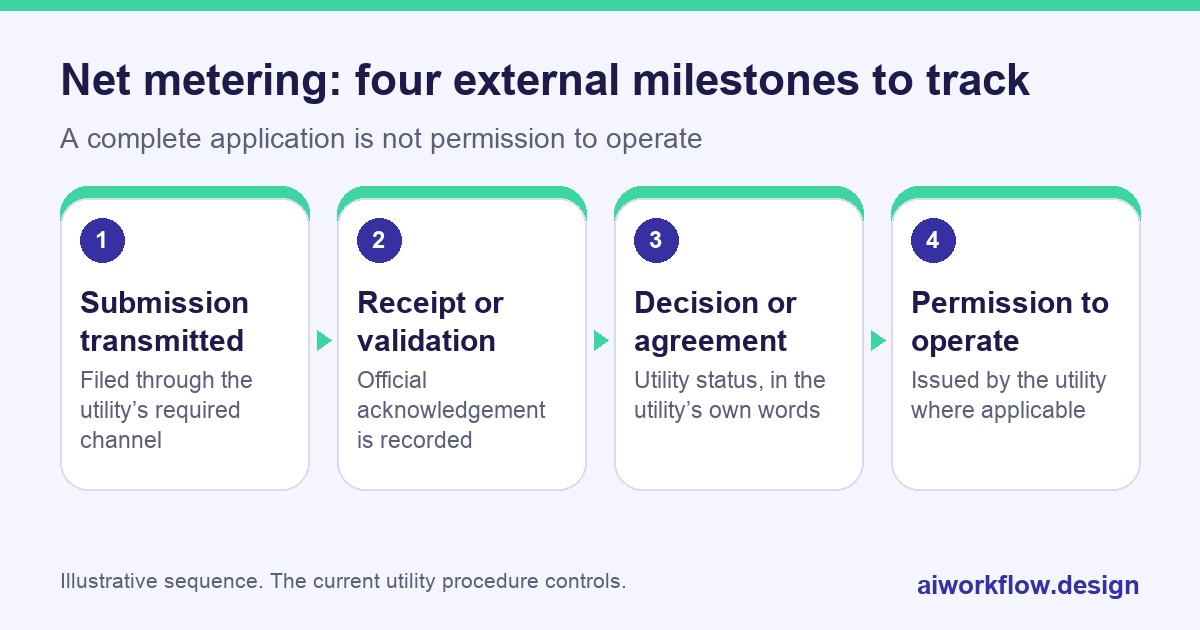
Track submission transmitted, official receipt or validation, utility decision/agreement, and permission to operate where applicable. The project may also have a separate rate enrolment or meter configuration milestone. Keep the actual utility status names and dates. The DOE project implementation explanation illustrates distinct interconnection review, construction, final inspection and utility permission-to-operate steps; the current provider’s procedure is controlling.
If the utility portal reports “in review”, the tracker should not convert that to “approved” because a contractor reported “all good”. When a correction arrives, record its official source and allocate the response to the right technical or administrative owner. Capture an acknowledgement after resubmission. Retain copies of official decisions or links in a controlled records system.
For a related dependency map, the existing interconnection follow-up guide explains why utility-owned stages must be separated from internal outstanding work. This article addresses the narrower, earlier issue of data accuracy and application completeness.
Build a short call sequence around missing information
Start with the customer-service data owner when an account detail is missing; then call the design document controller for the equipment schedule; then contact the application coordinator after submission to confirm the official acknowledgement. A typical question set is: “Which record is missing?” “Who owns the original?” “What is the latest approved revision?” “Has the file been sent through the required channel?” and “What exact evidence confirms that result?”
Never ask a general-purpose calling agent to collect passwords, payment-card data or full utility credentials. Give the customer a secure upload channel or the provider’s own portal. External utility enquiries should use designated contacts and prescribed procedures. Unanswered calls should lead to an internal next action, not an assumption about utility decisions.
It is also unwise to promise a universal application turnaround. Review time depends on provider workload, grid conditions, system characteristics, completeness and jurisdiction. A better customer update is “the revised inverter schedule was submitted on Tuesday; the utility has acknowledged receipt and has not issued a final decision”.
Handle programme changes and customer expectations
Tariff structures can change, and the phrase net metering may not describe every export-compensation policy. If a customer asks about savings or credits, route the question to an authorised specialist with current utility information and accurate system assumptions. Do not let a status-call summary produce a guaranteed savings estimate.
When the design changes after submission—for example, an inverter model changes or storage is added—ask the competent team whether a revised utility filing, permit or agreement is required. A sales amendment alone does not establish that technical or rate documentation remains valid. Keep the prior submitted revision accessible so discrepancies can be traced.
For inspection corrections, use the existing failed solar inspection and reinspection tracker instead of changing an application field to “complete” before the relevant authority finishes its process.
Fit Autoza to administrative status, not utility decisions
AI Workflow Design describes Autoza AI for monday.com as a scheduled calling and board-update product. With approved scripts, consent, permissions and mapping, a coordinator could use calls to collect missing-account-document status from an authorised internal person or confirm that a design packet was prepared. Utility submission and approval must still be verified from the official system by authorised personnel.
Test the workflow on one utility territory first. Measure the proportion of initial applications returned for missing information, response time for correction requests and time spent finding approved design revisions. These operational measures show whether the process is useful without claiming that AI speeds up grid review.
A closeout routine that prevents false “ready” messages
Before sending a customer readiness message, check three distinct records: the approved installation and inspection evidence required locally, the utility’s written interconnection or PTO decision as applicable, and the current export-compensation programme status. Keep them separate even if the same coordinator manages all three. The customer should receive a clear summary of confirmed decisions and still-open tasks.
If data collection is a repeated bottleneck, explore an authorised check-in workflow that prompts owners for missing administrative inputs while protecting technical review and utility authority. You can also browse more workflow guides.
Frequently asked questions
What information belongs in a solar net metering application checklist?
Typically verify utility and account-holder details, service and meter identifiers, current system design, equipment specifications, installer information, drawings, applicable certifications, signed agreements and the provider’s required supporting documents. Exact requirements vary by utility and programme.
Is net-metering enrolment the same as interconnection approval?
Not necessarily. Export compensation, interconnection and permission-to-operate steps can be combined or separate depending on local rules. Confirm which actual decision has been issued and never infer energisation permission from a complete application.
What should we do if the submitted equipment schedule changes?
Have the qualified design and application team compare the new configuration with permits, utility filings and agreements. Determine through the official process whether an amendment or new review is required, and preserve a version history.
Can AI call the utility to approve or expedite an application?
No. Approval and processing belong to the utility and authorities under their rules. A permitted internal status workflow may remind document owners and report whether an official response has been received, but should not impersonate an applicant or bypass communication procedures.
How should we report application progress to a solar customer?
Provide the submission date and reference, last verified utility response, outstanding questions, next action owner and reasonable update date. Clearly distinguish an estimated schedule from a formal approval or permission to operate.
Related reading
- Interconnection Delays: How to Follow Up on Outstanding Solar Project Tasks
- Failed Solar Inspection: Tracking Corrections and Reinspection Tasks
- Solar Permitting and Inspection Follow-Up: A Project Manager Checklist
- PV Monitoring Activation: Confirm Alerts and Owner Access After Installation
- Solar Roof Warranty Coordination: Questions Before Panel Mounting Starts