
A failed solar inspection does not automatically mean the entire installation must start again. It means the authority has identified issues that must be addressed according to its official notice and local procedures. A solar reinspection follow-up checklist should record each finding, its correction owner, the required evidence, and the verified route to a new inspection appointment. AI status calls may help coordinate those actions, but they cannot overturn an inspector’s finding, declare compliance or issue permission to operate.
Project managers often lose time when an inspection result is paraphrased as ‘just a few changes’ and the exact correction list never reaches the right people. Rooftop PV permitting and inspections depend on local government requirements, and utility interconnection remains a separate stage. This guide concentrates on the correction-and-reinspection cycle rather than duplicating a general permit application checklist.
Begin with the actual official inspection result
Obtain the inspection report, notice or portal entry from the authority having jurisdiction. Confirm the project identifier, permit reference, inspection date, inspector comments and any specified reinspection conditions. Translate those requirements into action items only after the responsible technical lead has reviewed them. An installer may describe a concern helpfully, but the authority’s written finding remains the source of truth.
Distinguish failed inspection, inspection incomplete, inspection not held and additional documentation requested. These are not interchangeable outcomes. A missed appointment or inaccessible site should be resolved through scheduling or access procedures, whereas a technical deficiency may require rework, a revised drawing, additional testing or a different review.
Break every correction notice into owned tasks
Create one trackable item per finding. Suggested fields include Official Finding Reference, System Area, Assigned Contractor, Qualified Reviewer, Correction Method Under Review, Evidence Required, Work Complete Reported, Evidence Checked, Reinspection Request Status and Formal Outcome. These are examples of recommended project management fields, not built-in product defaults.
Use the exact language of the official notice in the protected evidence record and a concise action label on the shared board. For sensitive information, limit distribution and avoid reading full inspection records into a general AI call. The coordinator should preserve all versions of drawings and correction documents so the final evidence can be reconciled with the relevant permit.
Establish who decides how a finding is corrected
Some findings are administrative, such as a missing document; others may involve protective equipment, wiring practices, labelling, roof access or system design. The installer may be responsible for carrying out a correction, but a qualified electrician, engineer or inspector may be required to determine the acceptable method. An AI caller should not tell a crew which conductor to replace, whether a disconnect is safe to operate, or whether a failed item can be ignored.
For an illustrative rooftop project, the written result requests updated labelling evidence and clarification of a diagram revision. Assign the documentation owner and qualified technical reviewer separately. ‘Labels installed’ may be a reported field update; ‘correction accepted’ must wait for the appropriate formal review. The same distinction applies even when the fix appears minor.
Build an evidence checklist before asking for reinspection
Verify that each required action has been performed by an authorised person and that the specified proof is available. Depending on the authority and finding, evidence might include approved revised plans, photographs, testing documentation, manufacturer information, inspection booking records and signatures. Do not collect unnecessary resident information or internal security details simply because a system allows file attachments.
The reinspection coordinator should answer four questions: What findings were issued? Who verified the corrective work? Have the required documents been submitted using the authority’s channel? Is the site available and properly prepared for the next visit? The formal reinspection outcome is a fifth, separate step that cannot be inferred in advance.
Plan calls around correction ownership and appointment deadlines
A sensible follow-up sequence is: immediately after the official notice, assign findings; before the agreed rework date, confirm parts, approved methods and site access; after reported completion, ask the technical lead whether evidence has been checked; before reinspection, confirm booking and required attendees; after the appointment, verify the official result. The actual cadence should follow local procedures and the risk of the open findings. If equipment is the bottleneck, our guide to panel and inverter delivery follow-up shows how to confirm parts before the crew returns.
Avoid interrupting technicians working at height or with electrical equipment. Calls should go to available supervisors, coordinators or document owners at permitted times, with clear AI disclosure and appropriate consent. An unanswered call should generate a retriable administrative action, not a false statement that a correction failed. See what managers should ask in daily solar crew check-ins for question design.
Keep inspection status separate from interconnection permission
A passed local inspection is important, but it is not automatically permission to energise or operate a grid-connected solar system. The utility’s separate requirements may still be outstanding, and the local regulatory sequence varies. Authority inspection and utility connection are distinct steps. Our article on interconnection delays covers the utility side.
A project dashboard should therefore show correction work, official reinspection result and utility permission or interconnection status as different fields. Don’t mark ‘ready to operate’ solely because a contractor says an inspector visited. Keep the authoritative outcome linked to the original issuing body or portal.
Use monday.com for coordination, not certification
A monday.com correction board can hold action owners, follow-up dates, progress notes and links to formal evidence. Autoza AI for monday.com offers scheduled status calls, summaries and board updates. With appropriate configuration and permissions, a call could collect whether a requested photograph was uploaded or whether an appointment was confirmed. It cannot edit the authority’s official inspection record, make an electrical safety judgement or submit a regulator decision on the regulator’s behalf.
Human reviewers should control any verified-compliance and release-to-operate fields. If the caller hears an unexpected hazard, damaged equipment or disputed correction, route the issue to the relevant responsible professional rather than continuing a routine checklist.
Look for preventable sources of repeat inspections
Useful quality measures include the number of findings by type, time to assign a responsible owner, proportion of evidence packages accepted without another request, time from corrective-work verification to appointment booking, and repeat findings across crews. Use these trends to improve design QA, field readiness and documentation before future inspections. A thorough solar site survey before design removes many avoidable findings.
The earlier Solar Permitting and Inspection Follow-Up checklist covers the broader approval pathway. This article focuses on what happens after an unsuccessful inspection, when correction ownership and a precise evidence trail matter most.
Close only after formal confirmation
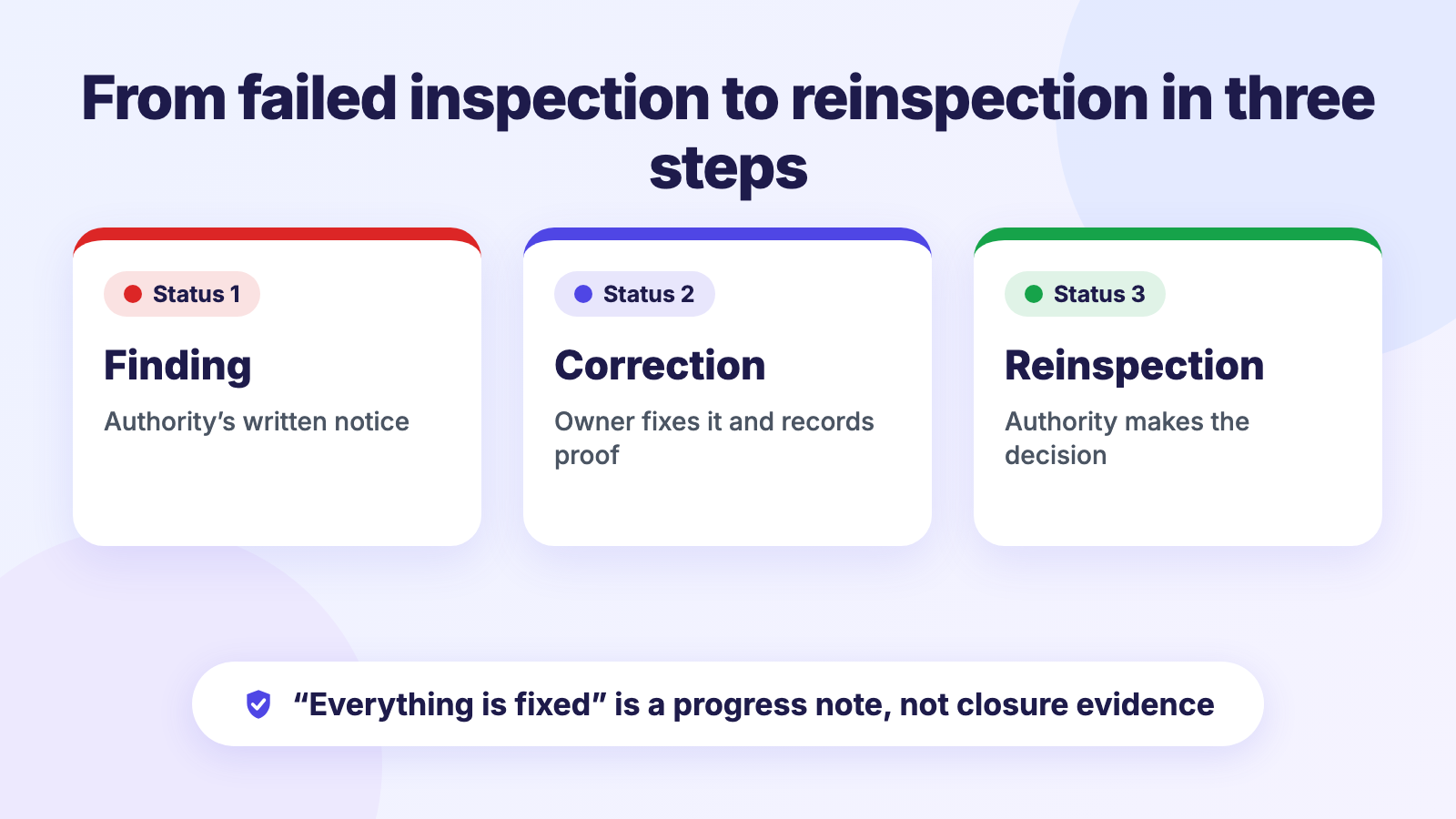
A job is ready to leave the reinspection queue when the authority’s result has been obtained, required records have been retained, the team understands whether any further conditions remain, and separate utility or commissioning prerequisites have been handled. A contractor’s statement that ‘everything is fixed’ is valuable progress information, but it is not closure evidence by itself. Once the authority has confirmed the result, the solar project handover process takes over.
If your team uses monday.com and spends time chasing correction owners, explore Autoza AI or request a workflow discussion about narrow, responsible project follow-up calls.
Frequently asked questions
Who decides what correction is needed after a failed solar inspection?
The authority issues the inspection findings and determines its acceptance requirements. A qualified designer or installer determines and carries out appropriate corrective work within their professional role. A project caller should only gather progress and route the official finding to the right people.
What evidence should be retained before requesting solar reinspection?
Keep the official finding, corrective-action owner, applicable revised drawings, approved testing or photographic evidence, technical review and submission records required by that authority. The exact package varies by jurisdiction and deficiency, so follow the inspector’s formal instructions.
Can an AI agent mark a solar inspection as passed?
No. The verified status must come from the authority having jurisdiction or its authorised channel. A call reporting that the crew fixed an issue is a progress note, not an official inspection result or permission to operate.
Is a reinspection the same as utility permission to operate?
No. Local inspection and utility interconnection processes can involve separate organisations and milestones. A project may need the appropriate utility authorisation even after passing the relevant local inspection. Track each outcome independently.
How should no-answer calls affect correction status?
Record that contact was not made, follow the permitted retry schedule and escalate time-sensitive dependencies to the coordinator. Do not infer that a crew failed the work, that an inspector rejected the request or that the job is complete merely because nobody answered.
Related reading
- Solar Site Surveys: Check Roof, Shade and Access Readiness Before Design
- Solar Plus Battery Design Changes: A Follow-Up Workflow for Scope Revisions
- Solar Permitting and Inspection Follow-Up: A Project Manager Checklist
- Solar Project Handover: Who Confirms Final Tasks and Documentation?
- Interconnection Delays: How to Follow Up on Outstanding Solar Project Tasks
- Autoza AI for monday.com: scheduled status calls
- Workflow automation services
- Daily Check-in Agent