

Adding storage to a solar project can change far more than the equipment list. A proposed battery may affect electrical design, inverter selection, equipment location, protection systems, permitting, utility arrangements, cost and customer expectations. Solar battery design change tracking should preserve a clear chain from requested change to technical assessment, authorised approval, revised drawings and installation release. An AI status call can help collect who has completed which action; it cannot approve a design, determine electrical compatibility or authorise energisation.
This guide applies to installation project managers, design coordinators and operations leaders handling photovoltaic and battery projects. Solar-plus-storage systems may be AC-coupled or DC-coupled, with different configurations and performance considerations. Which approach is suitable for a specific project is a qualified design decision, not a generic recommendation to be made by a blog or caller.
Define the requested change in operational terms
Start by identifying the original approved scope, the customer’s new requirement, the equipment or design elements affected, the reason for the request and the point reached in procurement and installation. Changes may arise because a customer wants more backup capability, a specified component becomes unavailable, a site survey identifies a constraint, or a utility response requires a revision.
Record the request as proposed, not accepted. The person receiving the call should note the source, date and next action, but not promise the client a battery capacity, backup duration or final price. Those statements depend on technical assumptions and contractual approval. Preserve the original design revision until a controlled replacement has been issued.
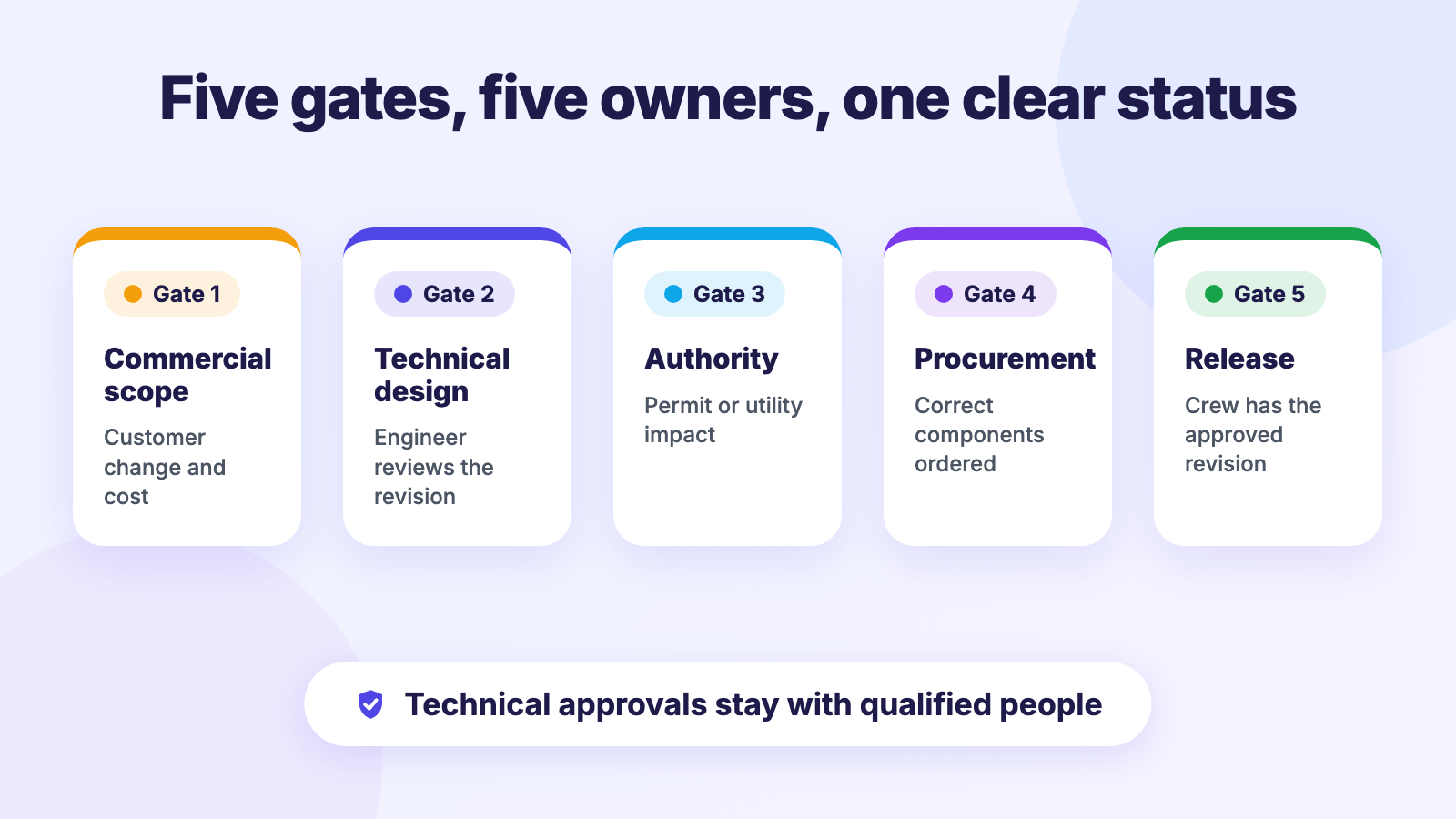
Separate five decision gates that teams often combine
First, commercial scope: what did the customer request, what is excluded and who approves cost and programme impacts? Second, technical design: has the competent engineer reviewed compatibility, topology, location, protection and control requirements? Third, authority requirements: is a revised permit, inspection or utility submission needed? Fourth, procurement: are the approved components available with the correct specifications? Fifth, construction release: has the site crew received the approved revision and any necessary work instructions?
These gates can overlap in preparation but should not collapse into one status named ‘battery approved’. A customer approving a quotation does not certify an electrical design. An engineer confirming compatibility does not automatically satisfy the building authority or utility. A supplier promising delivery does not authorise the electrician to install substitute equipment. Our checklist for solar permitting and inspection follow-up covers the authority gate in more detail.
Maintain version control of drawings and equipment
Use a revision register for the single-line diagram, layout, equipment schedule, bill of materials, required datasheets and relevant safety documentation. For each revision, record its author, checker, issue date, purpose and recipient. When a change is approved, superseded site instructions should be withdrawn from active use. If the technical review is ongoing, label the drawings accordingly instead of distributing them as final construction documents.
An illustrative battery upgrade changes an inverter specification after the installer has reserved equipment. The useful follow-up is not ‘Is the battery sorted?’ It is ‘Has the revised inverter selection been checked and approved, which purchase orders are affected, and who will confirm the site has the issued-for-construction revision?’ The coordinator can track these responses without deciding whether the components are safe together. For the procurement side, see follow-up calls for panel and inverter deliveries.
Check safety and permissions before scheduling rework
Energy storage introduces electrical, thermal, fire-protection, siting and equipment-access considerations. Relevant requirements vary with battery chemistry, system size and jurisdiction. Refer the design to qualified electrical and fire-safety professionals and the authority having jurisdiction. Do not give an AI calling system an instruction to override a protection device, energise equipment, perform tests or declare a system safe.
If a contractor reports that an alternative location would solve an access issue, record the proposal and arrange design review. The record stays ‘location change under assessment’ until the authorised reviewer has decided. General solar-plus-storage overviews provide useful context about configurations, but they do not replace project-specific engineering.
Map commercial decisions to the installation programme
A change can affect a start date through several routes. Revised equipment might need a longer lead time; additional conduit may conflict with completed finishes; customer consent can take longer than the field change; and an amended authority review may add a separate dependency. List each impact explicitly and give it an owner. Do not assume all effects are resolved because the purchase order was placed. Utility responses can add their own delays, as explained in our guide to interconnection delays.
A practical board may include Change ID, Baseline Revision, Requested By, Engineering Review, Customer Commercial Approval, Permit/Utility Review, Equipment Availability, Crew Briefing, Issued Drawing Version, Next Action and Escalation. These are illustrative fields for a monday.com workflow and should be configured only after confirming permissions and product behaviour.
Ask progress questions, not engineering questions
A routine scheduled call to the design coordinator could ask which revision has been submitted for checking and when a decision is due. A procurement call can ask whether the approved part number is available and what shipment evidence exists. A field supervisor call can confirm receipt of updated instructions and report unresolved questions. It should not ask workers to give an improvised judgement on whether an unapproved battery arrangement is compatible.
When a caller cannot verify a decision, the record should remain pending. Call transcripts and summaries should avoid collecting unnecessary customer financial details, home-security information or technical credentials. Autoza AI for monday.com offers check-in calls and board updates; specialised battery change-control fields require project-specific setup and authorisation.
Escalate disputed or incomplete design changes
An unresolved discrepancy between the installed component and approved drawing is a stop-and-review trigger for the competent supervisor, not an invitation to update the system to ‘complete’. The same applies to unexpected site conditions, damaged batteries, missing protective equipment, incorrect labels or a change that may affect permission to operate. Qualified personnel must assess hazards and determine safe next steps.
Track performance by counting unreviewed change requests, number of superseded drawings found in circulation, age of outstanding approvals and scope revisions causing rescheduled visits. These measures expose process weaknesses without pretending that increased automation substitutes for engineering quality.
Close the change only when the evidence is complete
A controlled closeout should confirm the customer has agreed the commercial change where required, the appropriate technical people have approved the design, external permissions are confirmed if applicable, the right equipment is on site, the crew is using the correct revision, and completion documentation matches the installation. Keep the authority’s decision and commissioning results in their original verified record. The solar project handover guide explains who confirms the final documentation.
For teams already using monday.com, scheduled calls can help chase the status of these actions. Review our product options and request a workflow review to explore a pilot that keeps all technical approvals with qualified humans.
Frequently asked questions
Who authorises a solar-plus-battery scope change?
Commercial approval belongs to the customer and other contractually authorised parties, while qualified technical professionals must review electrical design and compatibility. Regulators and utilities decide the external approvals they control. One party’s acceptance does not substitute for the others.
How should a revised battery equipment list be managed?
Use a controlled equipment schedule linked to the approved drawing version, technical review, procurement and installation instructions. Record substitutions as proposals until the relevant engineer and commercial decision makers approve them. Withdraw superseded lists from active use.
When should installers receive changed solar-battery plans?
Only after the required technical and commercial reviews are complete and the appropriate issued-for-construction information has been released. Brief the crew on differences, confirm receipt and preserve the version history. Do not direct installation from unreviewed call notes.
Can an AI agent decide between AC-coupled and DC-coupled storage?
No. That selection requires project-specific system design, equipment compatibility, performance, costs, code and utility considerations. An AI follow-up caller may report the engineer’s review stage but must not prescribe topology or certify the chosen arrangement.
Does a battery change always need new permits or utility approval?
Not necessarily; requirements depend on the jurisdiction, system characteristics and scope of change. A competent permit or design coordinator should check with the relevant authority and utility. Treat external approval as pending until its actual status has been verified.
Related reading
- Solar Site Surveys: Check Roof, Shade and Access Readiness Before Design
- Failed Solar Inspection: Tracking Corrections and Reinspection Tasks
- Panel and Inverter Deliveries: Follow-Up Calls Before Installation Day
- Solar Project Handover: Who Confirms Final Tasks and Documentation?
- Solar Permitting and Inspection Follow-Up: A Project Manager Checklist
- Autoza AI for monday.com: scheduled status calls
- Workflow automation services
- Daily Check-in Agent