

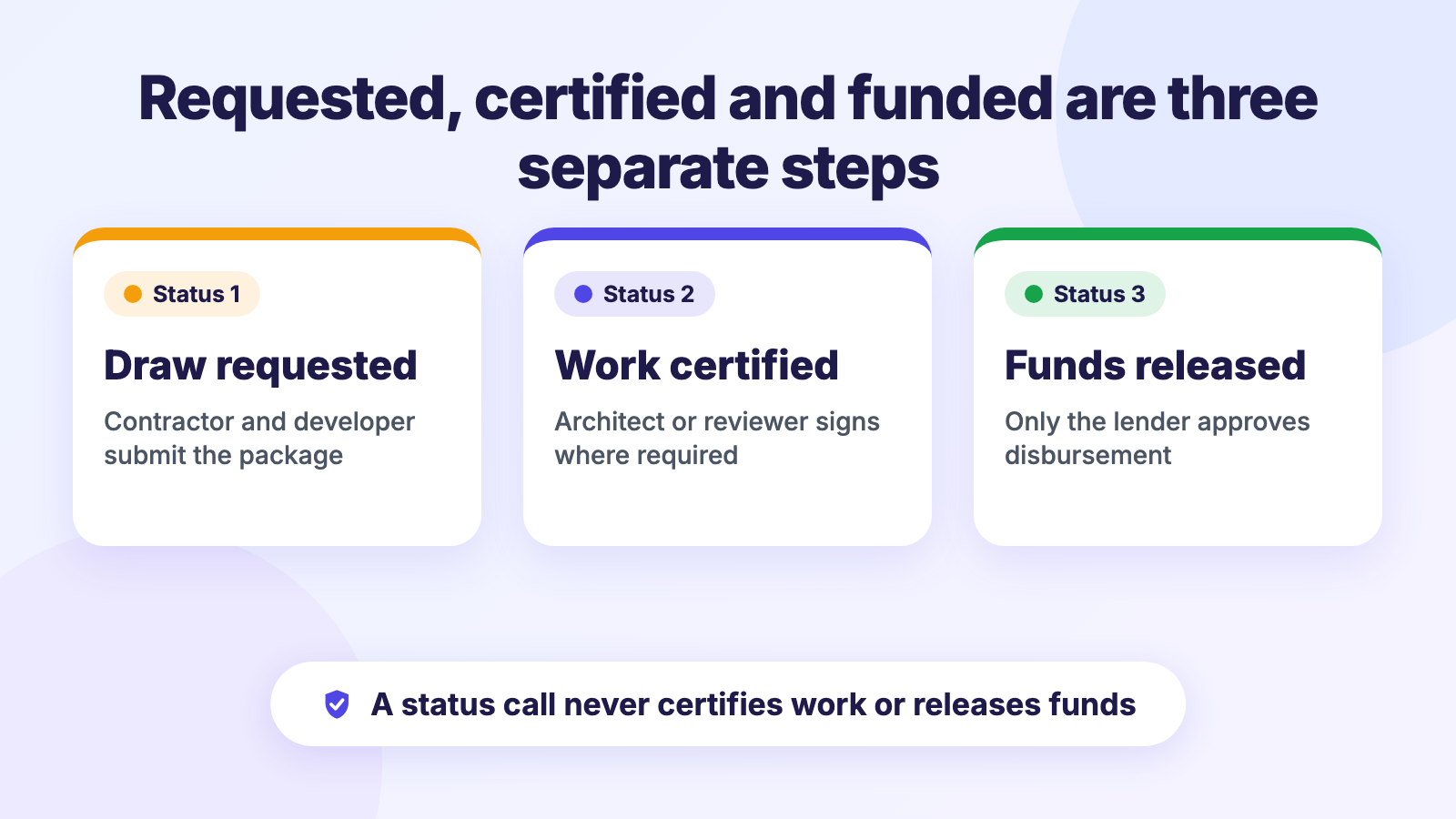
A construction draw request moves through several hands before money is released. A contractor may have finished its portion of the work, but the developer can still be waiting for an updated payment application, an architect’s certification, a lien waiver or a lender inspection. A reliable development draw request document checklist shows what is missing, who owns it, and which decision must be made before the funding request can progress. Scheduled project follow-up calls can collect those status updates; they cannot certify work, authorise a payment or direct a lender to release funds.
For developers coordinating several projects, the challenge is less about making a single phone call and more about maintaining one consistent evidence trail. This guide shows how to build that trail, distinguish administrative progress from approvals, and make each follow-up useful. Requirements are determined by the loan agreement, construction contract, lender and jurisdiction; the workflow below is a planning example, not a universal legal checklist.
Understand which payment process you are tracking
A contractor’s application for payment and a developer’s draw request to a construction lender are related, but they are not necessarily the same document. The contractor seeks payment from a contractual counterparty; a borrower requests a loan disbursement under the construction facility. The lender may require an independent progress review and other conditions before releasing funds. Calling both steps simply ‘draw approved’ hides important differences.
For projects using AIA forms, G702 summarises an application and certificate for payment, while G703 provides the continuation-sheet breakdown by work item. Under that contractual procedure, the architect reviews and certifies the amount due. Not every development uses these forms or appoints an architect to certify payment, so identify the actual contract forms and responsible signatories before building a status board. Lenders typically review supporting documentation and may arrange independent verification of the reported progress before releasing funds.
Start with a document register, not a single completion percentage
Create a distinct item for each requested draw period and a subitem for every required component. A practical register may contain the project and draw identifier, period ending, document type, submitting party, reviewer, contractual due date, received date, version, approval stage, restricted storage link, next owner and evidence of the latest decision. Keep sensitive bank-account and borrower information in the controlled document system, not in a call transcript.
Use understandable, non-overlapping stages such as ‘awaiting contractor document’, ‘under professional review’, ‘ready for lender submission’, ‘submitted to lender’, ‘lender questions outstanding’ and ‘funds confirmed received’. These are suggested labels, not installed Autoza or monday.com defaults. Record the actual lending institution’s terminology where necessary. A file sent by email is not necessarily received or accepted, and a contractor’s claim of completion is not independently verified progress.
Assign owners to the evidence most likely to delay the package
Typical follow-up items include a completed application, the current schedule of values, approved variations reflected in the claimed total, supporting invoices or stored-material evidence, relevant inspection reports, and any lien waivers or statutory declarations required by the governing agreements. A development manager should first read the loan conditions and confirm which documents apply. An indiscriminate checklist can produce unnecessary work or omit the document the lender actually needs.
Give each item one accountable person and a verifier. For example, the quantity surveyor may be responsible for reviewing measured work, while the contractor is responsible for submitting backup. The developer’s finance coordinator can confirm that the required signatures are present, but must not modify or reproduce them. A named reviewer is essential because ‘waiting for approval’ does not identify the person who can unblock the request.
Schedule follow-ups around decision points
A helpful cycle begins before the draw cut-off, not on the submission date. At the start of the period, confirm the contractual submission deadline and the lender’s current document requirements. Several working days before the cut-off, ask owners which evidence is still in preparation. On the agreed review day, check whether the consultant or architect has received the package. Follow up again only when a real dependency changes or a question is unanswered. The same principle applies when you get contractor milestone updates without extra meetings.
For an illustrative development, a contractor’s final valuation is due Wednesday, a consultant review is expected Friday, and the lender package is targeted for the following Tuesday. The scheduled call on Thursday should ask whether Wednesday’s valuation was delivered and whether the consultant identified missing backup. It must not record the draw as certified simply because the contractor says the submission looks complete. Actual timelines must be based on the contract and financing agreement.
Ask narrow questions that generate verifiable answers
A responsible follow-up call could ask: ‘Which draw number and document are you updating?’ ‘What was sent, when, and through which approved channel?’ ‘Who is reviewing it now?’ ‘What correction or signature remains outstanding?’ and ‘What is the next promised date?’ Request a document reference rather than confidential financial details. If the respondent cannot confirm the current status, record ‘verification required’ and refer the question to the authorised coordinator.
When updates are collected through monday.com, keep reported status separate from verified approval. Autoza AI for monday.com offers scheduled check-ins, call summaries and board updates. Whether a particular draw board can use the proposed fields or escalation paths must be confirmed during configuration. A voice update should never overwrite a lender decision or a signed professional certificate.
Handle discrepancies without rewriting the official record
Suppose a contractor reports that an invoice has been corrected but the developer has not received the revised attachment. Retain the current verified evidence status, add a follow-up task to the document owner, and note the report in a restricted progress field. If the architect certifies a lower amount than requested, keep both the submitted request and the actual certificate in the formal record; do not ask an AI caller to reconcile the valuation.
Escalate immediately when the required evidence is disputed, a suspected fraudulent instruction appears, or a confidential account change is requested. Those are human finance and security matters. Avoid placing payment account numbers, personal identifiers, privileged commentary or detailed financial terms in routine phone prompts.
Measure whether your follow-up process is working
The most useful measures are the percentage of packages complete before cut-off, age of unanswered evidence requests, time between submission and review, number of avoidable resubmissions, and time from authorised draw submission to confirmed lender response. Tag delays by document owner and cause, not only by contractor. This helps the team fix recurring preparation problems instead of increasing call volume.
For a broader view of related statutory dependencies, see our guide to permit and inspection follow-up for real estate development projects and browse the AI Workflow Design blog. A well-run draw process gives finance and site teams current information while protecting the signatures, inspections and formal approvals on which the transaction depends.
A practical draw-package checkpoint
Before submitting a draw, the project coordinator should be able to answer six questions: What amount and period are claimed? Which contract valuation is the source? Which required certificates and waivers are current? Have all relevant changes been reconciled by authorised personnel? Which documents have been checked against lender requirements? Who will record the lender’s official response? If any answer is unknown, the package needs an owner and follow-up action, not an assumed green status.
Put routine follow-up on a schedule
For teams managing draw preparation in monday.com, scheduled status calls can reduce repeated chasing of document owners while retaining human sign-off at every financial gate. Explore Autoza AI for monday.com or request a workflow discussion to evaluate which routine check-ins suit your project and how approvals will be protected.
Frequently asked questions
What documents are needed for a construction draw request?
The answer depends on the loan agreement and construction contract. A typical package may include the period-specific payment application, schedule of values, progress evidence, relevant professional certificates, change-order reconciliation and waivers or declarations required by the lender. Use the lender’s actual list rather than assuming a universal set of forms.
Who authorises the release of construction draw funds?
The lender makes the disbursement decision under its financing agreement and internal controls. Contract administrators, architects or quantity surveyors may certify work or payment applications where the contract requires it. A developer coordinator or AI status caller can track the stage but cannot replace those parties’ authority.
Can an AI call confirm that a draw package is complete?
It can collect an owner’s report that documents have been uploaded or submitted. Completeness should be checked by the authorised coordinator against the current lender requirements, and financial approval should remain a separate verified status. A reported upload is not proof of acceptance.
How often should a developer chase payment evidence?
Use the contractual cut-off and next decision date as the starting points. A short check before the package deadline and targeted follow-ups for missing documents are generally more useful than daily calls to everyone. Increase escalation only when an actual dependency threatens submission or funding.
How should draw discrepancies be recorded?
Keep the original claim, reviewer questions, corrected versions and official certificate or lender response in controlled records. Link the board action to the appropriate owner and due date. Do not overwrite disputed values with an informal phone answer or expose bank details in call transcripts.
Related reading
- Tenant Fit-Out Projects: Coordinating Landlord, Tenant and Contractor Actions
- Land Development Utilities: A Follow-Up Plan for Water, Power and Access
- Permit and Inspection Follow-Up for Real Estate Development Projects
- Before Practical Completion: A Punch-List Follow-Up Calling Plan
- How Developers Can Get Contractor Milestone Updates Without Extra Meetings
- Autoza AI for monday.com: scheduled status calls
- Workflow automation services
- Industries we support
- Construction Draw Requests: Track Evidence Before Lender Review