
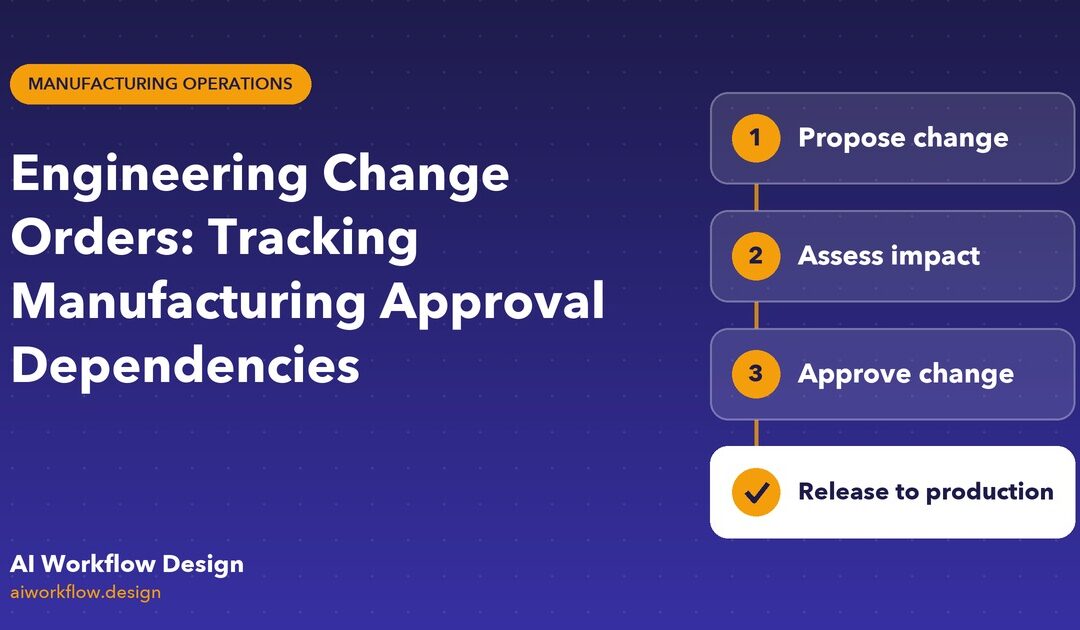
Reliable manufacturing engineering change order tracking follows more than a request to revise a drawing. It connects the change proposal to impact assessment, review authority, controlled document revision, inventory disposition, supplier communication, operator training, and verification of implementation. A line supervisor saying “the new version is ready” is a valuable status update, but it does not release a design change to production.
The practical goal is to make every approval dependency visible without weakening configuration control. A project manager can collect progress from each owner; the authorised engineering, quality, production and customer representatives must still approve changes under the manufacturer’s quality system.
Why an ECO is not an ordinary task update
Suppose a manufacturer changes a bracket hole pattern to address a fit issue. Engineering updates the CAD model, procurement has already ordered the previous revision, and operators are using work instructions that refer to the original dimensions. The supplier may have completed the new tooling, yet production cannot safely assume the change is ready for release. The change affects drawings, material, inspection criteria, fixtures and potentially customer approvals.
NASA’s configuration-management guidance describes engineering changes as revisions to a controlled baseline and emphasises coordination where interfaces or requirements are affected. NASA’s systems-engineering change process similarly distinguishes evaluating a proposed change, obtaining approval, implementing it and maintaining the record. These principles help explain why manufacturers should separate “reported done” from “released for use.”
Begin with a controlled change request
Every engineering change order should link to an original change request or problem statement. Record the affected part and revision, reason for change, product family, proposed effective date, originator, technical owner and required approvers. State whether the change affects form, fit, function, safety, regulatory obligations, service procedures or customer requirements. Classify priority through the existing quality process rather than through a generic AI sentiment score.
Avoid changing documents before impact analysis is complete. A drawing, bill of materials (BOM), work instruction and inspection plan may all need coordinated revision. If a supplier part number changes, procurement should understand which purchase orders and stocked items are impacted. Use a single official revision record and link supporting tasks to it.
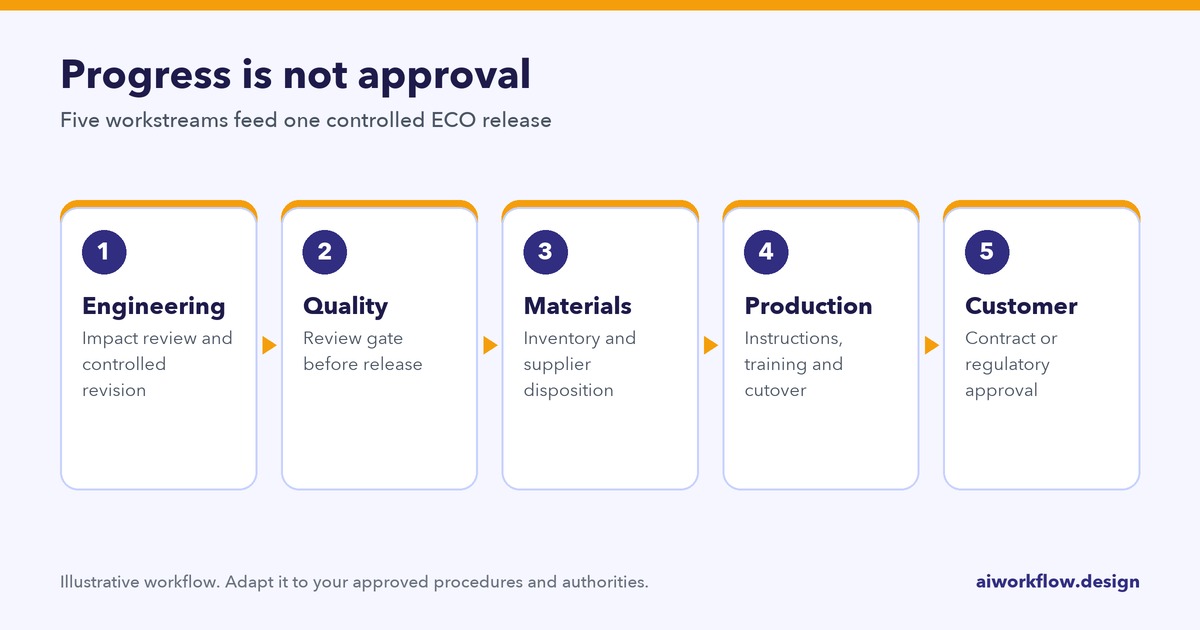
Map dependencies in five workstreams
Engineering: evaluate the proposed change, perform design review, update calculations or drawings, assess interfaces, and produce the controlled revision for approval. The design authority owns the technical decision.
Quality and compliance: assess new inspection criteria, validation requirements, nonconformances, customer submissions and any regulated change documentation. An unresolved quality review should block release where the approved procedure requires it.
Materials and suppliers: identify affected inventory, work in progress, open purchase orders, tooling and outsourced components. Record whether existing stock will be used, reworked, quarantined or disposed of under an authorised plan. Supplier confirmation is not the same as material disposition approval.
Production and maintenance: update routings, operator instructions, fixtures, machine settings and training as needed. Verify that the production site has the correct version before the effective date. Where the change touches safety-critical equipment, the plant’s safety review and permit procedures remain separate obligations.
Customer and commercial: secure customer or regulatory approval when required by contract or sector rules. A project coordinator should track the outstanding decision but should not infer that silence equals consent.
Build a change-control board that distinguishes status from release
A useful monday.com work board might have one parent record for each ECO and subitems for impact assessment, drawing update, BOM disposition, supplier confirmation, training, validation and final release. Suggested fields are ECO ID, Affected part, Old revision, Proposed revision, Impact owner, Approval role, Due date, Evidence link, Status, and Release reference. These are recommended fields, not claims about Autoza’s default configuration.
Use statuses that preserve meaning: Proposed, Under assessment, Awaiting approval, Approved for implementation, Implementation in progress, Verification pending, and Released. Avoid using “Approved” to mean both concept approval and release to manufacturing. The system’s governing documents should specify who can move an item through a formal gate.
For example: “ECO-218 | Bracket assembly | Rev B → C | Quality sign-off pending | Two old-revision work orders open | Planned effective date unconfirmed.” This is an illustrative scenario. The visible blocker is not that the design team failed to respond; it is that inventory and quality approval still control release readiness.
Use targeted check-in calls for dependency collection
An administrative call to procurement might ask: “Have all open purchase orders for the affected part been identified?”, “Is the supplier’s revised component availability confirmed?”, and “Is any material disposition decision outstanding?” A call to training coordination might ask whether revised work instructions have been distributed and which teams still need acknowledgement.
A caller should not ask an operator to approve machine safety, ask a supplier to substitute material outside contract controls, or announce that a design has been released. If someone replies, “We’ve switched to Rev C,” but the controlled approval is incomplete, raise an exception for the engineering and quality owners. Reported implementation outside the process may be a serious issue needing immediate human attention.
The Autoza AI product listing describes scheduled status calls and board updates. Before connecting this to an ECO board, verify the precise field-mapping permissions, permitted statuses and review path with the product team. Protect proprietary drawings and sensitive quality records by keeping them in controlled systems rather than reading them aloud during calls.
The handoff from approval to production
Once approvals are complete, production release still needs a coordinated effective point. Some manufacturers release a revision against serial number, lot, purchase-order date or a future work order. Record the approved cutover method and responsible owner. Verify that older material and instructions are treated in accordance with that decision and that operators can identify the correct revision.
An engineering manager should review the evidence that implementation was completed and the process remains in control. If issues appear during the first run, open the appropriate deviation or corrective-action process; do not retroactively edit the ECO to make the dashboard appear green.
Measure change-cycle quality
Useful measures are average time from proposal to impact analysis, time awaiting individual approvals, number of revision mismatches found after release, incomplete material dispositions, and frequency of reopened changes. Tracking only “days to close ECO” can reward premature closure. Better measurement shows where review bottlenecks occur and whether released changes are correctly implemented.
Good change management is traceable and proportionate. Straightforward documentation corrections should not create needless bureaucracy, but significant design or manufacturing changes need an approved record of what changed, who assessed the consequences, and when the change became effective.
For a closely related workflow, read Pilot Production Readiness: A Follow-Up Plan Before Ramp-Up. You can also explore Supplier Part Shortages: A Manufacturing Follow-Up Matrix for Planners, or browse more industry workflows.
Frequently asked questions
Does a verbal engineering update release an ECO to production?
No. A verbal update may report progress but does not replace the controlled approvals, documented revision and formal release steps required by the manufacturer’s change-control procedure.
Who confirms affected manufacturing inventory?
Materials, planning and quality representatives should identify stock, work in progress and open orders. The authorised disposition authority then decides whether affected inventory is used, reworked, segregated or discarded.
What belongs on an engineering change tracking board?
At minimum, the ECO reference, affected parts and revisions, impact assessments, approvers, supplier and inventory dependencies, training and verification tasks, evidence links, and final release status.
Can an AI caller approve engineering design changes?
No. A caller can collect administrative status from designated task owners when authorised. Engineering, safety, quality, customer and production release decisions require competent human authority and controlled evidence.
How do teams prevent older revisions from reaching production?
Use effective-date and lot or serial cutover controls, update BOMs and instructions, coordinate inventory disposition and confirm that production personnel understand which version applies. Verify completion through the quality system.
Keep ECO follow-up separate from ECO authority
See Autoza AI for monday.com workflows to explore structured status collection for engineering-change tasks. A pilot should use a noncritical, approved workflow and leave design approval, product disposition and production release in the manufacturer’s existing controlled process.
Related reading
- Pilot Production Readiness: A Follow-Up Plan Before Ramp-Up
- Supplier Part Shortages: A Manufacturing Follow-Up Matrix for Planners
- Corrective Action Ownership: Following Up on Manufacturing CAPA Tasks
- AI Calls in Manufacturing: Where Human Safety Approval Must Stay in Control
- How to Follow Up on Manufacturing Project Dependencies Without Daily Chasing