

A manufacturing pilot run readiness checklist should establish whether the people, materials, equipment, instructions and evidence needed for a controlled trial build are genuinely ready. The objective is not to fill a dashboard with green labels. It is to expose missing prerequisites early enough for engineering, quality and production leaders to make a defensible start decision—and to gather enough evidence from the pilot to decide whether volume ramp-up is appropriate.
Status calls can help planners confirm open actions across departments. They cannot approve a new manufacturing process, waive inspection requirements or certify that full-scale production will meet demand and quality targets.
Pilot production is a learning phase, not a ceremonial launch
A new product may look ready when design drawings have been signed and materials are on site. Yet the first trial build reveals that one fixture produces inconsistent alignment, a work instruction omits an inspection step, or the line cannot reliably meet the planned cycle time. Pilot production exists to discover those problems before the organisation commits to larger quantities and customer delivery promises.
The International Aerospace Quality Group’s APQP/PPAP overview explains the role of phased product and process planning and evidence that a production process can meet requirements at a customer demand rate in the aerospace context. The exact approvals differ among industries and customers; the useful general principle is that readiness must be demonstrated through objective process evidence.
Define the pilot’s entry criteria before scheduling it
Agree on what the trial will produce, the intended quantity or duration, acceptable material conditions, test plan, trained roles and expected evidence. Define whether the objective is design learning, process capability, operator training, tooling confirmation, or a combination. Without a clear objective, teams may complete a build yet be unable to say what it proved.
A controlled readiness register should include the pilot part or product, revision, site or line, build owner, planned date, material availability, fixture and equipment state, operator training, test equipment status, approved instructions, risk assessment, and required signatories. Use actual owners and evidence links instead of broad statements such as “Engineering ready.”
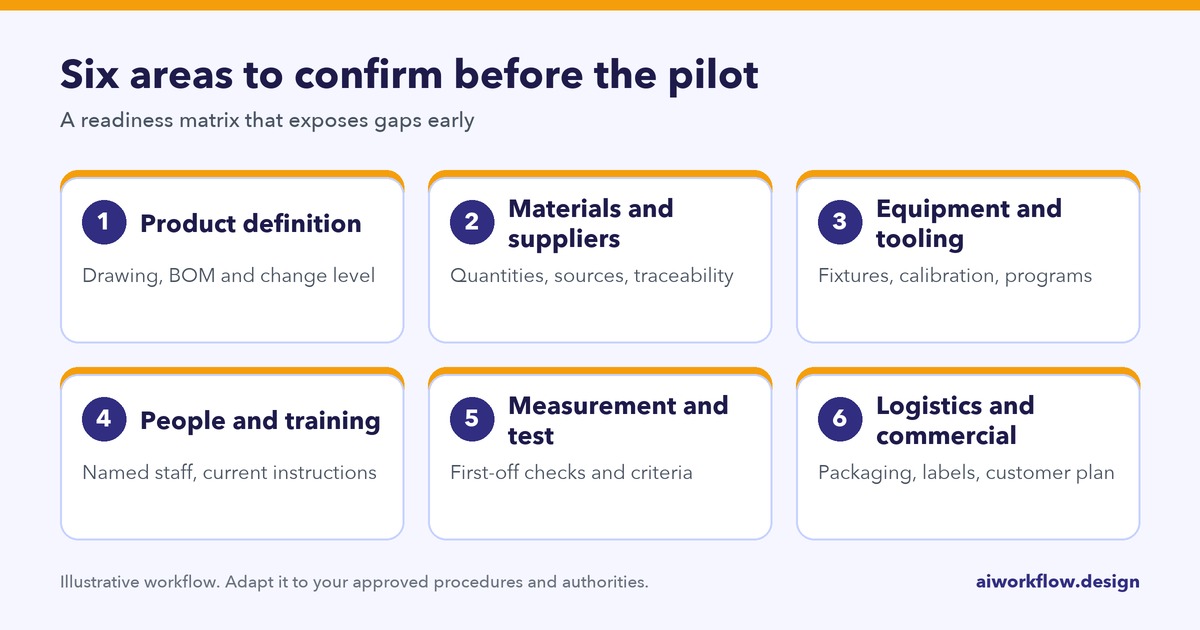
Build the readiness matrix across six areas
1. Product definition. Confirm that the team is working to the correct drawing, BOM, specification and current change level. All deviations needed for a trial must be reviewed under the site’s quality system. A design revision discussed in a meeting is not a substitute for a controlled engineering release.
2. Materials and supplier readiness. Check required quantities, approved sources, traceability, lead times and handling conditions. Differentiate material received from material inspected and released for the relevant build. If a substitute component is proposed, route it through approved technical and customer controls.
3. Equipment and tooling. Confirm fixture condition, maintenance status, programming revision, calibration where required and any safety-related prerequisites. The line supervisor and relevant safety authorities decide whether equipment may be operated; the pilot tracker merely records that the approval evidence exists.
4. People and training. Name the operators, technicians, inspectors and support personnel. Confirm they have the current work instructions and understand escalation points. A training attendance record is not necessarily proof of competence for a specialised process; apply the site’s required qualification method.
5. Measurement and test evidence. Define which first-off checks, capability studies, functional tests, inspection records and acceptance criteria are needed. Ensure that gauges and test systems are available and appropriate. Quality must decide whether results satisfy the process requirements.
6. Logistics and commercial coordination. Verify packaging, material movement, traceability labels, customer communication and the plan for pilot output. Pilot parts should not automatically be shipped as saleable production units without appropriate release and disposition.
Use a readiness board with explicit hold points
A monday.com task register can record parent items for each readiness area and subitems for the actual evidence. Suggested columns include Readiness gate, Task owner, Evidence required, Reported progress, Validation owner, Due date, Hold reason, and Go/no-go decision. Label the fields so everyone can see when a step is awaiting an authorised decision.
A useful set of statuses is Not started, In progress, Evidence submitted, Validation pending, Accepted, and Hold. A test result that arrives late should not silently flip the gate to Accepted. Where the organisation uses formal manufacturing execution or quality management systems, those systems retain authoritative approval records; the project board can link to them.
Schedule calls by dependency, not by the clock alone
Three days before a pilot, administrative check-ins might confirm that the required material and calibration records are available. The day before, call only owners with incomplete readiness tasks. On the morning of the build, the coordinator can collect a final list of unresolved administrative dependencies for the responsible production manager.
Ask short questions tailored to each role. For procurement: “Are the specified quantities of approved parts received, or is a shipment still outstanding?” For maintenance: “Is the fixture-preparation task completed and recorded?” For quality coordination: “Have the agreed inspection documents been issued to the inspectors?” If an owner reports a safety problem, nonconformance or missing approval, escalate immediately through the proper process instead of arguing about dates.
The AI Workflow Design products page describes scheduled status calls and task updates for monday.com users. Configure any pilot workflow to capture administrative answers only, using approved fields and an exception queue. Do not ask recipients to disclose confidential process parameters or make a go/no-go decision over an automated call.
What the pilot itself should record
Before the first part is processed, the production manager confirms that required entry conditions are met according to the site’s operating procedures. During the build, the team records quantities, defects, cycle times, equipment issues, workarounds, material consumption and deviations as appropriate. Test results should be attributed to the responsible inspector or engineer with links to controlled evidence.
At the end, a cross-functional review examines the findings. Questions include: Were the intended acceptance criteria demonstrated? Which defects were unique to the pilot setup and which suggest a systemic process weakness? Were operators able to follow the instructions without unofficial shortcuts? Are suppliers and capacity assumptions still credible?
If the pilot fails an essential criterion, assign corrective actions and define the verification needed before another build or ramp-up. “Pilot complete” means the exercise happened; it does not automatically mean the process passed.
Decide whether ramp-up is authorised
The final ramp-up decision should use an approved review package. Depending on the operation, that may include capability data, inspection and test results, validated tooling, operator qualifications, updated risk controls, accepted deviations, customer submissions and supply-chain capacity. The approval authority varies by site, product and contract.
For example, a team might finish a pilot on the planned day but still have an open gauge repeatability issue. Reporting “Build complete, quality review open” is accurate. Reporting “Production ready” would be premature. A useful project board protects this distinction and makes the next decision visible.
Turn pilot findings into the next controlled action plan
After the review, capture each issue with an owner, due date, evidence requirement and retest plan. Reconcile the approved instructions and control documents so the next shift does not inherit unofficial pilot adjustments. Review whether capacity and lead-time forecasts require updating, and communicate only authorised commitments to customers.
The key readiness metrics are not just pilot start date and number of calls made. Track unresolved entry criteria, evidence acceptance, first-pass yield where meaningful, critical process deviations, rework causes, and the time needed to close pilot findings. Those measures help management decide whether the process can scale reliably.
For a closely related workflow, read Engineering Change Orders: Tracking Manufacturing Approval Dependencies. You can also explore Production Changeovers: How to Track Each Owner Before the Next Shift, or browse more industry workflows.
Frequently asked questions
What is the purpose of a manufacturing pilot run?
A pilot run tests aspects of product and process readiness under controlled conditions, identifies gaps, and generates evidence for a later decision about production release or ramp-up.
What belongs on a pilot production readiness checklist?
Include approved product revisions, materials, tooling, equipment and safety prerequisites, trained staff, work instructions, test and inspection plans, traceability requirements, and accountable sign-off roles.
Does completing a pilot automatically approve full production?
No. The responsible engineering, quality, operations and customer authorities review evidence against their own approval criteria before authorising any larger-scale release.
Who should own a pilot run readiness board?
A designated programme or production lead coordinates the board, while engineering, quality, maintenance, materials and operations owners remain accountable for their specialist checks and approvals.
Can scheduled AI calls replace pilot readiness meetings?
They can reduce routine chasing by collecting authorised task-status updates. They do not replace risk reviews, qualified technical validation, safety clearance or the final ramp-up decision.
Coordinate your next controlled readiness review
Explore AI Workflow Design’s scheduled project updates to see where routine check-ins could support your manufacturing readiness board. Start with a clearly bounded administrative workflow, keep acceptance evidence in your approved systems, and make every final production decision traceable to a responsible human.
Related reading
- Engineering Change Orders: Tracking Manufacturing Approval Dependencies
- Production Changeovers: How to Track Each Owner Before the Next Shift
- Equipment Installation Projects: A Status Call Plan for Plant Teams
- Quality Inspection Follow-Up Calls: What Information Should Be Recorded?
- Planned Plant Shutdowns: Confirm Parts, Contractors and Work Packages