
A backup success notification does not prove that a business can restore the service it depends on. A useful backup recovery test checklist asks whether the right recovery scenario was tested, whether data integrity and application functionality were checked, whether evidence was retained, and who authorised the result. Task-owner follow-up matters because a restore exercise can involve infrastructure engineers, application owners, security staff, vendors and business representatives who each hold a different piece of the proof.
Scheduled status calls can reduce administrative chasing between those teams. They do not run a restore, certify data integrity, or declare a system recovered. The exercise should remain in the hands of qualified technical and business authorities.
Why “backup completed” is an incomplete answer
An MSP may have nightly backup job reports for every server, yet the first full restore exercise discovers that an application requires an undocumented licence key or that a dependent database cannot be brought online with the restored image. In another case, the data returns but the finance application fails a functional test. Both situations illustrate why an exercise must verify more than the presence of backup files.
NIST SP 800-34 Revision 1 covers contingency planning and the relationship between planning, testing and recovery responsibilities. CISA’s ransomware guidance advises maintaining and testing backups as part of resilience planning. Together, these are useful foundations for a recovery exercise that documents technical findings rather than accepting verbal reassurance.
Define the recovery scenario and test boundary
Before calling anyone, decide which recovery objective is under examination. Is the task to recover a deleted file, rebuild a server, recover a database to a designated point, or demonstrate that an entire application can function after a site failure? Different scenarios require different evidence and personnel. Document the test environment and ensure that the exercise cannot accidentally overwrite production data.
Record the targeted Recovery Time Objective (RTO) and Recovery Point Objective (RPO) where the organisation has approved them. RTO is the tolerable time for restoring a service; RPO is the tolerable data-loss window expressed as time. Both are business requirements, not automatically guaranteed by the chosen backup product. If no agreed targets exist, highlight that governance gap instead of inventing thresholds.
Create a controlled exercise record containing the system and application names, accountable owner, recovery scenario, intended restore point, dependencies, approval to begin, test window, evidence location and sign-off method. Keep sensitive recovery instructions, credentials and backup locations in the secure operating documentation—not in general-purpose AI transcripts.
Assign ownership across the full exercise
The infrastructure lead owns the technical restoration steps. An application owner verifies that critical workflows function. A security representative confirms that appropriate security checks were completed, including assessing whether data might be compromised. A business owner accepts whether the recovery objectives were demonstrated. The service delivery manager coordinates the schedule and exceptions; that role should not simply rubber-stamp all technical findings.
For a cross-system test, divide the main board item into recoverable tasks such as “Recover test database,” “Validate application login,” “Reconcile representative transactions,” and “Record acceptance.” Link the test evidence for each step. This task structure can be implemented in a monday.com-based work management process, but ensure the actual field mappings and approved call behaviours are tested before production use.
A practical backup restore test checklist
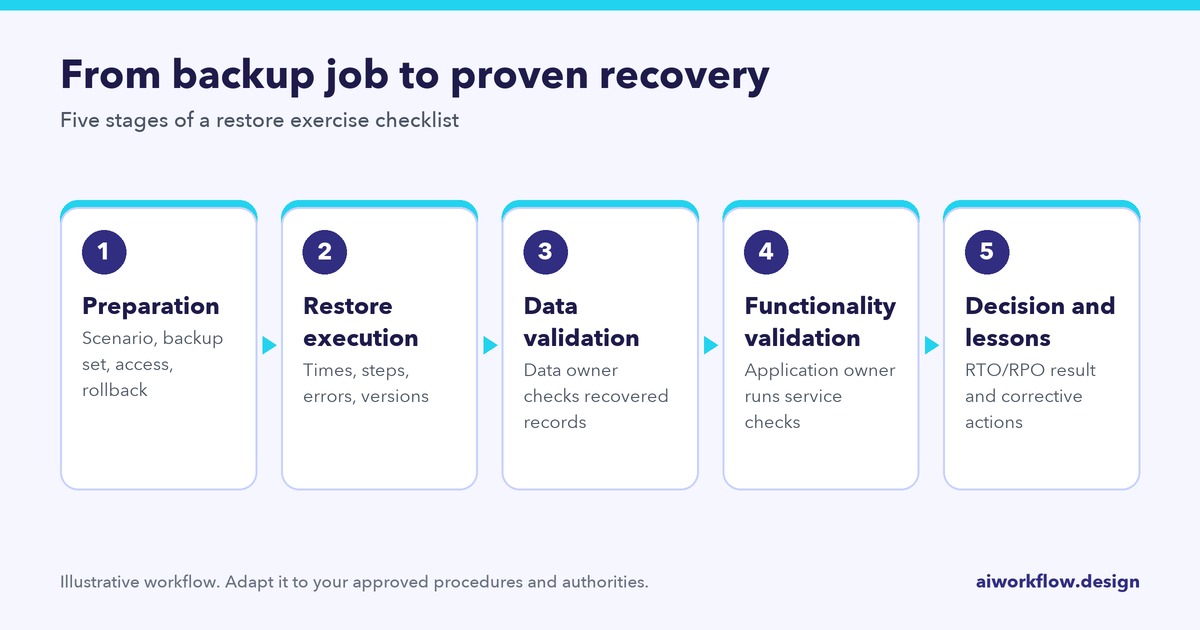
Preparation: confirm the scenario, backup set, restoration location, system owners, test data classifications, access approvals and rollback plan. Check that the people performing the work are trained and have the required access. Testing should not begin on a live system simply because a calendar reminder fired.
Restore execution: record the time restoration started, the steps attempted, tooling errors, recovered version or timestamp, and any missing dependencies. An engineer’s verbal “restore finished” is progress information; it is not the exercise result.
Data validation: have the designated data owner compare selected records, consistency checks, log positions or other approved evidence. Use the application-specific test plan. If the team cannot determine whether the restored data is complete enough, the exercise should remain unverified.
Functionality validation: the application owner runs representative business transactions or service checks. Restoring files successfully while users cannot authenticate or transact is a partial outcome, not a passed end-to-end exercise.
Decision and lessons: an authorised manager documents achieved RTO/RPO, unresolved exceptions, corrective actions and whether the test met its acceptance criteria. A failed or partial exercise is useful evidence when documented accurately; it should not be silently relabelled “passed” to complete a dashboard.
Use task-owner calls for the parts that can be safely delegated
A scheduled call can ask an engineer whether the authorised test step has started, whether evidence has been uploaded, whether a dependency is blocking the next test, and when a status update will be available. For an application tester, it can ask whether the assigned test cases were run and where results are recorded. For a business owner, it may request a meeting time to review evidence—not a verbal declaration that the system is safe to resume.
A suitable administrative script is: “This is the approved project follow-up for the restore exercise. Is your assigned validation step complete, blocked, or still underway? Do you have a test-record reference? What is the next expected update time?” The call must not ask the participant to disclose administrator passwords, recovery keys, backup vault locations, security findings or personal data.
The AI Workflow Design products page describes scheduled calls, summaries and updates to existing work systems. Use mapped board fields only for permitted, low-sensitivity status information. Actual backup validation and recovery acceptance should stay in the organisation’s approved technical records.
Handling ambiguous or failed updates
Differentiate these statuses: Not started, Running, Technical step completed—validation pending, Evidence under review, Accepted, and Blocked. If an engineer says “done” but cannot name which test completed, leave the item under review. If the application owner is unavailable, log an unconfirmed outcome and escalate to the delivery manager; do not infer success from silence.
Where a test produces concerning results, raise a technical incident or problem record under the MSP’s existing procedures. That process may have faster escalation requirements than the project follow-up schedule. A routine AI caller should never delay security incident response or alter recovery priorities on its own.
Measure resilience readiness, not attendance at calls
Useful measures include the percentage of scheduled recovery scenarios executed, evidence completeness, observed versus target recovery time, observed data-loss point, open remediation actions, and repeat failures across successive exercises. Record test dates and accountable acceptors. Avoid presenting a team’s response rate as proof of operational resilience.
Conduct periodic reviews with the customer: which systems are still untested, which dependencies were discovered, and whether the plans reflect current infrastructure? A backup recovery test is valuable when the findings improve the next recovery attempt, not merely when all board cells turn green.
For a closely related workflow, read Third-Party IT Vendor Delays: A Dependency and SLA Escalation Plan. You can also explore Post-Deployment Follow-Up: Questions to Ask Before an IT Project Handover, or browse more industry workflows.
Frequently asked questions
What does a backup recovery test checklist verify?
It should verify that an agreed scenario was executed, the intended data and application services were restored, evidence was recorded, and qualified personnel assessed results against predefined acceptance criteria.
How is a backup test different from a restore exercise?
A backup job test may confirm backup creation or integrity checks. A restore exercise goes further by recovering data or services and testing whether they operate as required in a controlled environment.
Who should approve the outcome of a restore exercise?
The organisation should name technical validators, application owners and the accountable business or recovery authority before testing. The coordinator can collect their evidence but should not replace their approval.
Can AI status calls test whether a backup is recoverable?
No. Calls can collect administrative progress and flag missing evidence. Recovery, data consistency verification, functional testing, and a decision to resume service require specialised technical steps.
What should happen if a restore exercise misses its target?
Record the actual outcome, identify root causes and assign remediation owners. Review recovery objectives and dependencies with the business before scheduling a retest; never mark the exercise passed solely to meet a reporting deadline.
Make recovery follow-up measurable
If your MSP already uses monday.com, review Autoza AI’s scheduled check-in approach for collecting routine exercise updates. Start with a low-risk tabletop or test-environment workflow, enforce data minimisation, and require human validation of technical evidence before accepting a recovery result.
Related reading
- Third-Party IT Vendor Delays: A Dependency and SLA Escalation Plan
- Post-Deployment Follow-Up: Questions to Ask Before an IT Project Handover
- IT Change Windows: When Should a Project Manager Schedule Follow-Up Calls?
- Vulnerability Remediation Projects: Track Action Owners Without Exposing Findings
- Cloud Migration Readiness Calls: How to Chase Dependencies Before Cutover