
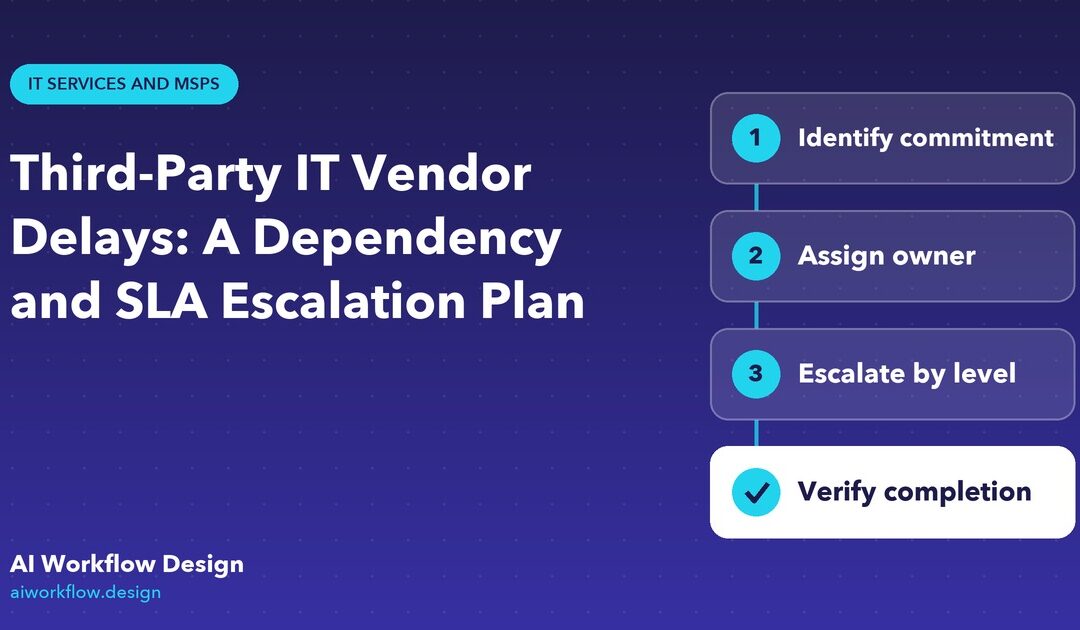
The most effective IT vendor SLA follow-up workflow separates two issues that are often confused: the vendor’s contractual service obligation and the project dependency waiting on that vendor. A supplier may be meeting the response-time target on a support ticket while an implementation milestone remains at risk. Conversely, a vendor might be late responding to a routine request that does not affect the critical path. The project manager needs a factual record of both, plus a clear decision about when and how to escalate.
A practical plan defines owner, deliverable, SLA reference, due date, downstream impact, evidence, and escalation authority. Scheduled calls can collect progress updates, but must not change contract terms or declare service-level breaches without review.
Start by identifying the type of vendor commitment
An MSP coordinating a CRM integration may depend on a third-party connector provider to enable an API feature. The provider’s support SLA might promise an initial response within a stated interval, but the project plan requires a tested integration before training begins. Those are different commitments. The response SLA concerns the support service; the milestone concerns a specific delivery outcome.
A vendor tracker should therefore carry both a service ticket ID and a project dependency ID. Store the contracted service levels and exclusions in the approved vendor-management repository, not in a general calling script. A status of “ticket acknowledged” should never be converted into “dependency resolved.”
Guidance on cyber supply-chain risk management reinforces the need to identify and mitigate risks introduced by third-party products and services. The exact contractual duties still depend on the agreement. Project staff should not invent breach notices or assert legal remedies simply because a task has gone overdue.
Define ownership before the first escalation
The project delivery lead owns the impact assessment: what milestone is blocked, what work can continue, and when the project baseline needs revisiting. The vendor relationship manager owns supplier contact and contract interpretation. The service desk owns the operational incident or support ticket. The customer sponsor approves material changes to delivery cost or schedule according to the project governance.
If a single organisation fills several of these roles, record the role separately on the board. A named person can be both project owner and vendor relationship lead, but the evidence and approvals for each responsibility are distinct.
Use one parent work item for the blocked dependency, with subitems for “Vendor response,” “Customer-side prerequisites,” “Integration test,” and “Go/no-go review.” Include the supplier ticket, environment, agreed target date, next call date, impact category, escalation level and link to the contractual record. This is a suggested monday.com board design, not an out-of-the-box Autoza template.
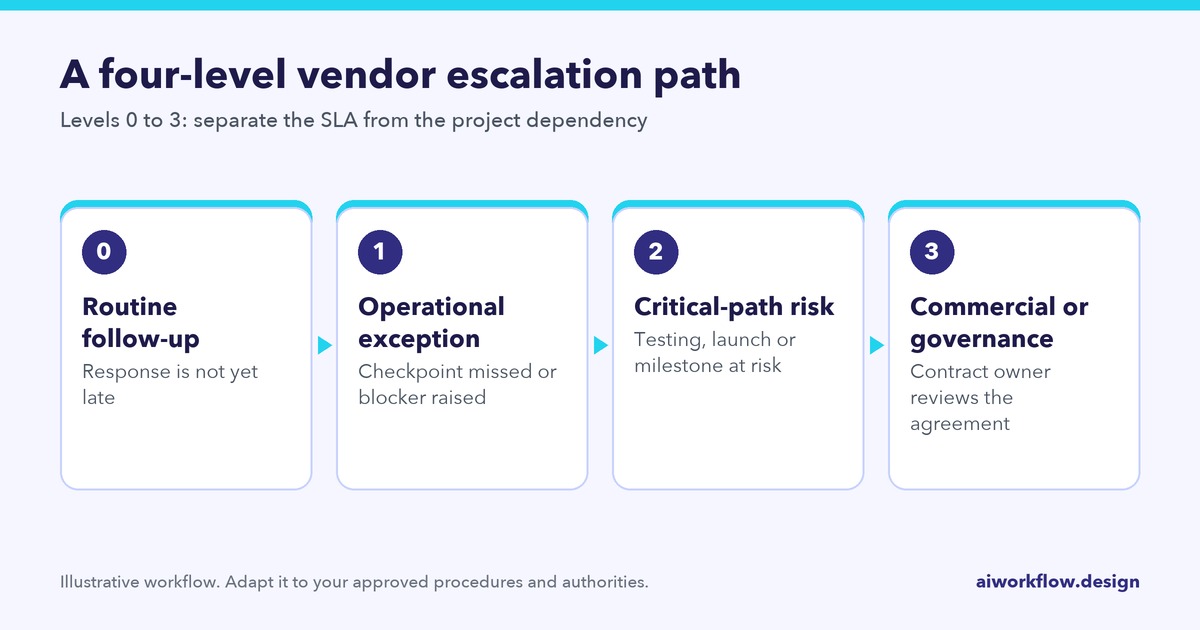
Establish a four-level escalation path
Level 0: routine follow-up. The expected response is not yet late. Confirm that the supplier has the correct problem statement, logs shared through approved channels, and a named contact. Ask for the next update, not a guarantee that the issue will disappear.
Level 1: operational exception. The expected response or delivery checkpoint is missed, or the vendor reports an unresolved blocker. Notify the service owner, document the actual commitment and contact the vendor using the normal support route. Verify whether any SLA clock is paused by customer action, maintenance windows or contract exclusions.
Level 2: critical-path risk. The missed dependency threatens testing, launch, a contractual milestone or a security-related requirement. The delivery manager reviews alternatives, the revised forecast and any customer decisions needed. This step should trigger an explicit internal risk review, not simply more frequent automated calls.
Level 3: commercial or governance escalation. The vendor manager or authorised contract owner reviews the situation against the agreement. Formal breach notices, credits, payment disputes or contract termination decisions belong to authorised parties and legal review where relevant. Do not delegate them to an AI voice assistant.
Define what triggers each level in writing. A high-severity cybersecurity incident may require immediate incident-response escalation outside this project hierarchy; it should not wait for the next daily check-in.
Separate vendor-reported status from independent verification
A vendor says an API connector is fixed. The project board may capture “Vendor reports fix deployed,” but the customer integration owner must still perform the agreed test. Only then should the dependent project task be marked validated. The same distinction applies to hardware deliveries, security attestations and software licence enablement.
Use statuses such as Waiting on vendor, Vendor update received, Customer action needed, Ready for validation, Verified, and Escalated. Include a note for the source of each update: a ticket response, authorised call summary, change record or test result. Avoid false precision: if the supplier says “early next week,” record the uncertainty and request a confirmed date.
Example follow-up script for a third-party vendor
A permitted administrative call might say: “I’m calling on behalf of the project delivery team about dependency INT-42. Is the agreed configuration change complete, in progress, or blocked? Is the previously supplied update date still accurate? Which reference should our technical owner use for verification?” The project owner can then compare the answer with the vendor’s ticket or portal record.
Do not ask the supplier to disclose passwords, vulnerability details, personal customer records or confidential commercial terms over an unapproved calling channel. If an unrecognised person answers, do not reveal sensitive project information. Call identification, consent, recording and working-hour requirements should be reviewed for the relevant jurisdictions and recipient types.
The AI Workflow Design product overview describes AI status calls with logged summaries. A vendor pilot should use only approved low-risk questions and human review of ambiguous answers. The team must confirm whether external vendor contacts, numbers and response fields are supported by its specific product configuration.
Build a dependency dashboard people can trust
Helpful dashboard fields include: Dependency, Vendor, Contract owner, Ticket reference, Due milestone, Latest vendor-reported status, Verification owner, Schedule impact, Next escalation decision, and Last evidence date. A red status should represent a defined risk or overdue obligation, not simply an unanswered call.
A short weekly review should ask which blocked dependencies affect the critical path, which customer actions can remove a vendor excuse for delay, and which supplier commitments need revised estimates. If several issues depend on the same provider, consolidate the governance conversation while keeping separate technical evidence for each deliverable.
Improve outcomes without inflating escalation volume
Track elapsed time waiting on vendors, the number of critical-path milestones at risk, time from a vendor’s “complete” claim to customer verification, and aged escalations. Also review how many calls generated meaningful new information. More follow-up is not always better: one concise request to the right contact may be more effective than five repetitive interruptions.
A clear escalation plan protects the working relationship and makes customer reporting credible. It shows when a supplier was contacted, what they actually said, what the contract requires, and what the project team did next—without treating a status update as a legal conclusion.
For a closely related workflow, read Backup Restore Exercises: A Task-Owner Follow-Up Checklist. You can also explore IT Service Tickets vs Project Tasks: Which Updates Belong on a Call?, or browse more industry workflows.
Frequently asked questions
When does a vendor delay become an SLA escalation?
When the facts meet a defined contractual or operational trigger after relevant exclusions and prerequisites are checked. Project schedule risk can warrant internal escalation before a formal service-level breach occurs.
How can MSPs track third-party integration dependencies?
Use unique dependency IDs linked to support tickets, named owners, required validation steps, milestones, and next-action dates. Keep vendor-reported completion separate from the customer’s acceptance test.
Is a missed project deadline automatically an SLA breach?
No. A response-time or availability SLA may measure something different from the project milestone. The contract owner must review the actual terms and evidence before claiming a breach.
Can an AI caller escalate a vendor contract dispute?
It can alert a human when predefined administrative triggers are met, if authorised. It should not issue legal notices, renegotiate terms, impose penalties or determine liability.
What should happen when the vendor says the work is finished?
Record the vendor’s claim, identify the agreed evidence, and ask the technical or business owner to validate the deliverable. Change the verified project status only after the appropriate confirmation.
Map your vendor follow-up workflow
Explore AI Workflow Design’s project calling products if your team spends too much time requesting routine vendor status. A scoped pilot can test whether administrative calls improve update timeliness while keeping contracts, technical validation and escalation decisions firmly with your authorised owners.
Related reading
- Backup Restore Exercises: A Task-Owner Follow-Up Checklist
- IT Service Tickets vs Project Tasks: Which Updates Belong on a Call?
- IT Change Windows: When Should a Project Manager Schedule Follow-Up Calls?
- Cloud Migration Readiness Calls: How to Chase Dependencies Before Cutover
- Multi-Site Software Rollouts: A Device Readiness Check-In Plan
- Major IT Incidents: Coordinate Customer Updates and Follow-Up Actions