
Quick answer: Multi-site solar installation tracking works best when every location reports the same core milestones while retaining local permit, access and interconnection requirements. Contractor calls should surface capacity and blockers; authorised project leads approve schedule changes.
Installing solar systems at one site is an operational challenge. Delivering ten sites at once adds a second problem: every project competes for the same crews, lift equipment, materials, inspectors and management attention. Multi-site solar installation tracking should make that competition visible without pretending each municipality, property and utility follows an identical process.
The practical answer is a portfolio view built from one common milestone vocabulary, site-specific readiness gates and concise owner check-ins. The central programme manager needs to know which sites can proceed next week, which depend on one scarce specialist, and which are waiting on a permit or grid decision that the contractor cannot control.
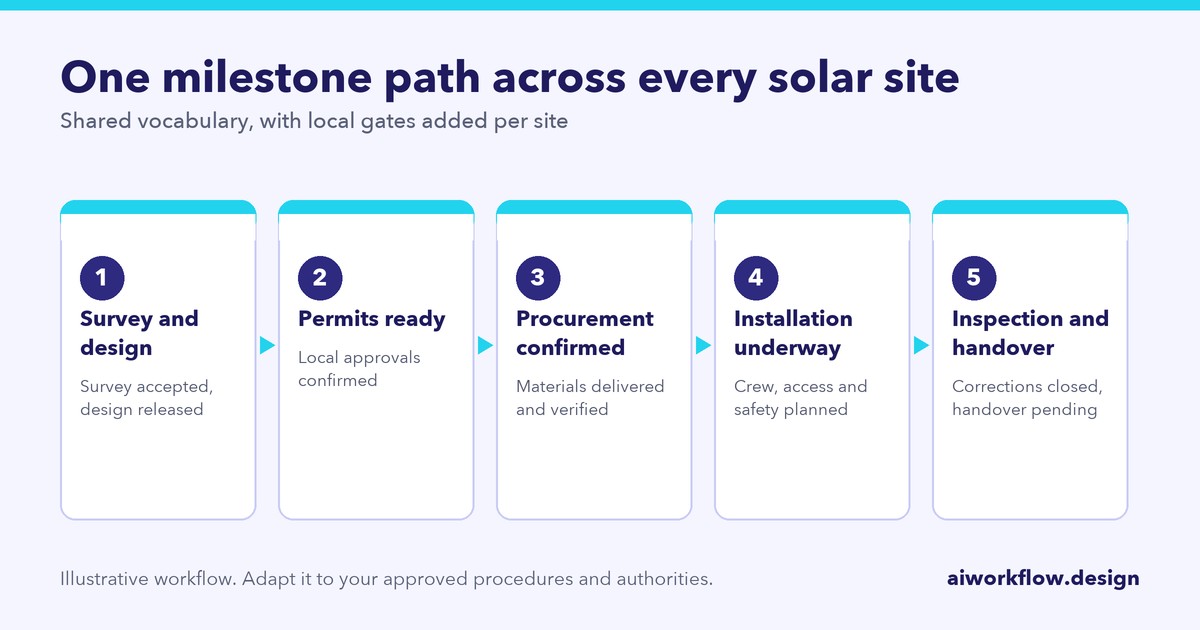
Define portfolio milestones without erasing local differences
Use a common sequence—survey accepted, design released, permits ready, procurement confirmed, access and safety planning complete, installation underway, inspection requested, corrections closed and handover pending. Then allow each site to add local gates. One rooftop may require landlord access; another may have a ground-mount civil package; a third may wait on a utility interconnection date.
A common status such as “installation ready” should mean the site passed its own documented entry requirements. Do not mark every project green just because the same generic checklist was completed. The DOE’s commissioning guidance reinforces why testing and documentation must be planned as part of the project lifecycle, not left until the equipment is installed.
Map contractor capacity by capability, not headcount alone
A portfolio planner needs more than “six people available.” Record the crew’s location, required competency, equipment dependencies, confirmed dates and site assignment. A roof team may not be interchangeable with an electrical commissioning specialist; a subcontractor assigned to a reinspection cannot necessarily start a new site the next morning.
An illustrative resource board can show crew ID, trade, qualified lead, current site, next available date, committed work package, travel time allowance, material prerequisites and conflict flag. Use a named person to confirm allocations before telling customers the new schedule. Contractors may report tentative availability over the phone, but only the authorised scheduler can accept a changed commitment.
Ask the same core questions at every site
A short check-in should establish: What work was finished against the current task? Which crew will attend next? Are the approved materials onsite? Is roof or ground access cleared? Are inspections or authority decisions holding progress? Is the completion date still credible, and what evidence supports the answer? Ask only the questions relevant to that contact and work package.
A useful outcome distinguishes confirmed, reported but unverified, blocked, awaiting external authority and no response. Those categories are more informative than a generic “on track.” For example, “module delivery expected Wednesday” is not the same as a confirmed delivery receipt; “inspection requested” is not an inspection passed.
Prioritise calls around scarce resources and irreversible milestones
Portfolio-wide daily calls to every worker create noise. Prioritise tasks with a near-term dependency, a shared contractor or a consequential missed date. A weekly survey follow-up may be sufficient during planning; a next-day delivery check may be appropriate before a crane booking; a formal exception escalation is better than repeated calls when a utility decision is overdue.
Build a call priority score around milestone proximity, uncertainty, downstream cost of delay and available alternatives. Use it as a planning aid, not an automated safety or contract decision. If a crew is missing, do not infer that the workers are absent from one unanswered call. Instead, flag that site as awaiting confirmation and route the issue to its project manager.
An illustrative example across three solar sites
Imagine Site A has a confirmed crew but an unverified inverter delivery; Site B has all materials but a pending building-access permit; Site C has approval to install but the specialist electrician is allocated elsewhere. A uniform weekly status update would label all three “in progress.” A dependency-based approach produces useful actions instead: procurement confirms the delivery receipt for A; the property contact supplies access approval for B; the operations director makes a verified resource decision for C.
In a shared tracker, the portfolio manager can review these exceptions in one meeting without asking every contractor to recite the full project history. That is the point of a consistent call-and-update process: less time recovering basic facts, more time resolving actual blockers.
Structure the monday.com portfolio with local accountability
Use a master programme board with linked site records or an agreed set of site boards. Suggested fields include site ID, jurisdiction, required permit, grid contact, phase, next milestone, contractor owner, next confirmed crew date, material receipt evidence, current blocker, responsible reviewer and call follow-up date. If the local authority or utility has not responded, preserve that external dependency rather than attributing the delay to the installation contractor.
Any mapped status update needs a narrow rule, for example “contractor said material arrived; project manager verification required.” Final statuses such as permit approved, inspection passed, energised or project accepted should be supported by the relevant official evidence, never by a caller’s interpretation.
Make an escalation plan before a schedule slips
Define who resolves capacity conflicts, who communicates with the customer, who may approve contract changes and who liaises with utilities and regulators. A deadline slip can have commercial consequences, so a field worker’s estimated date must not become an authorised contract extension. Escalation should include the affected site, evidence, options and a decision deadline.
Keep a two-way communication channel: contractors can correct an inaccurate task record, but should not edit other sites’ confidential allocation or pricing data. Schedule calls for appropriate local hours and comply with applicable disclosure, recording and opt-out rules. This matters especially when a national contractor works across time zones.
Use Autoza for administrative visibility, not technical authorisation
For teams already on monday.com, Autoza AI offers scheduled calls, summaries and board updates. A portfolio can test it for narrow, authorised project-status questions, provided the field mapping and call rules are reviewed before deployment. Do not assume a standard product configuration includes contractor capacity optimisation or multi-site resource scheduling; those are recommended process designs for the customer’s boards.
Begin with three sites and one type of resource conflict. Measure missing updates, late confirmations, escalation time and avoidable repeated calls. Then adjust the cadence. The result should be a portfolio where every site has a credible next action, without collapsing all local permits, safety gates and approval chains into one misleading green indicator.
Frequently asked questions
How should a solar portfolio prioritise calls?
Start with sites facing near-term milestone deadlines, shared crew conflicts, missing critical materials or decisions that block downstream work. Reduce routine calls where evidence is already current and escalate unresolved authority issues to the responsible manager.
What site differences need local review?
Permitting, utility connection rules, structural conditions, access agreements, inspections, weather constraints and contractor qualifications vary by location. Keep a common milestone language but document each site’s specific release requirements.
Who approves schedule changes?
The person with delegated scheduling and contractual authority, usually the project or programme manager after coordinating with the contractor and customer. A verbal availability update is evidence for a decision, not the decision itself.
Can one monday.com board track multiple solar sites?
A team can choose a portfolio board linked to site records or individual site boards. Whichever model is used, each site should retain its owner, next milestone, evidence links, local approvals and blockers.
How often should field crews receive status calls?
Base the cadence on site risk and the work phase. Weekly during early planning may suffice; short checks before deliveries, crew transitions and inspections are often more useful. Respect consent, local calling hours and worker availability.
See the monday.com project follow-up workflow
For scheduled status calls and controlled updates to an existing project board, explore Autoza AI for monday.com. Request a workflow review to confirm call scope, field mappings, consent requirements, limitations and human escalation rules before deployment.
Related reading
- Battery Storage Commissioning: A Safety-First Documentation Follow-Up Plan
- Solar Site Surveys: Check Roof, Shade and Access Readiness Before Design
- Daily Solar Installation Crew Check-Ins: What Should Managers Ask?
- Solar Permitting and Inspection Follow-Up: A Project Manager Checklist
- Interconnection Delays: How to Follow Up on Outstanding Solar Project Tasks
- Explore workflows by industry
- Autoza AI for monday.com