

Quick answer: A responsible staffing background check status follow-up workflow confirms whether required notices and permissions are complete, a screening vendor has reported a process milestone, and an authorised reviewer has the necessary material. It never requests criminal-history details over a routine check-in, evaluates the applicant or changes an employment decision. Separate administrative progress from the employer’s legal review and any required adverse-action process.
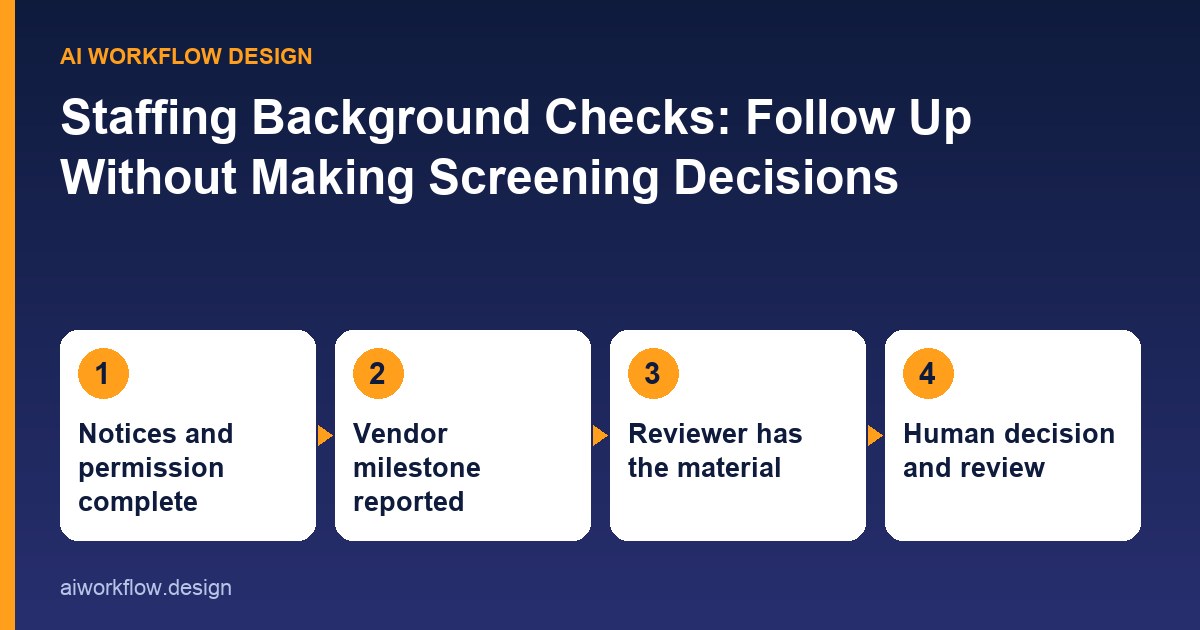
A staffing coordinator may be asked, “Is the candidate cleared yet?” That sounds like a simple status question, but it can conceal three different issues: the screening provider has not finished gathering records; a result is available for confidential review; or the client has yet to follow its documented decision process. Treating those situations as one green-or-red board status is both operationally unhelpful and potentially unfair. The agency needs a way to find the next owner without turning a task reminder into automated vetting.
Design the workflow around permissions, progress and decision ownership
Begin by confirming who orders the check and who acts as the employer for the relevant purpose. In some arrangements the staffing agency orders the report; in others the client handles a specific component. Legal responsibilities, access permissions and contractual terms cannot be guessed from the word “staffing.” Create a responsibility map before adding calls. Identify the candidate-contact owner, screening vendor liaison, client HR reviewer, privacy or compliance lead and the person authorised to communicate an outcome.
For US employment screening through a consumer reporting agency, the FTC and EEOC employer background-check guidance describes disclosure, written authorisation and pre-adverse-action requirements when applicable. Other laws can affect timing, use of records and fair-chance hiring. Document which regime applies to the specific placement; do not copy an approval pathway from one jurisdiction or role to another.
The useful board states are request not yet authorised, permission/documentation verified by authorised owner, vendor processing, vendor status requires coordinator action, report available to restricted reviewer, human review in progress, and communication completed by authorised team. None of these should be labelled “candidate suitable” by an automated workflow. The vendor’s label “complete” describes its own work; it does not necessarily mean the candidate is approved for placement.
Build a data-minimised tracker that does not expose the report
Use an internal case or requisition reference instead of putting a candidate’s full identity in widely accessible project boards. Proposed fields include role reference, screening type category, lawful-order confirmation owner, vendor reference, latest vendor milestone, last checked date, outstanding document category, next responsible actor, restricted review status and escalation deadline. These are suggested monday.com fields for a configured workflow, not standard Autoza features.
A status entry can say “Vendor requests clarification from authorised coordinator” without copying the contents of a consumer report or an unverified allegation. Keep the actual report, candidate explanation, identification documents and adjudication notes in the approved screening or HR system with role-based access. Linking to that system is preferable to forwarding an attachment into call transcripts, board comments or a team email. Apply documented retention and deletion controls rather than keeping every conversation indefinitely.
Distinguish three timestamps: when the vendor last updated its status, when the coordinator last checked, and when a qualified decision-maker actually reviewed the result. A current coordinator note cannot substitute for an old vendor report, and a newly delivered report is not proof of completed human review.
Schedule follow-ups at the correct stage
At intake, the internal coordinator checks whether the required ordering instructions, candidate-facing notices and permissions have been handled by their authorised owners. A reminder to a worker should never be a backdoor request to disclose protected personal information. Once the lawful request is accepted, the vendor liaison checks only the provider’s current processing milestone or missing administrative action. When the provider completes its work, a restricted HR reviewer receives a secure notification.
For example, three pending starts might show different blockers. Case A has an unresolved vendor identity-verification request; the authorised coordinator contacts the provider. Case B has a finished report waiting for HR review; HR owns the next action. Case C is awaiting the client’s formal response to an approved request for additional time. An administrative dashboard can show all three as open while assigning each to a different owner. This is an illustrative workflow, not a real customer case study.
A useful follow-up script asks, “Has the vendor provided a new process status?” “Does an authorised coordinator need to send a document through the secure portal?” “Who owns the next administrative action?” and “When should we check again?” It should never ask, “What offences were found?” “Is this person safe to hire?” or “Shall I mark the applicant rejected?” An unanswered call simply remains unconfirmed.
Put the adverse-action and fairness controls outside the calling loop
Where the Fair Credit Reporting Act applies, employers considering an adverse decision based on a consumer report have specific notice and process duties. A routine caller must not combine vendor completion with an adverse employment action. The legal or HR team determines which notices are required, who sends them, any waiting or dispute process and how candidates can respond. A report error or disputed record belongs in the appropriate confidential channel; it should never be paraphrased into a general task-board status.
The EEOC’s background-check guidance also addresses discrimination risk. Teams should use job-related, consistently applied selection standards and the relevant legal processes. An AI caller’s tone analysis, intuition or interpretation of silence has no role in the assessment. If a candidate asks about a report, a disability-related concern, an accommodation or a possible error, stop the routine script and route the conversation to the designated human contact.
The earlier responsible AI calls in staffing guide explains why consent, contact preferences and clear escalation must be designed before scheduled calling begins. This background-screening article adds the separate controls needed when regulated employment reports are involved.
Make client updates precise without revealing protected detail
Clients often need start-date planning, not personal screening details. Provide a narrow operational update such as “Required background-check workflow remains pending authorised review; revised readiness will be confirmed by the placement manager.” Avoid telling a hiring manager that a person has “failed” because the vendor produced an exception or has not yet completed verification. If a client is contractually entitled to particular information, the authorised data controller must decide what may be shared and through which secure process.
Define an escalation clock based on the proposed assignment start, vendor service expectations and legal obligations. If a deadline is at risk, notify the staffing account owner so the client can adjust scheduling without pressuring the screening reviewer or candidate. If the original start date changes, update the assignment plan separately; do not backdate screening or invent clearance evidence to make the staffing dashboard look complete.
Review audit logs periodically. Check for unauthorised access, copied report details, unsupported decisions, excessive retries and inconsistent candidate communications. Operational metrics can include time to obtain required consent records, aged vendor milestones, secure escalation response time and percentage of cases with a named next owner. These measure coordination, not “candidate quality.”
Where Autoza fits in a controlled pilot
AI Workflow Design’s products page describes Autoza AI for monday.com as scheduled status calls with board updates, summaries and retries. A staffing firm can evaluate that pattern for approved internal administrative check-ins—for example, asking its vendor liaison whether an authorised screening request has a new milestone. Configuring candidate calls, applicant-data processing and specific compliance integrations requires separate evaluation; the product page is not evidence that those capabilities or legal approvals are already in place.
Pilot with fictitious case references and internal recipients first. Confirm prohibited topics, data destinations, retention, retry limits and human handoffs. Ask a compliance reviewer to inspect whether the proposed board could inadvertently show screening detail to sales staff. The pilot succeeds when the right person gets an accurate next task while the confidential hiring process stays fully human-controlled. Explore an approved Autoza workflow discussion before introducing real candidate information.
Frequently asked questions
What records should a team retain for staffing background check status follow-up?
Retain the permitted administrative timeline, proof that required process steps were completed by authorised owners, vendor references, escalation history and human decision audit trails under applicable law and policy. Keep consumer reports, sensitive findings and candidate responses in the restricted screening system, not in broad call summaries.
When should staffing background check status follow-up be escalated to an authorised human?
Escalate immediately if a candidate disputes information, asks for clarification about a report, raises a legal or accommodation issue, or a proposed adverse action is being considered. Also escalate when vendor delays threaten a start date or the status cannot be verified through the authorised provider.
Does a screening provider marking a file complete mean someone is cleared to start?
No. Provider completion and employer or client approval are different stages. An authorised reviewer must complete any required assessment and notices, and the staffing account owner must confirm the actual placement-readiness decision before communicating a start commitment.
Can automated calls ask a candidate what appeared on their background report?
A routine status caller should not solicit or store confidential report contents. Candidate questions, disputes or sensitive explanations belong in secure channels managed by the employer, screening provider or designated compliance representative under applicable rules.
How should a staffing agency handle an unanswered vendor status call?
Keep the milestone unconfirmed, record the attempt and follow the preapproved retry or human escalation rule. Silence is not evidence of a completed screening, a problem with the candidate or consent to take an employment decision.