
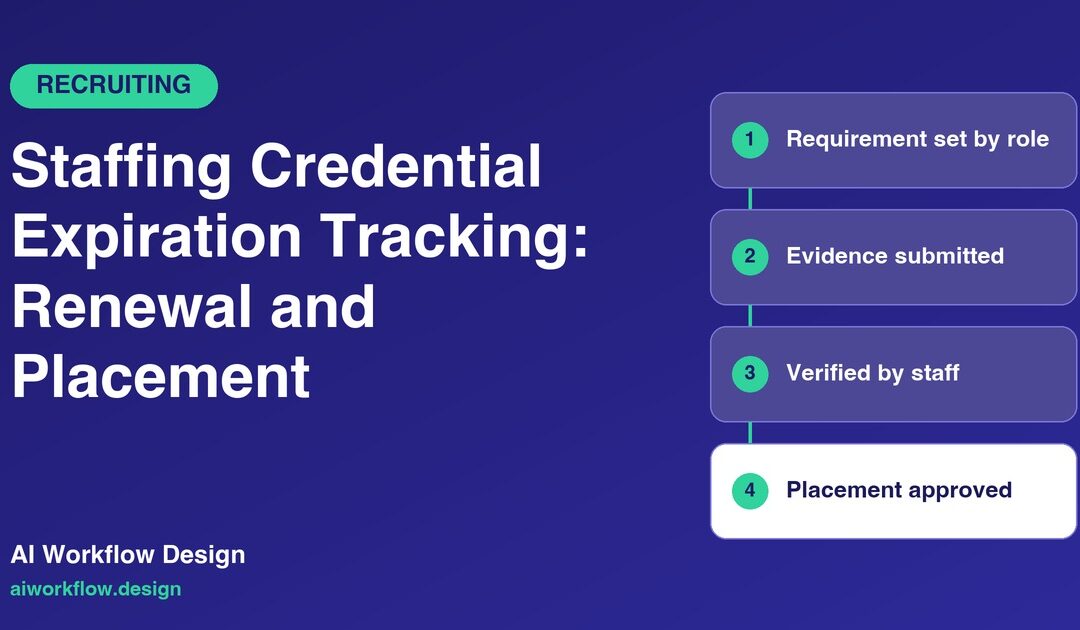
Quick answer: A staffing credential expiration tracker should show which role-specific documents are required, the issuing authority, effective and expiry dates, verification method, renewal owner, placement restrictions and final human review. It can send reminders and flag unverified evidence, but it should never automatically declare a worker clinically competent, legally eligible or cleared to perform a regulated role.
The staffing coordinator has a nurse available for a weekend assignment. The personnel file contains a licence image uploaded last year. The client needs cover urgently, and the scheduling board shows a green “Documents received” label. Nobody has checked whether the credential remains active, whether the licence is valid in the placement jurisdiction, or whether a client-specific competency requirement has changed.
That gap is not solved by uploading another image. The useful question is whether the staffing credential expiration tracking process preserves verified, current and role-appropriate evidence at the time of placement. The same principle applies to security contractors, tradespeople, education support workers and other workers whose assignments depend on licences, clearances, mandatory training or site authorisations.

Build the requirement matrix by role and jurisdiction
Begin with the job, not the candidate. A role-requirement matrix should identify what credentials the position requires, which authority issues them, how primary-source verification is performed when applicable, whether the item can expire, and whether the client imposes additional legitimate requirements. Do not assume that two positions with similar titles have the same rules in different states or countries.
For healthcare staffing, distinguish professional licensure from facility orientation, CPR or life-support training, client competency assessment and other requirements. The Joint Commission’s 2026 Health Care Staffing Services review process guide addresses credential and competency checks as distinct activities, including matching clinical staff to assignments. A credential tracking system can remind staff of requirements but cannot replace those assessments.
Record the source used to verify each credential, the reviewer, date checked and next review trigger. Treat uploaded copies as evidence submitted for review, not necessarily proof of current status. A worker may renew a licence without a new paper card being available immediately; equally, an old-looking document can be invalid despite an attractive expiry date.
Separate submitted, verified and eligible-for-assignment
A robust status design has at least five phases: Required, Worker notified, Evidence submitted, Verification completed, and Placement approved. Add Hold for review and Expired or otherwise invalid for exceptions. Only authorised staff should change the verification and placement decision states.
Consider the difference between these cases: a licence renewal is pending but the old credential remains valid; a credential has expired and no temporary authority exists; an online register shows a restriction; or the worker meets the licensing rule but not the client’s agreed experience requirements. They require different decisions. A generic “Renewal overdue” message cannot describe them reliably.
Before implementing any placement block, obtain policy and legal review so the system handles legitimate exceptions, protected leave, disability-related requests and jurisdictional requirements appropriately. Automated flags can trigger an immediate check; they should not make employment decisions without review.
Screening follows the same principle of administrative tracking without eligibility decisions; see staffing background check follow-up and candidate reference follow-up.
Define renewal lead times by actual requirements
One universal 30-day reminder is rarely enough. Some authorities process renewals quickly, while professional verification, specialised certifications or client onboarding can take longer. Establish lead times based on each credential’s issuing authority, known processing range and the staffing organisation’s risk policy. Use several targeted checkpoints only where they provide value.
A first notice should explain what is due and where to submit information securely. A follow-up should ask whether the person needs assistance or a corrected link. A final escalation should identify a human owner who can review restrictions, reassignment options and the placement calendar. Avoid alarming workers with phrases like “You are disqualified” before the record has been checked.
The staffing team should also track appointments already booked beyond a credential’s validity window. A document valid today may not cover the entire proposed assignment. A pre-dispatch check should confirm that the person meets requirements for the actual role, site and dates, including any multi-state licensing rules or client restrictions.
Design the monday.com credential register
Use a private worker profile linked to a credential record and a separate assignment board. Recommended fields include worker reference, credential category, role or site applicability, regulator, credential reference token, last verification date, verified expiration, renewal status, next action owner and restricted evidence link. Avoid storing full licence numbers in open dashboard views when a limited identifier is sufficient.
A useful rules engine can flag credentials approaching a policy date, missing verification, or proposed assignment dates extending beyond known validity. It must surface exceptions to credentialing professionals rather than setting the worker to “Eligible” just because a date is in the future. A current date does not validate disciplinary status, scope of practice or competency.
Board views should distinguish Upcoming renewal workload, Verification requests awaiting response, Assignments requiring review, and Client-specific requirements not met. Any automated integration with an external licensing service must be designed with permitted access, source reliability and change logs.
Limit automated contact to administrative questions
A scheduling agent could ask: “Have you submitted your renewal request?” or “Would you prefer the credentialing team to resend the secure upload link?” It can record that the worker needs help or the issuing authority has not yet responded. It must not ask a worker to disclose sensitive identification over an unsecured call or say that a licence is valid without an authorised verification.
AI Workflow Design describes status and attendance calling through Autoza AI for monday.com and its Daily Check-in Agent. Custom workflows can connect approved follow-up steps to an internal register, subject to configuration. They are not primary-source credential verification services or workforce eligibility decision systems.
Protect the call transcripts, keep retention periods appropriate and provide a human path for corrections. A voice summary can easily omit a qualifier such as “pending verification.” The source record should capture uncertainty faithfully and never replace the credentialing professional’s documented conclusion.
Example: an assignment crosses a licence renewal date
A clinician is offered a four-week assignment beginning on the 20th. The credential register shows a relevant document expiring on the 28th. The board flags the assignment because the dates overlap. Credentialing staff contact the clinician, check the issuing authority and review the client requirement. If continuation is not confirmed under applicable rules, the agency arranges an authorised alternative rather than assuming renewal will be granted.
On another assignment, the worker has a valid credential but the client’s site induction remains incomplete. The licence is not marked invalid. The assignment is held for a different reason—missing site-specific readiness—and the appropriate owner resolves it. This precision prevents the tracker from unfairly treating every missing item as a licensing problem.
Audit the system for fairness and accuracy
Run periodic sampling of records that are marked verified, records changed automatically and placements made near expiry dates. Confirm that evidence links are restricted, exceptions have a named reviewer and client requirements are current. Review false-positive blocks and missed expiry alerts; both affect workers and customers.
A credible renewal workflow reduces last-minute dispatch surprises because requirements are explicit and reviewed before a shift is offered. Its value is not the number of reminders sent. Its value is a defensible, current record that helps a human credentialing team make the right placement decision.
Payroll and timesheet exceptions deserve the same evidence discipline; see our staffing timesheet dispute workflow.
Next step
Want these follow-ups handled consistently? Explore Autoza AI for monday.com or talk to AI Workflow Design about scheduled, permissioned status follow-ups that leave approvals with the right people.
Frequently asked questions
What should a staffing credential expiry tracker record?
It should record credential type, role and jurisdiction applicability, issuing authority, validity, verification source, review owner, renewal state and assignment constraints without exposing unnecessary private details.
Does an uploaded licence image prove a person is eligible to work?
No. The credential may require primary-source verification, further competency review or other role-specific checks. Human reviewers should assess applicable requirements.
Can AI automatically remove a worker from a schedule when a licence expires?
A system may flag the assignment for urgent review under approved policy. Employment or placement decisions require authorised human assessment of the facts and legal requirements.
How early should renewal reminders begin?
Base reminders on issuing-authority processing times, the organisation’s policy, the worker’s assignment dates and the consequences of an unresolved renewal, rather than one universal interval.
How is licensing different from site induction?
Licensing establishes a defined professional or regulatory status; site induction covers location-specific instructions and access conditions. Both may be necessary, but they are not interchangeable.
Related reading
- Staffing Timesheet Disputes: Resolve Missing Approvals Without Delaying Wage Review
- Staffing Background Checks: Follow Up Without Making Screening Decisions
- Candidate References: A Consent-First Follow-Up Schedule
- Candidate Withdrawals: A Replacement and Client Communication Workflow
- After an Offer Is Accepted: A Staffing Handover Checklist