
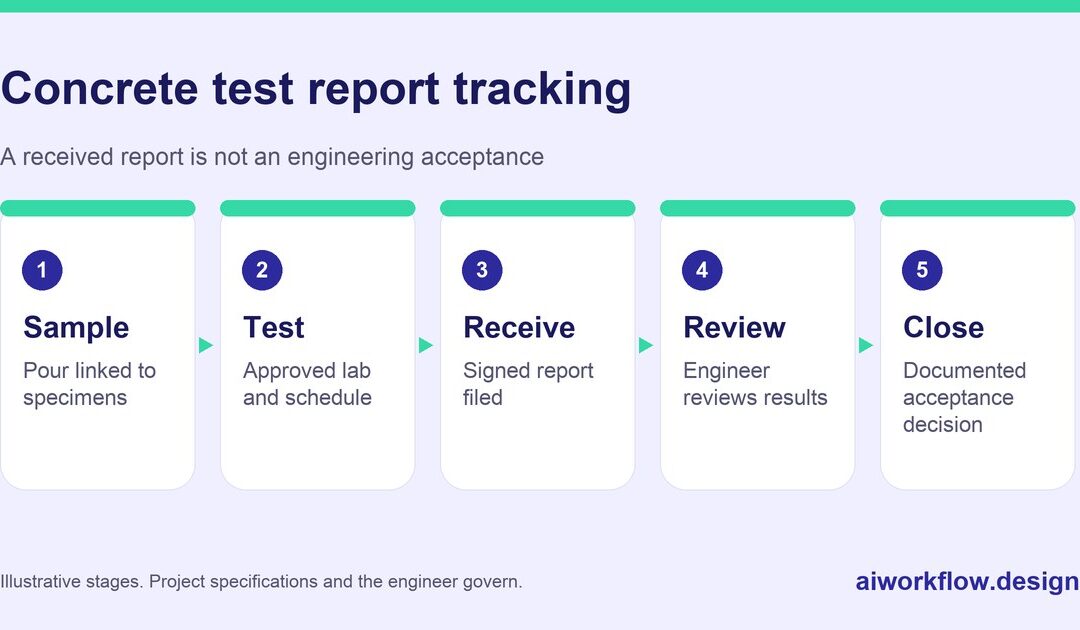
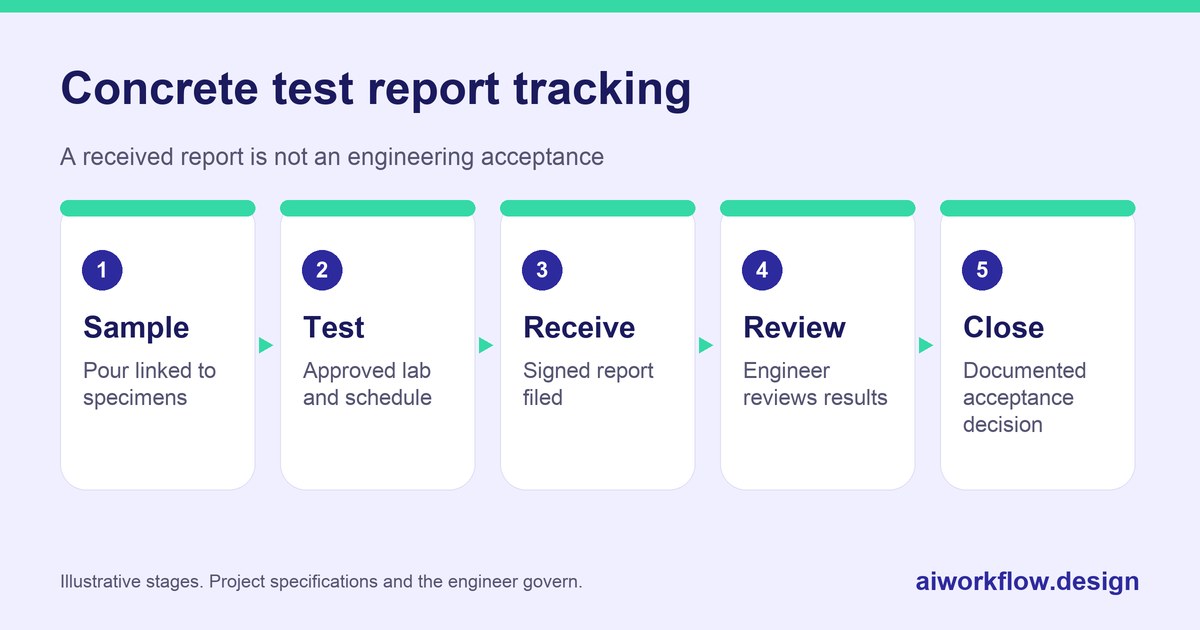
Quick answer: A concrete test report tracking workflow links every sampled pour to the correct test specimens, accredited or contractually approved laboratory, test schedule, signed report, technical reviewer and documented acceptance decision. The project coordinator can chase late laboratory results and route reports. They must not interpret compressive strength on behalf of the engineer of record or release structural work based on an automated score.
The site team pours an elevated slab, records the batch tickets and moves to the next workface. Several test results are expected later. One email attachment arrives without the sampling location, another carries a different specimen identifier, and a third has an apparent low value that the site supervisor wants to explain away. The problem is not only whether a number looks acceptable. It is whether the right evidence reached the right professional at the correct decision point.
Separate concrete testing from acceptance decisions
Sampling, standard curing and testing follow the relevant ASTM and ACI frameworks. Project specifications, adopted codes and the contract determine the applicable tests, frequency, age and acceptance requirements. The coordinator should not assume all projects follow identical schedules or that every cylinder result has the same significance.
Sampling and specimen preparation, laboratory testing, engineering evaluation and permission to proceed can each belong to different parties. A test laboratory reports what it measured under its procedures. A project engineer or authorised technical reviewer evaluates the result against the project requirements. The contractor manages the programme and any required hold point. An administrative workflow can keep those records aligned without crossing professional boundaries.
Build a traceable register for each placement
Use a unique pour or placement ID tied to the drawing location and date. Keep the concrete mix or approved design reference, supply batch or ticket numbers, sampling time and location, specimen IDs, laboratory and testing personnel, required testing age, requested delivery date and report ID. Attach the laboratory’s original report, not a screenshot of one highlighted figure.
Where the project requires field-test records, associate them with the same placement ID. Record whether a specimen or report has been corrected or superseded, retaining the previous version and the reason for the change. This prevents a late attachment from being matched to the wrong pour because both happened on the same day.
The board should also distinguish the expected report date from the date the engineer received the complete packet. A result can be produced on time but delayed in an inbox, creating an avoidable approval bottleneck.
Use states that describe evidence, not structural safety
A practical sequence is Placement recorded → Specimens registered → Testing due → Lab report pending → Report received → Technical review pending → Clarification / investigation → Accepted by authorised reviewer or Further action required → Documentation closed. The last two states must be controlled by the designated professional under the project procedure.
Keep an explicit Incomplete / mismatched report state. Examples include an absent specimen ID, incorrect project name, missing signature where required, inconsistent test age, wrong location, or a report that refers to a different mix. A completeness check is administrative: it does not establish that the test method was performed correctly or that the result supports acceptance.
A missing report should not automatically be labelled a failed test. Conversely, a delivered report should not automatically become accepted. Maintain distinct booleans or statuses for received, complete, technically reviewed and accepted.
Follow up on the lab without changing its technical report
When a report is late, ask the laboratory for the specimen reference, expected issue date, whether testing occurred, and who can resolve administrative discrepancies. If the test has not been performed, record the reason and inform the project testing and engineering leads. Do not demand a favourable number or suggest a revised result. If the laboratory issues a corrected report, link both versions and preserve the correction history.
If an apparent low-strength result appears, immediately follow the project’s specified nonconformance and engineering notification route. Do not wait for a routine next-day call. Specimen handling, sampling and technical context matter, and the response belongs to qualified technical personnel, not to a generalized AI prompt.
Coordinate technical review and downstream work
A placement may be linked to formwork removal, loading decisions, post-tensioning, follow-on trades or inspection milestones. The exact dependency depends on the engineered design and approved method statement. Therefore, the board should link the testing packet to the relevant hold points without translating “report received” into “safe to proceed.”
Record the name and authority of the technical reviewer, version reviewed, decision date, conditions or requested investigations, and the person who communicates the decision to site operations. A project manager can act on an authorised instruction; an unreviewed laboratory number is not a substitute for that instruction. For adjacent upstream coordination, see the construction material delivery discrepancy workflow and the building permit renewal checklist.
Design a monday.com report register
Create one item per placement or approved test lot, with subitems for individual expected reports if that matches the test plan. Suggested columns are Placement ID, Structure/Zone, Pour Date, Approved Mix Reference, Lab, Specimen IDs, Expected Test Dates, Report Due, Report Received, File Version, Technical Reviewer, Review State, Linked Hold Point, Exception Type and Next Action Owner.
Set notifications when a required due date passes without a report, when a mismatch is logged, or when an authorised reviewer requests more information. Avoid automation rules that select an acceptance state from a numeric threshold unless the engineer explicitly designs, validates and governs that process within the designated technical system. A generic monday.com formula is not a building-code interpreter.
Use scheduled status calls for administrative facts only
An approved AI call can ask a laboratory contact, “Is the report for placement reference CP-204 ready?” and “What is the expected issue date?” It can ask the internal coordinator whether the complete report was forwarded to the reviewer. It should not read test results aloud to unauthorised contacts, suggest that a number is satisfactory, or promise that the site can strip forms the next morning.
AI Workflow Design’s products describe monday.com-linked check-in calls that capture operational updates. Configure specific contacts, narrow questions, escalation thresholds and a link to the authoritative file repository. The safest pilot measures whether late administrative documents are found sooner, not whether an AI agent can judge concrete strength.
Review patterns without inventing compliance KPIs
Useful operational measures include the share of required reports received by the planned date, time between lab issue and engineering review, reports returned for missing identification, and open clarification requests. Trend by lab or placement type to spot communication issues, but do not infer laboratory competence or structural compliance from speed alone.
At project closeout, confirm that the specified testing records, engineering decisions, investigation results and final versions are included in the quality file. If an unresolved result remains, disclose it to the designated owner and keep its status open under the project procedure. An immaculate dashboard cannot replace a complete, technically accepted record.
Next step
Want these follow-ups handled consistently? Explore Autoza AI for monday.com or talk to AI Workflow Design about scheduled, permissioned status follow-ups that leave approvals and decisions with the right people. For a companion workflow, read Construction Waste Haulage Records: Track Transfer Tickets and Disposal Evidence. More guides: browse our construction workflow guides or see all industries we support.
Frequently asked questions
What belongs in a concrete test report tracking log?
Record the placement ID and location, mix reference, sampling and specimen IDs, laboratory, required dates, report version, receipt date, technical reviewer, decision status, evidence link and any unresolved discrepancy.
Does a laboratory report automatically approve a concrete pour?
No. Laboratory reporting and technical acceptance are distinct. The engineer or other authorised reviewer interprets results under applicable specifications and codes, then communicates the relevant decision.
What happens when a concrete cylinder result is late?
Confirm the specimen ID and test status with the laboratory, log the expected issue date and escalate any linked programme hold point to the construction and engineering leads. Do not guess a result or release work from a calendar reminder.
Can monday.com or AI decide whether a strength result passes?
Not as a routine administrative workflow. A governed engineering process may use specialised calculations, but final technical judgement and project approval must remain with authorised professionals and applicable systems.
How should corrected concrete reports be managed?
Keep the original and corrected versions, document the laboratory’s explanation, update the evidence link and request a fresh review if the correction affects the decision. Do not silently overwrite the historical file.