
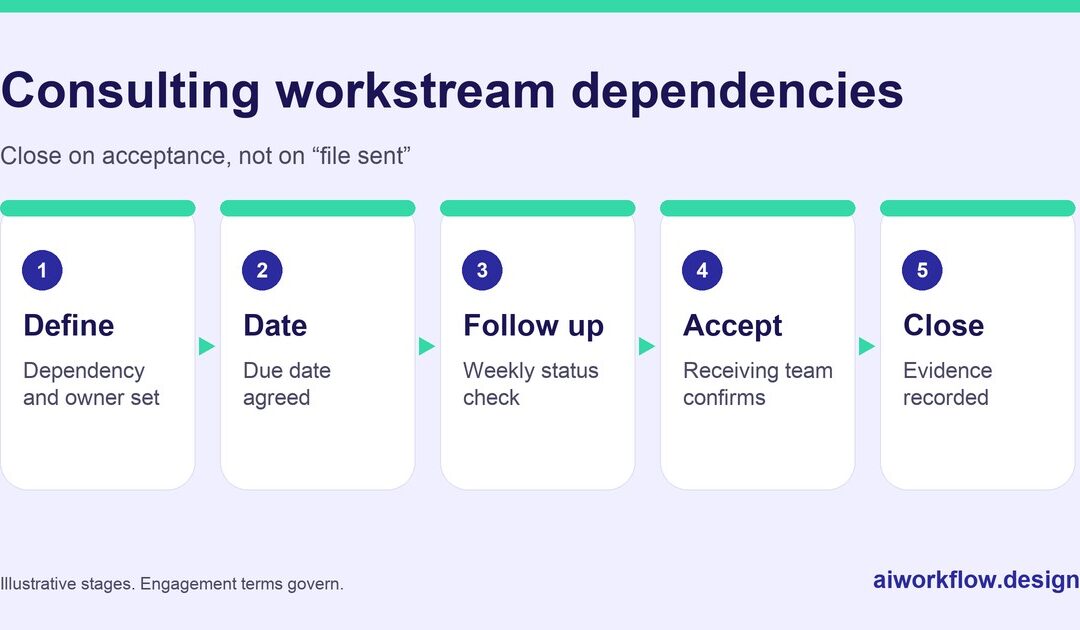
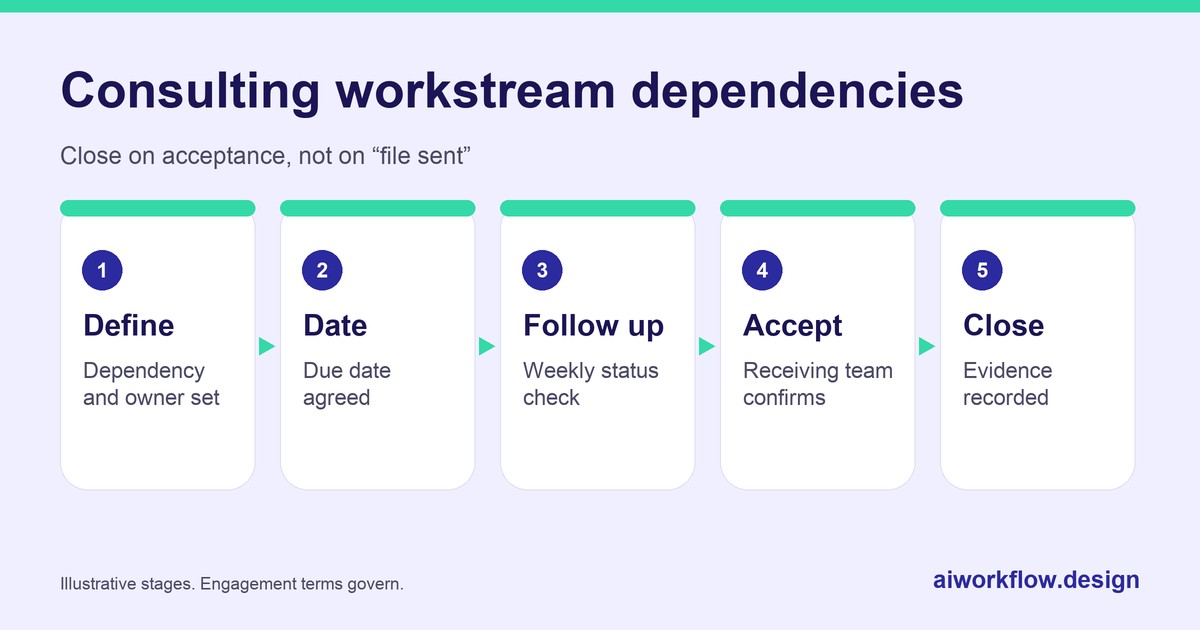
Quick answer: A consulting workstream dependency tracker shows which team must deliver which input before another team can begin, how the dependency will be accepted and what happens if the date slips. The strongest workflow distinguishes requested, received, usable and accepted. Automated status check-ins can help locate stalled handoffs, but only the responsible project owners can change scope, approve a revised milestone or accept an incomplete deliverable.
A transformation programme can be “90% complete” in every workstream and still miss the launch. Finance has finished its reporting design but is waiting for an approved account hierarchy. Technology has built an integration but needs a final identifier mapping. Change management has prepared training materials using an outdated process diagram. None of the teams is necessarily inactive; they are waiting on one another. An action list says that people are busy. A dependency register shows why the programme cannot move.
In consulting engagements, dependencies often cross organisational boundaries. The client owns a source-system export, an external provider controls access to an interface and the consulting team owns the downstream analysis. When those handoffs are invisible, a downstream delay is blamed on the team currently holding the task. A practical dependency workflow keeps responsibility and risk visible from the start.
What makes a dependency different from an action item?
An action item asks someone to do something. A dependency is a condition that must be met before a successor activity or decision can proceed. The difference matters because a task can be marked finished without the output being usable. “Finance sent the workbook” is an action completed. “The approved cost-centre mapping needed for system testing is available in the correct version” is a dependency satisfied.
Record predecessor, successor, deliverable, specific acceptance criteria, required date, providing owner, receiving owner, criticality, evidence location, current blocker and next decision. Dependencies should be named precisely. “Waiting for data” is weak; “Waiting for client-approved list of active location IDs in the target CRM schema” gives an owner something concrete to resolve.
Categorise dependencies as internal, client-owned, supplier-owned or regulatory/third-party. This helps direct escalations without inventing authority over another organisation. Do not treat a vendor’s estimate as a guaranteed delivery date or a client’s informal chat reply as an approved change to the statement of work.
Expert availability is a common blocker; see subject-matter expert bottlenecks.
Build a dependency register around acceptance, not promises
Start with the next deliverable, then work backward. If a target operating model requires process-owner interviews and validated workload volumes, identify both as predecessor conditions. Ask the receiving team to define what “usable” means before the providing team starts. A dataset might need a date range, validated field names and a reconciliation note; a legal input might need formal counsel review, not simply an uploaded draft.
Use at least five operational statuses: Not yet requested, Requested, Provided—under review, Accepted for use and Blocked/escalated. Add Rejected/rework requested when the artifact does not meet agreed criteria. These states stop the classic false-green report in which an emailed file closes a task even though the analyst cannot open or trust it.
Set one owner for supplying the artifact and one for confirming receipt and suitability. A project manager can coordinate the transfer but should not pretend to be the technical acceptor for tax policy, safety approvals or data-quality checks. Store version and acceptance comments so that later revisions are not confused with the agreed input.
A six-step weekly follow-up cadence
- Review the next two reporting periods. Identify dependencies that could block near-term milestones, rather than chasing every open item with the same urgency.
- Confirm the requirement in writing. Name the exact output and format, why it is needed, who will accept it and the agreed delivery date.
- Request a credible status. Ask for delivered/not delivered, likely completion, concrete blocker and who can resolve it. Separate the supplier’s forecast from the programme’s approved schedule.
- Check usability on receipt. The receiving workstream verifies the version, completeness, access permissions and agreed checks before changing the dependency to accepted.
- Assess downstream impact. If a dependency moves, show which task, decision or meeting is affected. Record mitigation options, not just a red label.
- Escalate decisions explicitly. Sponsors approve a change in priority, budget, scope or deadline under the engagement’s governance process. The project board records the decision and revised baseline.
This sequence can run in a weekly programme review, with short check-ins on high-risk dependencies between meetings. Excessive reminder messages rarely solve a dependency that needs a decision. The better escalation may be a 15-minute meeting between two accountable owners who have been interpreting the requested output differently.
Example: a client mapping file blocks three workstreams
Imagine a hypothetical ERP readiness project. Finance needs an agreed entity-to-cost-centre mapping to validate reports. IT requires the same mapping to test posting rules. Training needs the approved entity names to produce examples. The original deadline passes and the client has supplied a draft file, but two entities are unresolved. A generic board might show “file received” and three workstreams appear on track until testing begins.
A dependency register shows Provided—under review, with two unresolved mappings and a named finance approver. IT can test unaffected entities under a controlled limitation, training can prepare layout without final figures and the consulting lead can bring the outstanding decision to the next sponsor forum. No one silently assumes the missing rows are immaterial. The revised milestone is approved only after impact is assessed and the client accepts the change.
Configure the board and dashboards in monday.com
Create an item for each dependency. Recommended columns include Dependency ID, Providing team, Receiving team, Needed by, Milestone, Acceptance test, Status, Confidence, Evidence link, Next follow-up and Escalation owner. Use related items or mirror columns to connect the dependency to the downstream deliverable. Where the board supports dependencies or automations, configure reminders for the accountable person and alerts for blocked milestones. Do not make a date change self-authorising.
A useful executive view displays three signals: high-impact blockers, the number of dependencies received but not accepted, and the most exposed milestone. Keep “overdue by days” as supporting context, not the sole priority rule. A two-day slip on a critical regulatory input can be more serious than a month-old noncritical template approval.
For complex cross-tool orchestration, AI Workflow Design’s workflow automation service describes bespoke integrations. Its products overview covers Autoza AI for monday.com and status-checking agents. These tools may support approved routine follow-ups and board updates, but the final process, data permissions and approval gates must be designed for the particular engagement.
Write status questions that can be answered safely
A short approved check-in should ask: “Can you confirm whether the mapping package was shared?”, “Is your review complete or is a clarification needed?” and “What is your expected next update?” Avoid reading confidential annexes aloud, collecting passwords or asking a caller to approve commercial changes. Some owners will not be able to give a reliable new date; record “date unconfirmed” and escalate rather than filling the register with an invented commitment.
Keep consent, call timing, retention rules and access permissions consistent with the client’s policies and applicable law. A call summary is a communication record. It is not proof that a predecessor artifact met acceptance criteria.
Close a dependency only when the receiving team confirms it
The providing owner may say work is complete, but the receiving owner must check the agreed acceptance criteria. Attach a decision note or link to the approved artifact, identify the accepted version and document any residual limitations. If the receiving team later finds a material defect, reopen the dependency and show the effect on its successors. Closing loops this way provides a defensible record at steering meetings and in client handover.
The Association for Project Management’s project handover guidance emphasizes planning handovers rather than treating them as end-stage paperwork. Its competence guidance also identifies dependencies as part of integrated planning. Those principles apply at a smaller scale to every input exchanged between consulting workstreams.
Pilot gates use similar acceptance logic; see consulting pilot exit criteria.
Next step
Want these follow-ups handled consistently? Explore Autoza AI for monday.com or talk to AI Workflow Design about scheduled, permissioned status follow-ups that leave approvals and decisions with the right people.
Related guides:
- Subject-Matter Expert Bottlenecks: Prepare Inputs Before Consulting Workshops
- Consulting Pilot Exit Criteria: Track Evidence Before a Wider Rollout
More guides: browse our consulting workflow guides or see all industries we support.
Frequently asked questions
What is a consulting workstream dependency tracker?
It is a register showing the inputs one team needs from another, the owners of both sides, acceptance criteria, delivery timing, current status and impact on downstream milestones.
Why is “file sent” not enough to close a dependency?
Receipt does not prove that the correct version was shared or that it meets the receiving team’s requirements. Closure should follow a documented usability or acceptance check.
How often should dependencies be reviewed?
The cadence depends on risk and the delivery schedule. Review critical near-term dependencies more frequently and less urgent items during the agreed weekly programme cycle.
Can an AI caller approve a revised project date?
No. An AI status check may capture a proposed date or report a blocker. Approval of revised contractual, financial or milestone commitments belongs to the designated human authority.
How do you report a dependency with no reliable completion estimate?
Mark the date as unconfirmed, identify the constraint and escalation owner, show the downstream impact and seek a decision about mitigation. Do not publish a fictitious green forecast.