
Quick answer: Managing several consulting engagements becomes difficult when every client has a different deadline, every workstream has a different owner, and project managers have to ask the same progress questions repeatedly. A practical multi-client project follow-up system combines a clear engagement portfolio, risk-based contact schedules and concise status records. Routine calls can collect updates; engagement managers still make decisions about scope, cost, client commitments and acceptance.
The goal is not to call everybody more often. It is to make sure the right person is contacted about the right dependency before that dependency threatens a milestone. For consulting delivery teams using monday.com, that means organising each engagement so scheduled follow-ups produce useful, attributable information rather than a long collection of vague notes.
Why multiple engagements create invisible status work
A consultant delivering one project can often remember who promised a document or which stakeholder has not confirmed a meeting. When the firm runs five or ten engagements simultaneously, that memory-based method breaks down. A director asks for an update, the engagement manager checks messages, an analyst contacts the client and another team member edits the board. Nobody can quickly tell which information is current.
Problems usually fall into four categories: unassigned next actions, unclear client ownership, different reporting cadences and status language that mixes facts with forecasts. An update such as “finance should respond soon” offers little value to a person allocating staff for the following week. Instead record who owns the response, what is needed, when it is expected and whether another task is blocked.
The monday.com guide to defining the scope of services reinforces the value of explicit deliverables, responsibilities and change boundaries. A portfolio follow-up process should use those agreed commitments as its reference, rather than quietly expanding work through telephone conversations.
Build an engagement portfolio before setting call schedules
Start with a portfolio view that distinguishes client, engagement, workstream and task. Give each active engagement a single accountable manager and a reporting rhythm approved with the client. Then record individual deliverables beneath the engagement: board-ready status, owner, due date, evidence link, blocker, last verified update and next action.
| Level | Example | What the manager needs to see |
|---|---|---|
| Engagement | Retail operating-model review | Client sponsor, manager, stage, next milestone |
| Workstream | Finance process interviews | Lead consultant, required client decisions |
| Task | Confirm interview participants | Named owner, target date, response status |
| Subitem | Supply region-specific contact list | Contact, approved question, escalation route |
This is a suggested board design, not a claim that any AI calling product automatically creates these fields. Keep a separate field for “reported progress” and another for “approved or accepted”. A client saying “the draft looks fine” during a routine check-in does not amount to contractual sign-off unless the agreement explicitly recognises that mechanism and the authorised reviewer confirms it.
Classify follow-ups using a portfolio priority grid
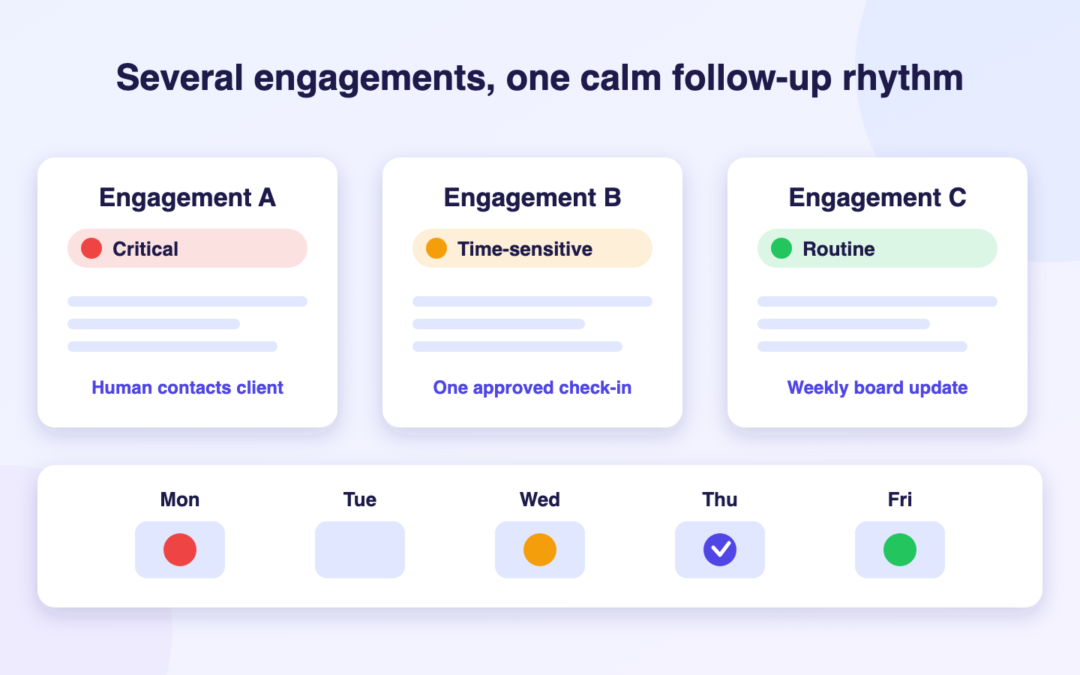
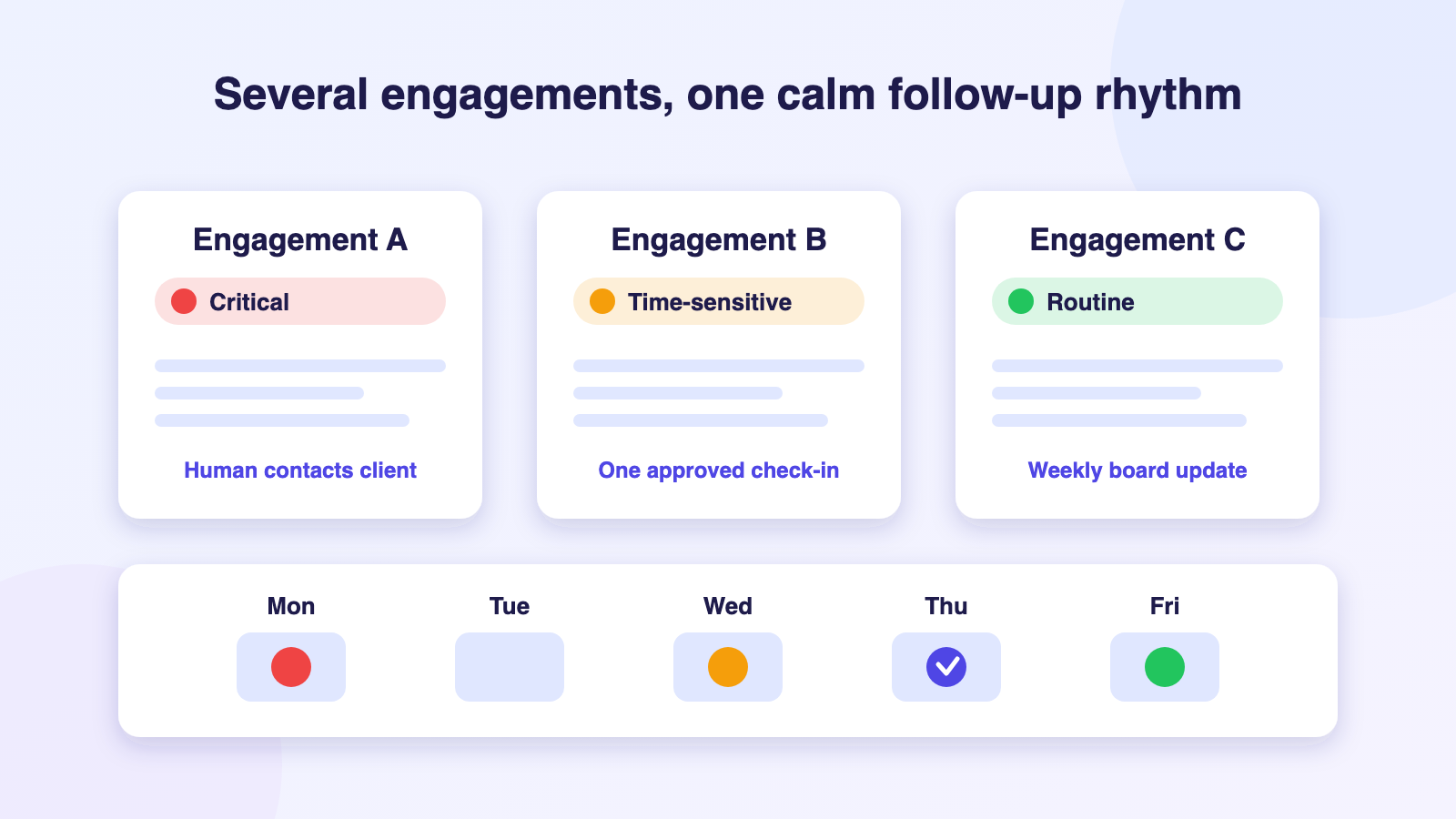
A useful portfolio manager looks at impact and time sensitivity, rather than distributing the same reminder to every open task. An engagement with an agreed workshop next month should not receive the same frequency of calls as a migration workshop tomorrow that depends on missing access approvals.
| Priority | Typical condition | Suggested response |
|---|---|---|
| Critical dependency | Client input blocks a milestone within one business day | Human owner contacts the client through an agreed channel |
| Time-sensitive | Required information due within two to three working days | Schedule one approved check-in and review the answer |
| Routine | Work progressing with no near-term dependent milestone | Weekly board update or meeting summary |
| Stable | Work accepted or no decision pending | No follow-up call; retain record |
Do not let an arbitrary traffic-light colour override the substance of the problem. “Amber” on a minor formatting change can be less urgent than “green” on a regulatory deadline whose evidence has not been checked. Add a short reason for the priority and a named person able to change it.
Design a follow-up question set that scales across clients
The simplest standard is a short, consistent set of administrative questions. Ask whether the respondent is the nominated owner, what has changed since the last checkpoint, which item remains outstanding, whether another party is waiting on them and when the next realistic update can be provided.
Adapt the question to the engagement. For an organisational redesign, ask whether the approved interview roster has been delivered. For a finance transformation, ask whether the scheduled data-extract request has been acknowledged, not for confidential transaction details to be spoken over the phone. For a technology advisory project, ask whether test participants have confirmed attendance rather than collecting passwords or systems credentials.
A good answer can be represented in one line: “Interview roster awaiting HR confirmation; programme lead expects update Thursday; Friday workshop remains at risk.” Preserve the difference between a stated expectation and verified completion. If a respondent does not know the answer, write “unconfirmed” rather than guessing.
Where scheduled AI calls fit in monday.com
Autoza AI for monday.com publicly describes scheduled start-of-day and status calls, questions set by the team, board updates, retries and call summaries. For a consulting organisation, those capabilities may support selected administrative follow-ups once the team has validated permissions, field mappings and recipient consent. The product should not be assumed to resolve every client workflow or to hold contractual approval authority.
A sensible setup sequence is: select one well-defined engagement; identify task owners who agree to calls; write only permitted questions; map responses to non-sensitive status fields; set business-hour schedules and retries; and review exception reports each week. Ensure client-side requirements, confidentiality obligations, local calling rules and approved retention practices are addressed before a production rollout.
Do not assume that a multi-board portfolio will automatically be reconciled. Test the intended board structure and confirm how the selected configuration handles items, subitems, permissions and exceptions in the actual environment.
Example: three engagements and one overloaded manager
Consider a fictional consultancy running a customer experience study, an ERP planning engagement and a procurement review. Monday’s portfolio review identifies three unresolved prerequisites: an interview list, a workshop-room confirmation and a supplier-data permission. Rather than calling 25 participants, the coordinator selects the three responsible people and asks narrow questions about those prerequisites.
One owner confirms the room. Another says the interview list will be available Wednesday, leaving enough time to proceed. The third explains that data-sharing permission is still with legal. The manager records the legal dependency separately and agrees an authorised human escalation; the AI does not seek the restricted data itself or imply permission has been granted.
The benefit is traceability. A delivery director can see which client action remains open, who was contacted and which milestone could be affected. No improvement percentage is assumed: the team should measure its own call time, missed dependencies and clarification effort before making any performance claim.
Keep the client relationship human
Consulting involves judgement, ambiguity and trust. A client may mention a new priority that changes the engagement scope or ask for a decision about fees. Those are discussion points for the engagement lead, not routine fields for automated updates. Set escalation triggers for disputed requirements, commercial changes, dissatisfaction, sensitive information, unclear identities and any threat to a contractual deadline.
Offer alternatives to calling. Some clients prefer their scheduled steering meeting, an email action register or an update directly in monday.com. The right workflow can use a call for an urgent unanswered logistical dependency and leave ordinary document reviews in the usual secure collaboration system. Respect the recipient’s time zone, working hours and opt-out requirements.
Measure whether the cadence is genuinely helping
After two to four weeks, review the proportion of critical tasks with a verified owner and current update; how long material blockers remained unknown; how many calls were unanswered; and how often a manager had to call again because the response was ambiguous. Ask client contacts whether the process felt useful or intrusive.
A sustainable target is fewer avoidable status requests and earlier visibility of the blockers that matter, not maximum calling volume. Review the priority rules monthly as engagement stages change. A workshop-heavy discovery phase needs different contact points from a document-heavy final acceptance phase.
How to get started
Choose a small consulting portfolio, make ownership and acceptance rules explicit, and introduce scheduled check-ins only for the work that benefits from a telephone response. Explore Autoza’s scheduled monday.com check-ins or request a workflow review to assess one controlled use case before scaling.
Frequently asked questions
What is multi-client project follow-up in consulting?
It is the organised process of collecting progress, blockers and next-action information across several client engagements without repeatedly contacting every contributor. It uses named owners, agreed milestones, appropriately timed reminders and a reliable project record.
Should every consulting task receive a daily AI call?
No. Daily calling usually creates unnecessary interruption. Reserve calls for selected time-sensitive, unanswered dependencies and use weekly updates or existing meetings for stable work. Recipients must have an agreed, compliant contact process.
Can AI approve consulting deliverables on behalf of a client?
No. A routine status call can record that a reviewer plans to assess a deliverable or has supplied feedback. Formal approval and contractual acceptance should remain with the designated authorised person through the agreed process.
How should monday.com tasks and subitems be organised for several engagements?
Use a consistent hierarchy, usually engagement, workstream, task and optional subitem. Each follow-up item should identify its owner, deadline, allowed response fields, last contact and escalation path. Test any automation against the real board configuration.
What is the best KPI for a consulting follow-up pilot?
Track whether critical dependencies receive timely, useful updates and whether manual clarification calls decline. Compare against the firm’s own baseline and include client feedback, rather than treating call volume as a success metric.
Related reading
- Client Action Items After Workshops: Who Should Be Called and When?
- How Consulting Firms Can Automate Follow-Up on Client Deliverables
- Project Sign-Off Delays: A Follow-Up Workflow for Consulting Teams
- What Should Never Go Into an AI Consulting Project Follow-Up Call?
- Autoza AI for monday.com: scheduled status calls
- Workflow automation services
- Daily Check-in Agent