
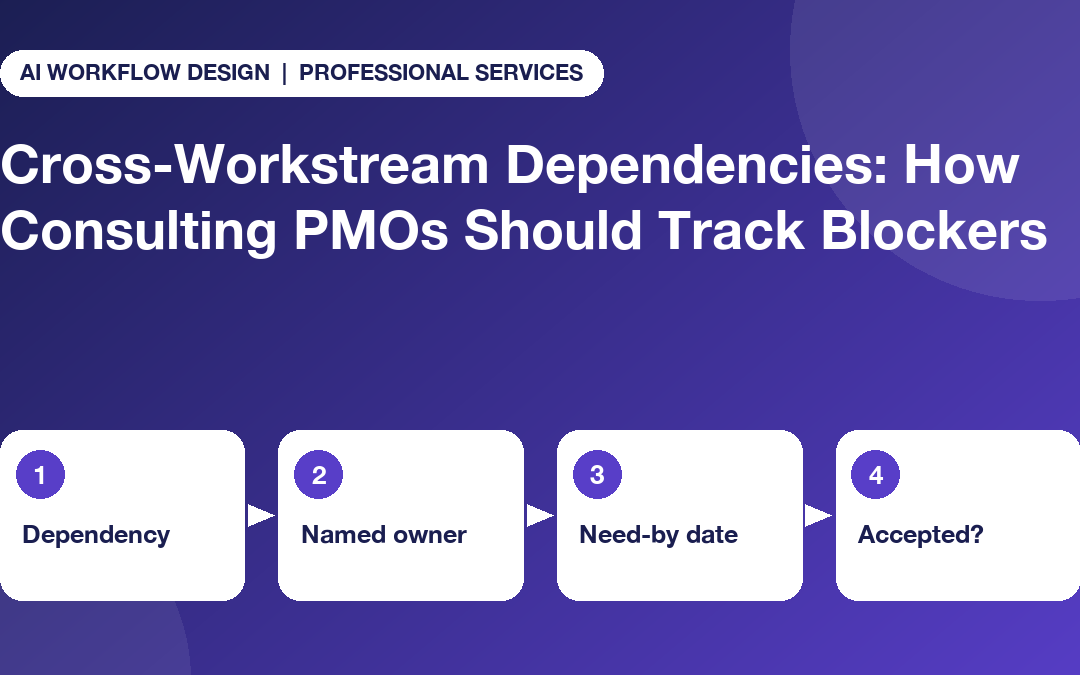
Quick answer: Consulting workstream dependency tracking works when each dependency has a source workstream, a receiving workstream, a named owner, a need-by date and an acceptance test. Record dependencies separately from risks, issues, actions and decisions, and let status calls collect reports while the receiving team verifies acceptance.
Consulting workstream dependency tracking becomes difficult when several teams each believe another group owns the next step. A technology team may be ready to test, but legal has not agreed data usage. Finance may need the implementation design before approving the business case. A green status in one workstream can hide a red programme dependency.
A consulting PMO needs a shared map of what is blocked, who must act, which milestone is affected and who can approve the next decision. Scheduled follow-ups can help collect missing status, but they cannot resolve conflicting authority or independently declare a dependency satisfied.
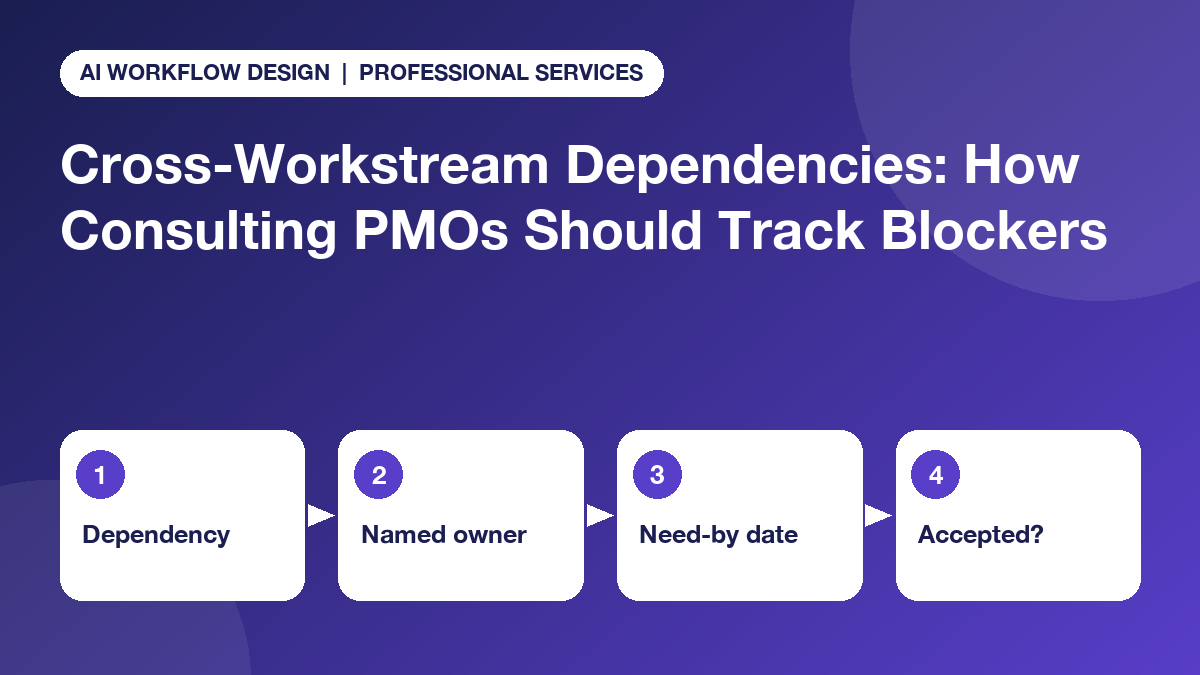
Separate dependencies, risks, actions and decisions
A dependency says ‘Workstream B cannot begin until Workstream A delivers an agreed input.’ A risk says ‘that input might be delayed.’ An issue says ‘the input is late today.’ An action says ‘the named owner must submit it by Thursday.’ A decision records the authorised choice taken in response.
A RAID log tracks risks, actions, issues and decisions with owners, dates and resolution history. A dependency register can link those records to receiving workstreams and programme milestones without treating them as the same thing.
This distinction matters because calling the supplier of a late item is useful only if the PMO already knows whether the need is information, work, approval or a sponsor decision.
Create a dependency contract between workstreams
For each critical cross-workstream dependency, write one plain-language outcome: what must be delivered, by whom, to whom, by when, using which acceptance test. Then capture its impact on the receiving team’s planned start or decision.
A legal workstream may own the final contract approval; the technology lead may own technical feasibility. The PMO is responsible for visibility and escalation but does not inherit either team’s professional authority.
Recommended register fields include:
- Dependency ID and source workstream: One durable identifier with the team producing the input.
- Receiving workstream and acceptance owner: Who needs the output and who verifies it meets requirements.
- Deliverable and evidence link: What specifically must exist, stored in an approved repository.
- Need-by date and impact: The decision or scheduled activity delayed if the condition remains unmet.
- Reported status versus accepted status: Submitted, awaiting review, accepted, rejected or blocked.
- Escalation threshold: A defined condition that requires the programme director or sponsor’s attention.
Avoid exposing confidential contract clauses or personally identifiable data in a broad team board. Link to a restricted system when detailed evidence is necessary, as outlined in what should never go into a consulting AI follow-up call.
A cross-workstream example: implementation readiness
Consider a transformation programme with operations, finance, legal and IT streams. IT says the testing environment is available, but the required dataset cannot be transferred until legal approves the permitted use. Finance expects the first benefits baseline two weeks later and assumes testing has begun.
The PMO should not mark the dependency closed because IT reports ‘environment ready’. Instead it records the separate prerequisites: technical environment provision, lawful data permission, approved test dataset and verification by the receiving test lead. Each has an owner and an acceptance condition.
The useful follow-up question is not ‘Is everything on track?’ It is ‘Has the approved test dataset been made available to the test owner through the agreed channel, and what is preventing acceptance?’ The response may identify a missing legal decision rather than an IT delivery failure.
Build an impact-based follow-up cadence
Prioritise calls by consequence and information need. A cross-workstream dependency within the next critical decision window may warrant a focused check-in; a long-range dependency with no changed facts may only need a scheduled dashboard review.
Set one relationship owner responsible for contacting the producing team, and allow the receiving team to verify whether the delivery is acceptable. A simple cadence might include weekly baseline reviews, a focused check near a critical milestone and immediate escalation for a material issue. These are illustrative choices, not recommended calling hours for every client.
Keep ‘not reached’, ‘reported on track’, ‘evidence submitted’ and ‘accepted’ distinct. A no-answer call should never silently become a ‘failed task’ or a performance judgment.
Autoza AI publicly describes scheduled monday.com status calls, retries and board updates. Used on approved tasks, such calls can improve visibility, but the PMO remains responsible for deciding which fields may change and how ambiguous responses are reviewed.
Escalate on authority and business impact
An unresolved dependency may need a line manager’s decision, a client sponsor’s direction, a legal interpretation or a contractual change. The PMO should document the proposed options and recommendation, then route the case to the right authority.
Material scope, schedule, resource and go/no-go questions belong with the sponsor rather than routine delivery decisions. A programme team can prepare the fact base; the sponsor or designated committee must decide what the programme is authorised to change. Our guide to steering committee prep and decision papers shows how to bring those decisions to the right forum.
Make escalation specific: ‘Dataset approval has not been issued, integration testing cannot begin, and the current benefits milestone is at risk. Sponsor decision required on re-sequencing versus date change by Friday.’ That is actionable in a way that ‘red due to client delay’ is not.
Use monday.com without building a second issue universe
If the project already has risk and issue processes, preserve them. A dependency board or linked view should point to the official RAID or governance record and should not become a parallel source of conflicting decisions.
For example, a task owner’s spoken status may populate ‘update received’ and ‘expected delivery’. The receiving workstream verifies ‘accepted’. A steering committee minute or signed approval document supports ‘decision made’. This respects the difference between collecting an answer and governing the programme.
Our guide on managing several consulting engagements offers a related prioritisation framework for deciding which teams need timely human attention instead of blanket status calls. Dependencies also appear at the start of an engagement, as covered in consulting kickoff delays and missing client data.
A 15-minute PMO dependency review agenda
Start with blockers approaching their need-by dates. Check the evidence and receiving-owner acceptance, then address disputed ownership and escalation choices. Review newly discovered dependencies before asking for low-priority updates. Finish by confirming who will act, what proof they must supply and when the PMO will review it.
Track leading indicators such as dependencies lacking owners, aged critical blockers, acceptance rework and sponsor decisions overdue. Avoid treating a high volume of calls as evidence of progress; each call should either verify a fact or reveal an action that can be taken.
Improve cross-team visibility without replacing governance
Teams already coordinating consulting delivery in monday.com can review Autoza’s project check-ins or discuss a workflow review. Keep the dependency map, approval rights and confidential project evidence under the programme’s established controls. You can also see how consulting teams handle follow-up on client deliverables.
Frequently asked questions
How is a dependency different from a risk or issue?
A dependency links one deliverable or decision to another. A risk is an uncertain potential event, while an issue is an existing problem. A missed dependency can create an issue, but the categories should be recorded distinctly so the PMO knows what is needed next.
What belongs in a consulting PMO issue log?
Record a clear issue statement, impact, owner, date opened, proposed resolution, decision authority, target resolution date, evidence and escalation history. Avoid lengthy or confidential details in fields visible beyond the relevant project team.
When should a cross-workstream blocker be escalated?
Escalate when the accountable team cannot resolve the blocker within its authority or when impact on a committed milestone, resources, scope or risk tolerance exceeds an agreed threshold. Urgent blockers should not wait for a routine meeting.
Can an AI call automatically close a dependency?
A call may capture that an owner reports a prerequisite complete. Closure needs the receiving team to verify acceptance and, where required, a sponsor or control owner to approve the change.
How can PMOs prevent duplicate follow-up calls?
Assign a single accountable relationship owner for each cross-team dependency, agree update dates, and use the status already recorded in the system. Calls should be triggered by genuinely missing or consequential information, not every open task.