
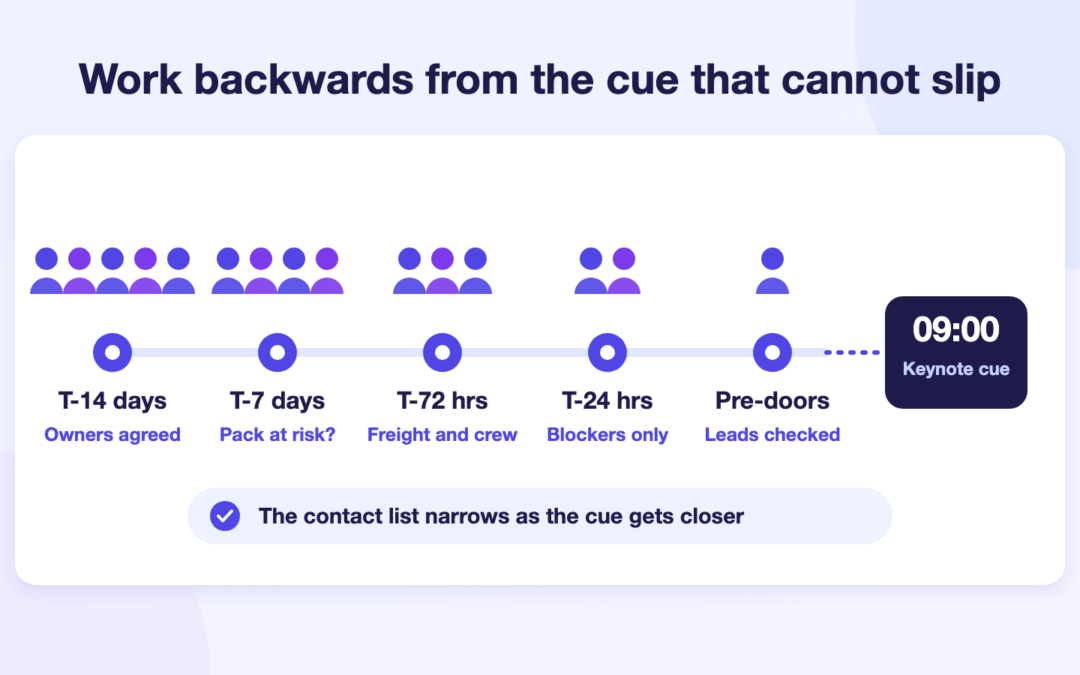
A run of show follow-up schedule connects the event’s live programme to the supplier tasks that make each cue possible. Rather than calling every vendor at random, the producer identifies the next dependency, the person who owns it, when their answer will be useful and how the team will act if the answer is unclear. The result is a concise rhythm of meaningful pre-event confirmations, not an endless round of calls.
A run of show (ROS) is the ordered sequence of programme segments, cues and responsibility hand-offs. A vendor follow-up schedule is the separate workback plan that tests whether each required component is ready before it becomes a live cue. monday.com’s event-planning guidance distinguishes planning timelines, vendor management and event-day operations; those layers should connect, but they should not be mistaken for one document.
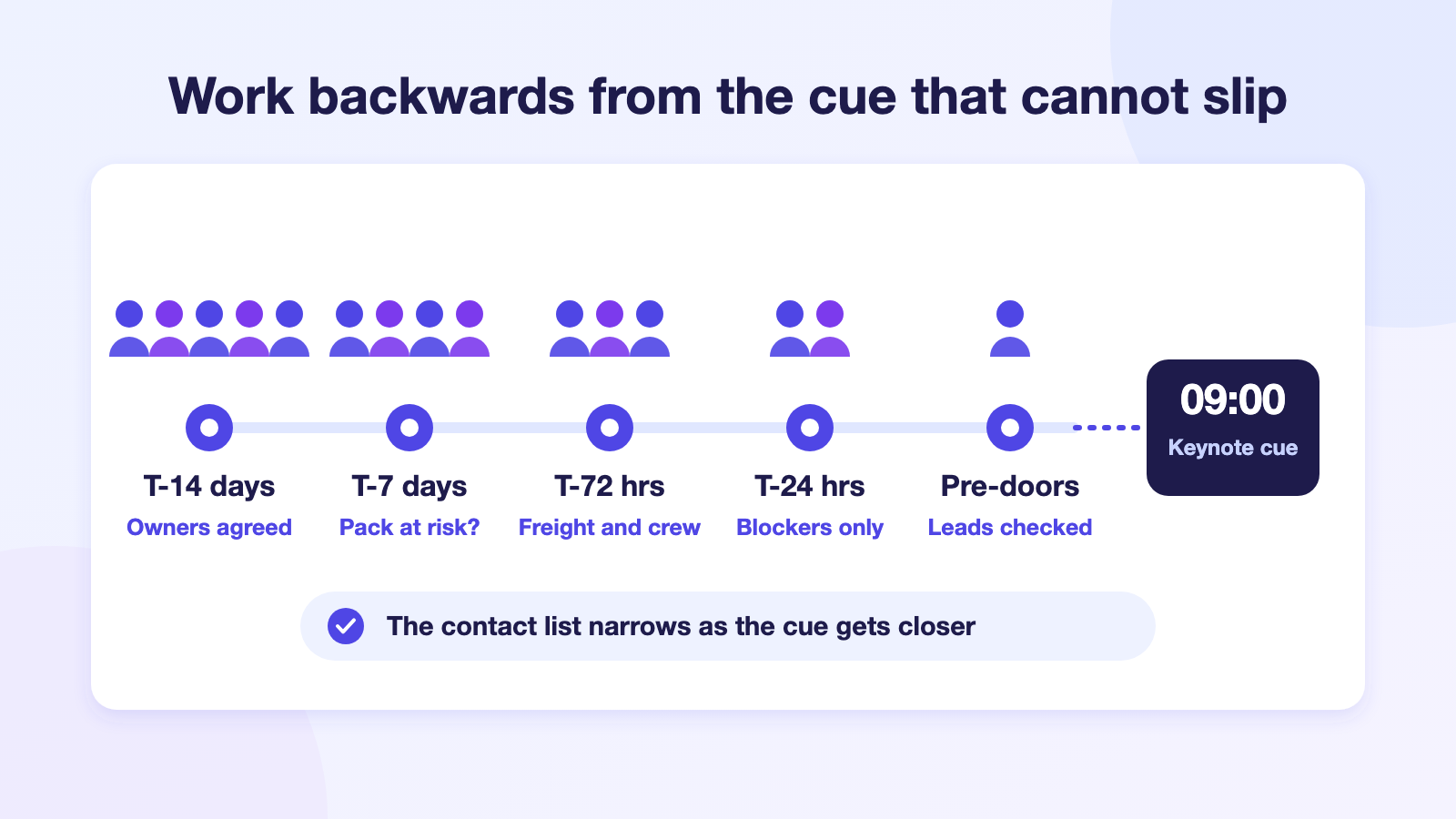
Work backwards from the cue that cannot slip
Consider a conference keynote at 09:00. Its cue depends on an approved deck, a rehearsed microphone handoff, working playback, stage access and a presenter who knows the arrival time. “Keynote ready” is a weak status because it hides which of those inputs remains open. Break the cue into deliverables with individual owners and evidence requirements.
For each ROS segment, document its time, the responsible stage manager or producer, the upstream vendor packages, the last useful time for a progress update and the decision maker. A dependency is more than a date: if the video team cannot test playback before the speaker deck arrives, content delivery is the predecessor to testing. monday.com’s event Gantt-chart guide emphasises making these predecessor relationships visible.
Use a T-minus schedule, not a uniform daily chase
The schedule below is an illustrative planning model, not a universal industry rule. It assumes a one-day conference with venue, AV, staging, catering, registration and transport suppliers. Adjust it to your contracts, event size, working hours and safe contact windows.
| Checkpoint | Decision the producer needs | Suggested contacts |
|---|---|---|
| T-14 days | Are major deliverables, access approvals and named owners agreed? | Venue operations, lead AV vendor, caterer, registration lead |
| T-7 days | What is at risk of missing the final production pack? | Suppliers with unfinished drawings, menus, assets or permits |
| T-72 hours | Are freight, crew arrival and rehearsal dependencies confirmed? | Logistics, stage, video, audio and venue coordinator |
| T-24 hours | Which unresolved items could block load-in or rehearsal? | Only owners of material open dependencies |
| Pre-doors | What has been checked by the authorised leads and what remains on hold? | Producer, technical leads and venue duty manager |
The contact list should get narrower as the event approaches. The purpose of the last round is to resolve exceptions, not to reconfirm every earlier ‘yes’. A vendor that completed its deliverable and supplied accepted evidence should normally disappear from routine calling unless the underlying plan changes.
Give each call one deliverable and one decision
A useful question set starts with identity and scope: “I’m checking the ballroom video package for Friday’s rehearsal. Are you the nominated owner?” Then ask for the most recent completed step, outstanding prerequisite, next reliable handoff time and person who can authorise a change. Keep estimated completion separate from observed completion.
For catering, the critical question may be whether final headcount, dietary production requirements and delivery access have been received. For transport, it may be the vehicle arrival window and venue loading permission. For AV, it may be equipment arrival and the agreed time for a technical inspection. The earlier vendor readiness guide provides the complementary supplier-level questions; this article concentrates on how their answers affect the ROS.
Create a board that identifies the affected cue
In a suggested monday.com board, use a parent item for a ROS segment and subitems for independently owned prerequisites. Practical columns include Segment / cue, work package, owner, next decision time, reported status, blocker, next update, human approver and last response. This is a proposed design for teams to validate, not a statement that Autoza automatically creates these fields.
Use distinct status values: Not checked, In progress (reported), Blocked (reported), Awaiting evidence, Verified by owner and Escalated. A supplier saying “the screen is installed” may justify a reported-progress update, but not “technical acceptance complete”. The latter requires the appropriate person to check the actual installation and sign off where required.
Autoza AI for monday.com publicly describes scheduled check-in calls, question collection, item updates, retries and call-history summaries. Those capabilities can support administrative follow-ups after the manager configures the intended scope. It is not a show-control system and must not be presented as one.
Handle exceptions before they reach the stage manager
An unresolved supplier answer should produce an action with an accountable owner, not a silent retry loop. Mark low-impact artwork refinements for the next planned check. Escalate a delayed truck that affects loading dock allocations to the operations producer. Send power, rigging, crowd-safety or venue-access hazards to the established immediate human safety route, not an automated call campaign.
If the vendor does not answer, retain No answer / status unknown. Do not translate silence into ‘late’, ‘ready’ or ‘failed’. Record the attempted time, approved retry window, affected ROS dependency and escalation owner. Schedule any retry outside active setup tasks that would make taking a phone call unsafe.
Example: the keynote looks green but is not ready
Imagine the video supplier reports all displays installed at T-24 hours, while the content owner has not supplied the keynote deck. The stage manager has reserved a 16:00 test slot. The correct board interpretation is “video installation reported complete; playback test blocked by missing file”. The next call should go to the content owner, not back to every AV technician.
If the file arrives and the technician later confirms playback testing was performed, record the reported test outcome and preserve the producer’s approval step separately. If the file remains absent at the agreed cutoff, the producer makes a human decision about a fallback, delay or programme change. No AI call should amend a live cue sheet without that authority.
Review effectiveness after the event
Compare the number of genuinely actionable calls with the number of calls that delivered no new information. Track how often a dependency surfaced before the rehearsal, whether it had a named owner, how long exception resolution took and whether the ROS team could trust the data. Those are useful process signals; they are not a promise of fewer delays.
For deeper treatment of the technical handoffs, see AV and stage setup check-ins. Start the next show with a short retrospective on which checkpoints came too early, too late or reached the wrong person.
Put the plan into practice
Select one event, one set of interdependent cues and three vendor groups. Map the workback dates and update permissions, and test a small number of agreed calls before extending the schedule. For a walkthrough of the product’s actual capabilities against your board, request an Autoza workflow review.
Frequently asked questions
What is the difference between a run of show and a follow-up schedule?
The run of show controls the order and timing of the live programme. The follow-up schedule checks whether upstream vendors, assets and approvals are ready in time to support those programme cues.
How far ahead should vendors receive check-in calls?
Schedule based on the latest time a missing answer can still change the plan. The T-minus examples are planning suggestions; contract terms, complexity, local working hours and safety considerations take precedence.
Can one vendor update multiple run-of-show tasks?
One call can gather updates about several explicitly identified work packages if the respondent owns them. Record each answer against the correct task and avoid assuming a single general response closes all dependencies.
Should the AI caller change the live cue sheet?
No. Administrative progress can be gathered through approved check-ins, but cue changes, rehearsals, technical sign-offs and emergency decisions belong to the authorised production team.
What should happen when a vendor does not answer?
Record the attempt as unknown, use a bounded retry rule if appropriate and escalate to the named producer before the affected decision deadline. Silence must not be treated as confirmation.
Next step: review one real workflow
See how your project questions, permitted board fields and escalation owners could fit a controlled implementation. Explore Autoza AI for monday.com or request a guided workflow review.
Related reading
- AV and Stage Setup Check-Ins: What an Event Producer Should Ask
- How to Run Vendor Readiness Calls Before a Major Event
- Speaker Materials Running Late? A Follow-Up Workflow for Event Teams
- Event Rehearsal Follow-Up: Calls, Task Owners and Exception Rules
- Autoza AI for monday.com: scheduled status calls
- Workflow automation services
- Daily Check-in Agent