
A TLS certificate renewal task checklist should follow a certificate all the way from inventory and ownership through validation, issuance, deployment and live endpoint testing. A newly issued certificate is not enough if the web server, load balancer, proxy or API gateway still serves the old one. MSPs need a repeatable owner-and-evidence process that avoids expiry surprises without relying solely on one vendor’s reminder email.
Why certificates expire despite automatic renewal
Modern platforms can automate certificate issuance and renewal, yet automation has preconditions. Domain validation records may be missing, the certificate may not be eligible for managed renewal, a hostname may have moved behind a different load balancer, or the renewed artifact may never reach a manually managed endpoint. AWS Certificate Manager documentation distinguishes renewal states such as pending validation, success and failure. Some managed certificates renew only when specified association and validation requirements remain satisfied.
A project manager should not infer “good for another year” from an automated-renewal setting. Certificate lifetimes, issuance and renewal behaviour vary by certificate authority and product. Record the real notAfter date from the live endpoint and follow the current issuer documentation. Shorter lifetimes increase the value of repeatable automation, ownership and monitoring rather than memorised reminder intervals.
Build an inventory that answers who owns each endpoint
Include environment, service owner, technical certificate owner, hostname or service identifier, certificate source, issuer account, validation method, expiry date, renewal mechanism, deployment point, change window and final verification owner. Sensitive private keys, tokens and account recovery details do not belong on a broad work board. Keep them in the organisation’s secrets management and PKI systems.
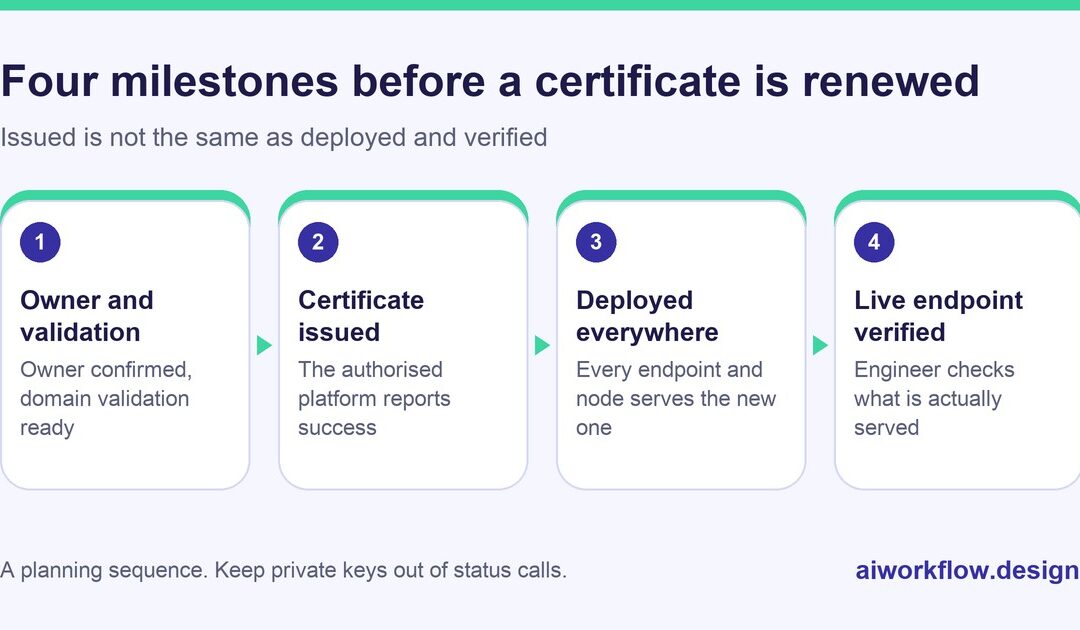
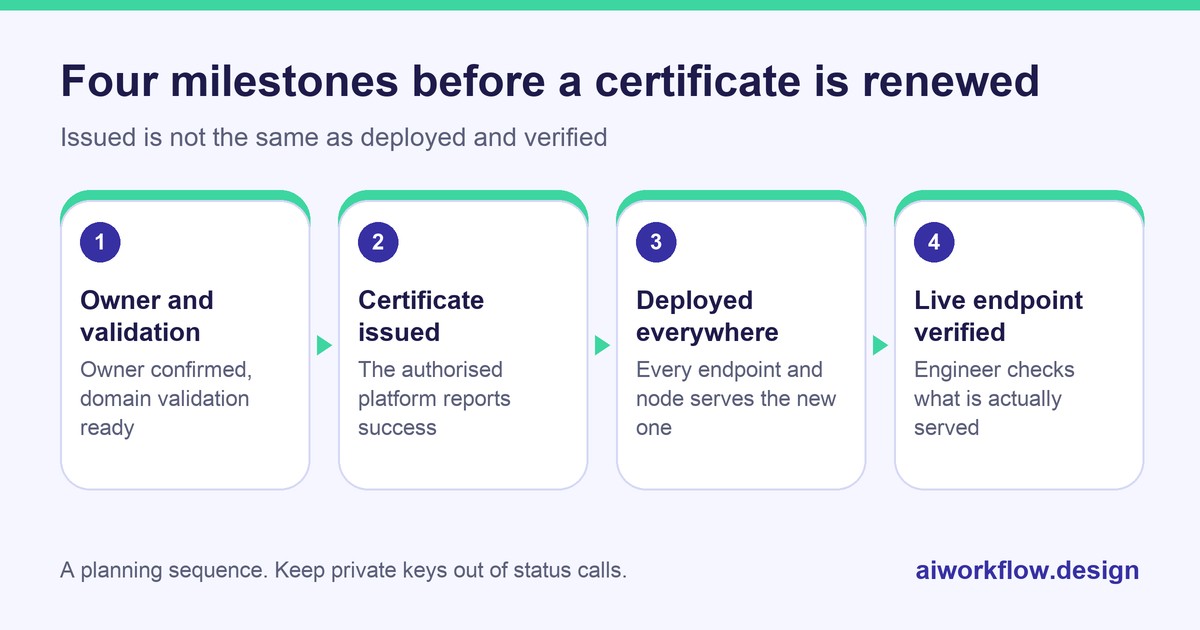
Separate three milestones: renewal initiated, new certificate issued, and new certificate deployed and verified. The distinction matters for multi-node services where one endpoint may still present an expired chain even after another node has been updated. Include relevant certificate-chain and domain-coverage checks in the authorised technical verification procedure.
Coordinate domain, infrastructure and application teams
DNS or domain administrators may need to restore a validation record. Cloud platform owners may need to repair an automated renewal configuration. Network and infrastructure teams may own a load balancer; application owners may need to test client compatibility after deployment. Security may be responsible for certificate policy and key management, but should not be forced to act as the only deployment owner.
Use a dependency record rather than a generic “certificate renewal” task. If domain validation is pending, specify the DNS record owner and next checkpoint. If issuance succeeded but the service still serves the old certificate, assign the deployment owner. If a renewal changes a certificate chain or client trust, route testing to qualified application engineers.
A practical staged follow-up plan
At the first checkpoint, confirm the inventoried endpoint and responsible team. At the next, verify that issuer prerequisites and domain validation are in place. During the agreed change window, ask only about implementation status and unresolved blockers. After deployment, require the authorised engineer to check the live endpoint—not merely the issuance console—and place a brief evidence record in the approved ticket.
Avoid a universal 30-day schedule. An organisation may choose earlier lead times for customer-facing services or manually deployed certificates; managed platforms provide their own notices. The sequence is more important than a fixed number: owner confirmed → validation ready → certificate issued → deployed → endpoint verified → change closed.
Five questions a scheduled call can ask
A limited operational status call can reference a work item without collecting private cryptographic material:
- Is the certificate owner responsible for this service still correct?
- Is renewal waiting on domain validation, provider action or an approved maintenance window?
- Has the new certificate been issued by the authorised platform?
- Has the deployment team finished the agreed rollout, or is a node still pending?
- Has an engineer placed live endpoint verification evidence in the approved change record?
If someone replies “renewed”, clarify whether they mean requested, issued or deployed. Keep the spoken answer as a reported status until independent evidence is reviewed. Never ask a respondent for private keys, authentication tokens or the contents of a certificate signing request containing sensitive data.
Example: the green dashboard and the failing endpoint
Imagine a fictional organisation with two public application gateways. The issuer shows renewal success, and the primary gateway now presents the new certificate. A secondary gateway still uses the previous one because its deployment step was omitted. A phone check-in may reveal that secondary deployment is pending, but only endpoint inspection can confirm the status. The correct board result is “issued; partial deployment; technical verification pending,” not “renewal complete.”
For services that handle sensitive traffic, an expiration incident can affect user access and availability. If an endpoint is already failing TLS validation, use the incident or service-restoration procedure as appropriate rather than waiting for the next project reminder.
What to monitor and what to keep human-led
Track certificates with no owner, expired verification dates, failed validations, deployments pending after issuance, nodes with mismatched chains and repeated manual interventions. Do not equate a successful call with secure TLS configuration. Qualified engineers must check protocol settings, trust chains, hostname coverage and service behaviour under the organisation’s change and security policies.
AI Workflow Design publishes scheduled project-check-in capabilities that can help collect permitted status updates in connected boards. This would be a coordination layer, not a certificate authority or automated PKI tool. For other MSP coordination patterns, the existing IT vendor escalation guide covers ownership and missed supplier commitments.
TLS certificate renewal task checklist
List affected endpoints, owner and issuer; check validation prerequisites and renewal eligibility; establish a change and rollback plan; confirm issuer result; deploy to all intended termination points; inspect the certificate actually served by each endpoint; save verification evidence and close the approved change. Reconcile the inventory after any migration so old names and unused certificates do not keep generating false alerts.
Next step
Discuss an administrative renewal-status workflow for teams already coordinating IT projects in monday.com, keeping private keys and technical changes in the authorised systems. Explore Autoza AI for monday.com or browse more workflow guides.
Frequently asked questions
Is a renewed certificate automatically active on every server?
Not necessarily. Issuance and live deployment are different steps. An authorised engineer should verify the certificate actually served at each relevant endpoint, including load balancers and secondary nodes.
What should a TLS certificate renewal checklist include?
Include ownership, endpoint inventory, issuer, validation method, expiry date, renewal mechanism, deployment location, change window and independent live-endpoint verification.
How early should IT teams start renewal follow-up?
Base reminders on certificate validity, provider capabilities, deployment complexity, business impact and internal policy. Do not assume one fixed renewal interval applies to every certificate or provider.
Can a project calling assistant handle private certificate keys?
It should not request private keys, tokens or other secrets through routine calls. Any approved project-status integration should use minimum necessary operational fields.
What if AWS Certificate Manager reports pending validation?
Have the authorised certificate and domain owners check the applicable validation requirements and renewal status. A project coordinator can assign follow-up tasks but should not treat the certificate as successfully renewed until confirmed.
Related reading
- Third-Party IT Vendor Delays: A Dependency and SLA Escalation Plan
- IT Change Windows: When Should a Project Manager Schedule Follow-Up Calls?
- Backup Restore Exercises: A Task-Owner Follow-Up Checklist
- Vulnerability Remediation Projects: Track Action Owners Without Exposing Findings
- IT Service Tickets vs Project Tasks: Which Updates Belong on a Call?