
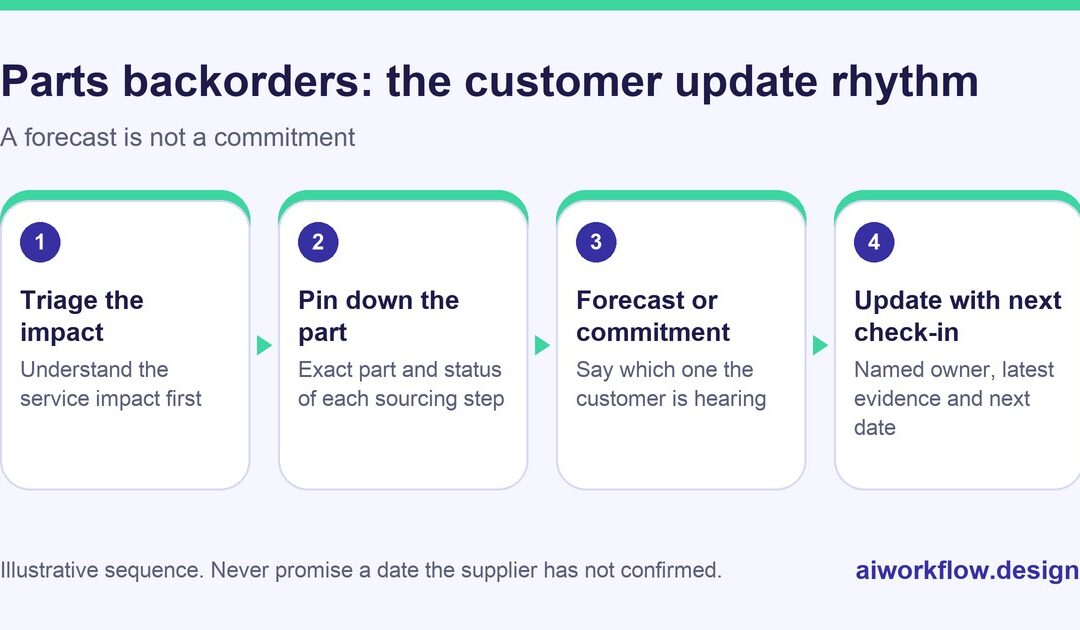
An emergency field service parts backorder workflow needs more than a supplier’s estimated delivery date. When an urgent repair stalls, the dispatcher is managing three connected promises: what the supplier can actually provide, when the engineer can return, and what the customer should expect in the meantime. If those promises are based on an unverified “tomorrow”, a single late part can become a preventable trust problem.
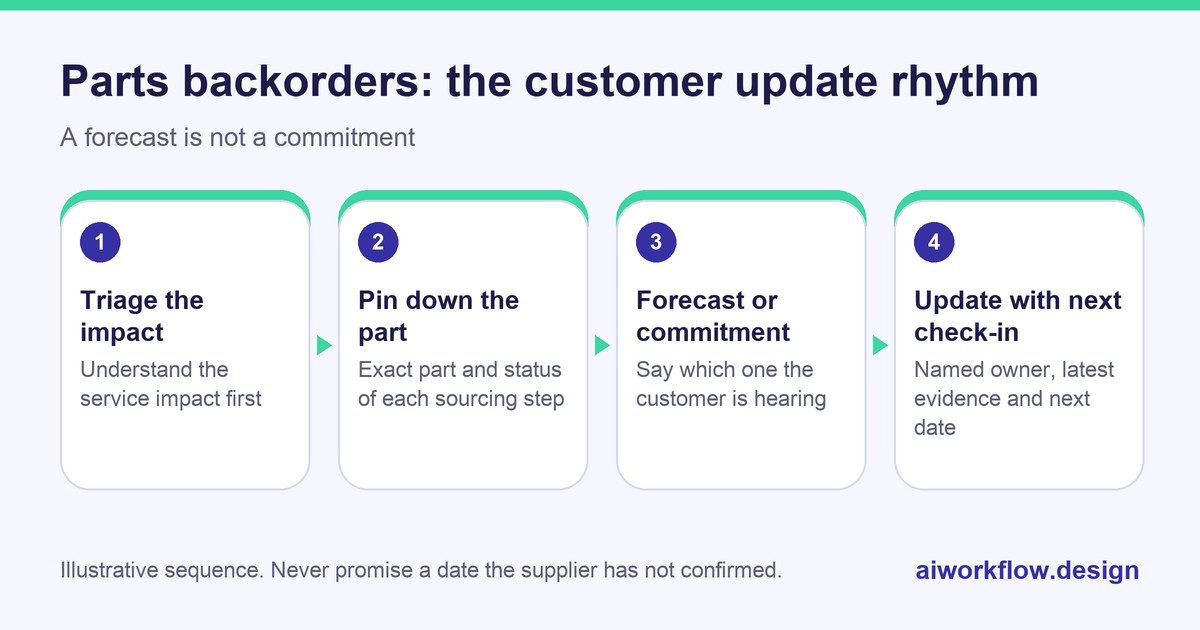
The better approach is to separate confirmed facts, supplier estimates and operational decisions. Give every update a named owner, a source and a next review point. Use automated calls to chase routine facts, not to make engineering or customer-contract promises on the team’s behalf.
Triage the service impact before calling the supplier
Identify the affected asset, job priority, customer impact and whether an authorised person has assessed temporary controls. A part required for non-critical planned servicing is different from one affecting essential refrigeration, accessibility or a potentially dangerous installation. Urgent safety or welfare concerns must go through the organisation’s human emergency procedure, not a scheduled AI call queue.
Record who may approve customer communications and any temporary operational arrangements. Do not ask an AI caller to advise a customer to bypass equipment safeguards, ignore an alarm or operate defective machinery. The service supervisor must decide whether the work area or equipment should remain out of service.
Identify the exact part and the status of each sourcing step
A usable backorder record includes Part number or approved reference, Equipment model, Quantity, Supplier, Order acknowledgement, Stock allocation status, Dispatch status, Carrier tracking when available, Site delivery requirements and Review owner. An order accepted by a supplier does not mean the item is physically in stock. Stock allocated does not mean it has shipped. “Out for delivery” does not guarantee the technician can install it on the same day.
If the part identifier changes, ask an authorised technical owner to confirm compatibility. Keep the original part and proposed substitute visible instead of overwriting the record. Warranty and safety consequences may depend on manufacturer instructions and contract conditions.
Communicate the difference between a forecast and a commitment
When the supplier gives an ETA, record its source, timestamp, confidence and next expected confirmation. For example, “supplier estimates dispatch Wednesday; allocation not confirmed” is more reliable than “repair Wednesday”. Only commit to a service return after dispatch and the necessary parts and technician prerequisites have been checked through the approved process.
Use consistent status terms: Sourcing, Supplier estimate, Stock confirmed, Dispatched, Delivered awaiting inspection, Technician scheduled and Repair verified. Keep “awaiting part” distinct from “technician delayed”. A customer should not infer that the engineer missed an appointment when the true blocker was an unavailable component.
Create a repeatable customer update rhythm
Set a specific next update during the first affected customer conversation. For a genuinely urgent situation, the next contact point may be closer, but it should reflect the service impact and the supplier’s next meaningful checkpoint. Provide an interim message when the supplier cannot verify a date, rather than staying silent or inventing certainty.
A strong update covers four facts: what is known, what remains uncertain, what action the company is taking, and when it will communicate next. Avoid sending identical daily messages that claim progress without evidence. Escalate material changes—such as a cancelled order or rejected alternative—to the assigned dispatcher and account manager before issuing a new promise.
Five useful supplier check-in questions
For a particular order, ask: (1) Is the required part number and quantity still correct? (2) Is stock allocated or only expected? (3) What shipping milestone has actually been confirmed? (4) Is there a documented alternative or new blocker for technical review? (5) When will you next have verified information? Preserve the source of the response, not just a yes/no status.
For a field technician, the questions should instead confirm whether a return visit depends on the part, whether additional materials or access are required and whether the approved repair plan needs supervisor review. Do not schedule calls while the technician is driving or doing hazardous work.
Handle alternatives without creating a second problem
A supplier may propose a different component when the specified item is unavailable. That suggestion is a request for evaluation, not approval. Technical staff should check fit, manufacturer guidance, certification, warranty and operational implications; the customer or contract owner may need to agree the change. Record the decision and evidence before changing purchase orders or appointment plans.
For an illustrative failed commercial HVAC repair, the approved part is on backorder and a supplier proposes another unit in its catalogue. The dispatcher logs the suggestion as “alternative review requested”, not “part found”. The technician or technical supervisor assesses compatibility. Only then should the team revise the supply plan and customer expectations.
Keep an auditable handover if shifts change
A backorder may outlast several dispatcher shifts. The field service shift-handover guide recommends preserving the latest reliable status, blockers, next owner and next due action. That applies especially to urgent parts: each incoming dispatcher needs to know when the customer expects contact and who can authorise a revised repair plan.
If a supplier does not answer a routine follow-up, keep the order status unverified and apply a limited escalation rule. The missed-technician-call guidance illustrates why silence must not be converted into a factual conclusion about the person’s performance. The same discipline applies to suppliers.
Automate follow-up where the evidence is repeatable
A scheduled supplier or technician status call can save time when the questions are specific. Autoza AI for monday.com may be configured to collect approved task updates in an existing monday.com workflow; the Daily Check-in Agent is presented for teams using other trackers. Neither product should invent ETAs, approve substitute parts or automatically promise repair dates.
Assign the customer update to a human owner, attach the latest supplier evidence and record the next check-in. Then review an automated follow-up workflow for the repetitive coordination that currently occupies dispatchers’ time.
Explore Autoza AI for monday.com or browse more workflow guides.
Frequently asked questions
How often should customers receive updates about urgent parts backorders?
Set an agreed next-update time based on service impact, the supplier’s next reliable checkpoint and the customer’s needs. Communicate sooner when the material facts change; do not invent frequent updates that contain no new information.
What is the difference between an estimated and confirmed parts ETA?
An estimated ETA is a forecast or preliminary indication. A confirmed milestone should identify its source and what has actually been verified, such as stock allocation or a dispatch scan. Neither guarantees final delivery.
Can an AI caller promise a replacement part will arrive tomorrow?
No. Automated summaries should reflect the verified supplier response and its uncertainty. Customer-facing commitments should follow the company’s approved communication and dispatch policy.
Who approves alternative or substitute parts?
A competent authorised person should assess compatibility, manufacturer requirements, warranty, safety and customer or contract permissions. A supplier suggestion or AI transcription does not authorise substitution.
How should an unresolved backorder appear on monday.com?
Keep the affected work order open with the required part, supplier status, verified evidence, customer update owner, next check time and escalation path. Do not mark the job complete merely because a part has been ordered.
Related reading
- Second-Visit Jobs: Confirm Parts and Access Before Dispatching a Technician
- Warranty Service Follow-Up: Record the Right Evidence Before Closing a Job
- Shift Handoffs for Dispatch Teams: Stop Losing Open Service Jobs
- Field Service Photo Evidence: What to Request After a Job Update Call
- How Many Field-Team Check-In Calls Are Too Many?
- Technician Van Stock Replenishment: Track Parts Usage and Shortages