

Quick answer: An excavation utility locate checklist should establish the approved dig scope, utility-notification reference, required response window, available locate markings and plans, site-specific permits, competent-person inspection, and a documented authorisation to start. A phone check-in can collect the status of these prerequisites, but it must not interpret buried-service locations, certify trench safety or tell a crew to dig.
The excavator arrives before sunrise, the operator is booked and the traffic-control team is standing by. Someone recalls that a locate request was submitted, but cannot show whether all affected utilities responded. Another person has an old site plan. The foreman is now deciding whether the schedule pressure is worth a delay. This is where a permit tracker either helps or gives the team false confidence.
The problem is rarely one missing phone call. Excavation brings several different controls together: public utility notification, privately owned services, municipal permissions, access and traffic arrangements, drawings, changing ground conditions and a competent person’s inspection. They cannot be reduced to one checkbox labelled “811 done.” Under the US OSHA excavation requirements, the estimated location of underground installations reasonably expected to be encountered must be determined before opening an excavation, and utility owners must be contacted under the applicable response conditions.
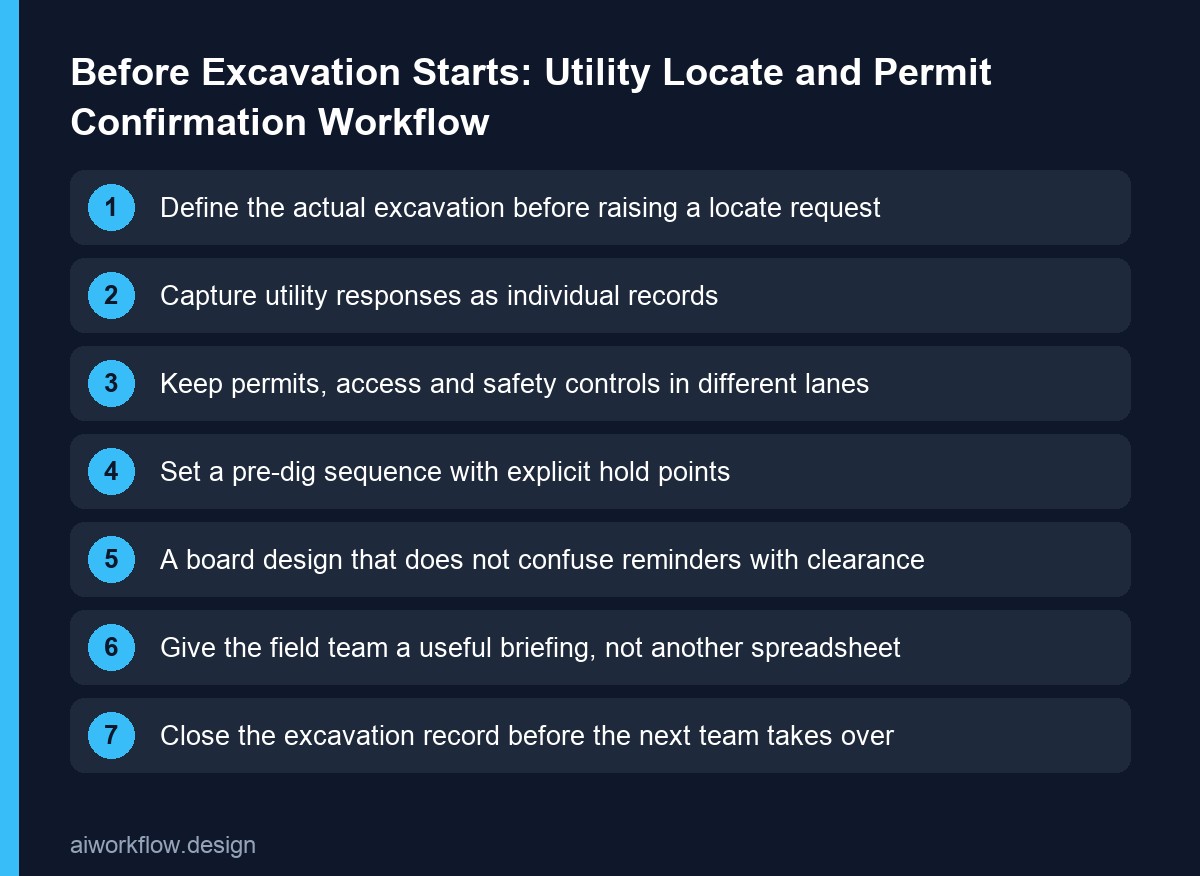
Define the actual excavation before raising a locate request
Start by recording the work area, proposed depth and method, planned date, site boundaries, responsible contractor and the drawings used for planning. A shallow signpost hole, a trench beside an existing building and mass excavation for a new basement have different risks and dependencies. A request that describes only a project street address may not adequately identify where the ground will be disturbed.
Attach a controlled site plan showing the intended work zone. Record whether the work involves private utilities, overhead lines, abandoned infrastructure, adjacent structures or sensitive public areas. The utility-notification process often does not locate every privately owned service inside a property boundary; the contractor must check the applicable programme rules and arrange additional investigation where needed.
Keep planned dates distinct from authorised dates. Booking a machine for Thursday is a commercial arrangement, not evidence that Thursday is a safe or legally permitted start day. If the scope moves, the team must check whether its locate request, permits, markings and risk assessment still cover the revised work.
Capture utility responses as individual records
The reference number for a call to a notification centre is the beginning of an audit trail, not the final approval. Build a response register by utility owner or operator, with the requested area, notification date, required response date, response type, sketch or marking evidence, outstanding issues, next action and responsible reviewer. “No conflict,” “marked,” “not yet responded” and “requires on-site meeting” are meaningfully different outcomes.
US 811 programmes differ by state in notice periods, response processes, expiry rules and the meanings of marking statuses. Do not publish a national “always wait two days” instruction or assume all marked services are shown at exact depth. Check the local one-call centre and the current work location requirements. The excavation supervisor should ensure that unresolved responses are handled using the applicable procedure rather than treating absence of an email as clearance.
Use a separate line for private utility locating, potholing or exposure confirmation where required by the safety plan. As excavation approaches an estimated underground installation, OSHA requires exact locations to be determined by safe and acceptable means. Locates and drawings inform the plan; they do not remove the need for careful field verification.
Keep permits, access and safety controls in different lanes
A site may require excavation, street-opening, road-occupation, traffic management, environmental or client-specific permits. Not every site needs all of them. The permits coordinator should identify the requirements from the location and project documents, store authorised numbers and conditions, and track any changes. A draft application is not an issued permit; a permit covering one block does not automatically authorise work on another.
Alongside permits, identify the competent person who will inspect the excavation and protective systems. OSHA calls for inspection before work and as needed during shifts, including after rainstorms or other hazard-increasing events where exposure can reasonably be anticipated. Other controls may include cave-in protection, access and egress, spoil placement, water management, atmospheric assessment and the stability of adjacent structures.
The status tracker should show whether these tasks are assigned and documented, not pronounce the work safe. If the competent person identifies a hazardous condition, the stop-work and corrective-action process governs. A call centre, AI assistant or general project manager must not override that decision because the schedule is tight.
Set a pre-dig sequence with explicit hold points
Planning stage: confirm current drawings, utility owners, dig footprint, required notices and permit applications. Pre-mobilisation: verify that required utilities have responded and that outstanding conflicts, third-party permissions and site-specific investigations have an owner. Day before: reconcile changed scope, weather, access, plant, protective systems and the latest notifications. Day of work: the competent person conducts the required inspection and authorised site personnel brief the crew using current evidence.
No item should turn green merely because someone said “we should be fine.” For every hold point, store its required evidence and the role authorised to release it. If a marking is disturbed or no longer legible, or the work zone changes, the supervisor must decide what additional notification or remarking is needed under the applicable rules.
Use a clear do not start status for unresolved critical prerequisites. A coordinator can help the decision-maker see the blocker, but only the site’s authorised personnel can release work under the project’s procedures. This separation is especially important when a contractor and subcontractor use different job-management systems.
A board design that does not confuse reminders with clearance
Create one project item for each excavation zone and subitems for utility notification, each relevant utility response, private-service checks, permits, drawing revisions, traffic arrangements, competent-person inspection and toolbox briefing. Useful columns include responsible owner, due date, evidence reference, reported status, verified status, last contact and escalation route.
monday.com’s automation options can notify named owners when dates or statuses change, subject to the actual configuration and plan capabilities. Avoid an automation that changes a “Site released” field from several completed reminders. The authorised supervisor should make that decision based on the complete current record and the conditions on site.
If crews use Autoza AI’s monday.com check-ins, the administrative use case is narrow and useful: ask whether the utility response is logged, who is waiting on the permit and when the crew can update the board. Do not ask an automated agent to assess gas-line clearance, interpret marking colours or permit trench entry. For a separate quality-control gate, the site’s pre-pour inspection checklist demonstrates why formal release and progress reporting must stay distinct.
Give the field team a useful briefing, not another spreadsheet
At the pre-start briefing, the supervisor should be able to answer: What is being excavated today? Which current drawing and zone apply? Which utilities have responded? Are there private services or unresolved conflicts? What permits and restrictions govern the work? Where are locate records and emergency contacts? Who is the competent person, and what protective measures have been selected?
Use a short, controlled summary that links back to the source records. If the crew reports an unexpected pipe, cable, smell, water inflow or soil movement, the required response is not to update a dashboard and carry on. Stop affected work, move people out of danger where necessary and escalate under the site safety plan to qualified responders.
An effective checklist does not guarantee zero strikes or establish regulatory compliance. It makes missing administrative evidence visible early enough for responsible specialists to act.
Close the excavation record before the next team takes over
When excavation ends, update the controlled record with the actual work zone, encountered services, approved design changes, field photographs where permitted and any required as-built information. Confirm who owns backfill inspection, reinstatement, permit closeout and notice to affected utility owners. Keep safety observations and formal testing evidence in the authorised project system, not in a general voice transcript.
A short closeout review can also improve the next excavation. Was a private service missing from the initial plan? Did a permit condition arrive later than expected? Did a utility response need escalation? Capture these as process improvements without changing historical evidence or attributing blame from unverified comments. The aim is to make tomorrow’s pre-dig briefing more reliable—not to declare that a completed trench was free of risk.
Next step: pilot one dig-zone readiness board
Map a real upcoming excavation into dated evidence requirements and name the supervisor who controls the release decision. Use AI Workflow Design’s products for optional task follow-ups, while keeping excavation permits, utility confirmation and safety sign-off in their authoritative systems.
Frequently asked questions
What is the minimum excavation utility locate checklist?
It should identify the exact work zone, current drawing, locate-ticket reference, relevant utility responses, private-service investigation needs, required permits, field verification plan, competent-person responsibilities and clear unresolved hold points. Expand it according to the site’s hazards and local requirements.
Does an 811 ticket mean digging is automatically authorised?
No. A notification ticket documents a request and may support required communication, but response obligations, wait periods, ticket validity and unresolved conflicts vary locally. Safety inspections, permits and on-site controls remain separate responsibilities.
Can a crew use old utility markings after the dig area changes?
Do not assume so. The supervisor should verify whether the existing notification and markings cover the changed location and remain valid and legible. Request new or updated locates and revise the plan when required by local law or field conditions.
Can automated status calls verify that a trench is safe?
No. A call can collect an administrative progress report. A competent person and other qualified parties must inspect conditions, evaluate hazards and implement the necessary protections under the governing requirements.
What should happen if a utility owner has not responded?
Record that response as unresolved, review the applicable local process and OSHA requirements with the responsible contractor, and escalate the start decision to authorised site personnel. Do not silently mark “clear” or infer permission from non-response.
Related reading
- Construction Closeout Packages: Following Up on O&M Manuals and As-Built Drawings
- Pre-Pour Readiness: Who Confirms Concrete Inspection Hold Points?
- Equipment Rental Off-Hire: Avoid Paying for Idle Plant on Site
- Land Development Utilities: A Follow-Up Plan for Water, Power and Access
- Managing Multiple Construction Sites: Standardise Foreman Status Reports
- More AI workflow guides