

Quick answer: A construction stormwater inspection follow-up workflow tracks which inspections are due under the site’s applicable permit, who performed them, what deficiencies were recorded, which contractor owns each correction, when evidence was submitted and who verified closeout. It must not replace required field inspections or interpret permit compliance automatically. The Stormwater Pollution Prevention Plan (SWPPP), permit conditions and qualified inspectors remain the authoritative sources.
On active developments, earthworks shift every week. A sediment barrier is moved to make way for an access road. Stockpiles appear, a washout area is relocated, and a heavy shower exposes weaknesses that were not visible during the last walkover. The problems are rarely solved by collecting more generic status updates. They are solved by connecting the observed condition to a specific owner, deadline, repair and reinspection.
This is an administrative workflow that supports environmental oversight; it is not itself an environmental inspection or a substitute for the controls required by law.
Identify the governing permit before choosing a checklist
In the United States, construction stormwater requirements are generally administered under a national permitting framework by the federal environmental agency or an authorised state. Coverage triggers, inspection cadence, storm-event provisions, corrective-action deadlines and reporting procedures vary. A developer must first identify the permit and the precise site’s conditions, including any additional state or local requirements.
Permit terms and effective dates change over time, so confirm which general permit currently applies to the project and whether a replacement is pending. Do not treat proposed permit language as already effective, and never take an inspection interval from a generic blog when a different local permit controls the project.
Identify the responsible operator or operators, permit coverage reference, site SWPPP owner, qualified inspection personnel and authorised environmental contact. Check whether the project has any special waters, dewatering or high-risk conditions that change its obligations. Use an up-to-date copy of the actual permit and SWPPP as the review baseline.
Design records around findings, not just inspection dates
A calendar entry that says “stormwater check complete” hides almost everything a developer needs to manage. Each inspection should link to the actual report, site and inspection date, inspecting person, applicable permit or SWPPP revision, areas inspected, findings, observed discharge where relevant, photographs, weather context and any required corrective-action or follow-up items.
A finding should become its own action with an unchanging ID, location, description, risk or priority as assigned by an authorised person, responsible contractor, instruction source, due date, evidence location, reviewer and verified closure timestamp. Do not let the contractor’s “fixed” status overwrite the inspector’s original finding.
If the same silt fence is damaged during a second storm, create a linked new event rather than rewriting the previous inspection report. Recurrence is operational information: it may indicate poor installation, an undersized measure or a change in site runoff that requires redesign.
Build a stormwater action flow with explicit review gates
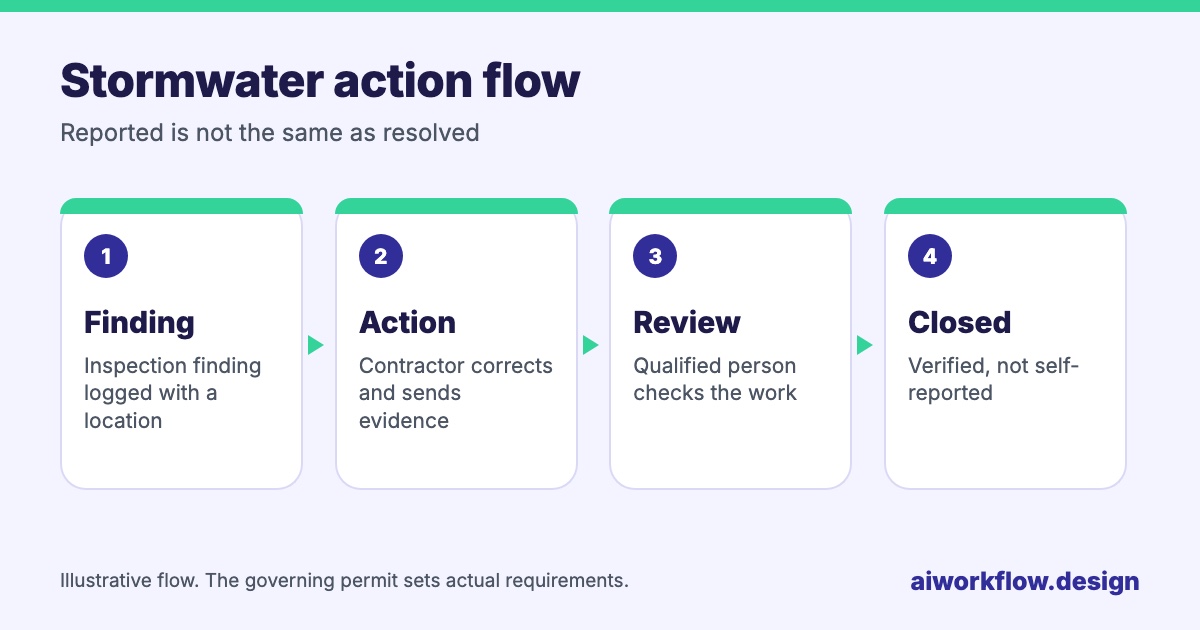
A workable sequence is Inspection scheduled → Inspection conducted → Findings recorded → Correction assigned → Contractor reports action → Qualified review / reinspection → Verified closed. Also use distinct statuses for Escalated, Unable to access and Reopened. Inspection overdue should never be marked complete because somebody confirmed they intend to visit tomorrow.
The contractor performing a repair might provide photos, invoices, GPS-tagged notes or a signed work ticket. Those records document what the contractor reports. A qualified inspector or authorised environmental lead must then determine whether the evidence and, when required, a site verification are sufficient for closeout. A photograph of newly placed straw wattles does not prove the measures are correctly sized or effective.
Add escalation triggers for missed deadlines, repeat defects, reported discharges, access constraints and discrepancies between the contractor’s account and the inspection record. The thresholds for regulatory notification must come from the applicable permit and professional advice—not from a generic automation rule.
What to check during an active-site follow-up
Disturbed soil and slope protection
Assign open areas to a responsible earthworks lead. Check whether reported stabilization and erosion-control work has been inspected as required, including along newly cut paths. Track the location and evidence of work rather than an unsupported percentage called “site stabilized.”
Sediment barriers and inlets
Record findings for perimeter controls, drainage inlets, check dams or other permitted measures. A contractor may report a repaired filter or removed sediment; the inspector decides whether the controls meet the applicable site requirement and whether further maintenance is needed.
Vehicle entrances and track-out
Repeated sediment leaving the site can affect roads and nearby drainage. Record the observed location and cleanup or access measures as separate tasks. A traffic or civil contractor may own physical cleanup, while the SWPPP team retains oversight.
Material stockpiles, concrete washout and chemicals
Follow up on inspection findings involving exposed stockpiles, waste storage, spills and washout provisions. The appropriate specialist must assess environmental and emergency implications; administrative staff should not offer containment instructions beyond approved procedures.
Discharge points and dewatering
Dewatering and runoff discharges can carry permit-specific controls or monitoring. Escalate uncertain observations to the qualified environmental lead rather than having an AI system infer whether turbidity, treatment or discharge conditions are acceptable.
Use rain events as a trigger for review, not an invented universal threshold
Weather is useful context for scheduling. A project may record rainfall amounts, storm end times and a task to consult the relevant inspection obligations. But different permits define different triggers and inspection timeframes, so do not hardcode a threshold such as “0.25 inches always requires a next-day inspection” across every site.
If an authoritative local permit requires an event-driven inspection, the site owner can configure the actual requirement into the tracker and route the task to the named qualified inspector. A weather feed is only an input. A forecast, a gauge reading or a no-answer phone call must never be mistaken for the field inspection record.
Example: sediment-laden runoff near a temporary entrance
Consider a hypothetical development where the appointed inspector records sediment tracking at a recently opened access gate after rain. The finding refers to a dated photo and a site location. The civil subcontractor receives an assigned action to address the observed condition under the site team’s instruction. It later reports that a permitted corrective measure has been implemented and provides a photo.
The environmental lead reviews the action against the SWPPP and permit obligations, requests any needed site verification and records the closeout decision. If a further event reveals the same problem, the tracker connects the new finding to the earlier case without deleting either history. The workflow records people, dates and evidence; it does not make an environmental compliance finding on its own.
Use AI calling only for authorised administrative reminders
A controlled check-in can ask the assigned contractor whether the corrective-action task has been scheduled, whether photos have been uploaded and which supervisor owns a blocked follow-up. It may also remind the environmental team that an inspection report is awaiting submission. It should not ask unqualified staff to certify that discharge is lawful, infer SWPPP compliance from a verbal “done,” or classify an environmental incident.
AI Workflow Design provides status-checking products and custom integration services that can be assessed for this narrow administrative use. Ensure site-specific authorisations, call consent, records retention and restricted access before connecting operational records. For incident or regulatory deadlines, use direct notification paths designed by the responsible environmental team.
Measure whether actions are genuinely closed
Useful measures include overdue inspections under the site’s actual permit, corrective-action ageing, repeat findings by location, time between contractor-reported completion and authorised verification, and number of actions reopened after a later inspection. Avoid a dashboard that celebrates 100% task completion when inspections are missing or findings have been closed without review.
At weekly construction meetings, review the open environmental register beside the site programme. If the project is changing drainage or excavation sequencing, update the operational plan and request qualified input before the changes occur. Stormwater oversight works best when the environmental team hears about project changes before the next storm.
Administrative visibility should reinforce field accountability
A mature process puts the current permit, SWPPP, real inspection reports and qualified reviewers first. Technology then helps contractors receive clear actions, submit attributable evidence and avoid forgotten follow-ups. The point of an automated reminder is not to pronounce a site safe or compliant; it is to make sure that the person who can make that determination has the information and time to do it.
Next step
Want these follow-ups handled consistently? Explore Autoza AI for monday.com or talk to AI Workflow Design about scheduled, permissioned status follow-ups that leave approvals with the right people.
Frequently asked questions
What is a construction stormwater inspection follow-up?
It is the administrative process of tracking required inspections, findings, assigned corrections, submitted evidence and qualified verification under the site’s permit and SWPPP.
Does every US construction project follow the same inspection schedule?
No. Applicable federal, state and local permits, site conditions and special requirements can differ. Use the project’s current legally applicable permit.
Can a contractor photograph alone close a stormwater violation?
A photo may support an action record, but the authorised reviewer must apply the permit, SWPPP and any field-verification requirements before determining closure.
Can an AI call replace a post-rain inspection?
No. It may remind the assigned inspector or contractor about a task, but only a qualified and properly documented inspection satisfies the inspection obligation.
What should be escalated immediately?
Any issue the site’s applicable permit, emergency procedure or environmental lead identifies as urgent, including serious discharge concerns, missed mandatory deadlines or conditions posing immediate harm.
Related reading
- Phase I Environmental Assessments: Track Consultant Evidence Requests
- Municipal Hearing Conditions: Following Up on Development Entitlements
- Land Development Utilities: A Follow-Up Plan for Water, Power and Access
- Permit and Inspection Follow-Up for Real Estate Development Projects
- Site Inspections Delayed? Build a Dependency-Based Calling Schedule