
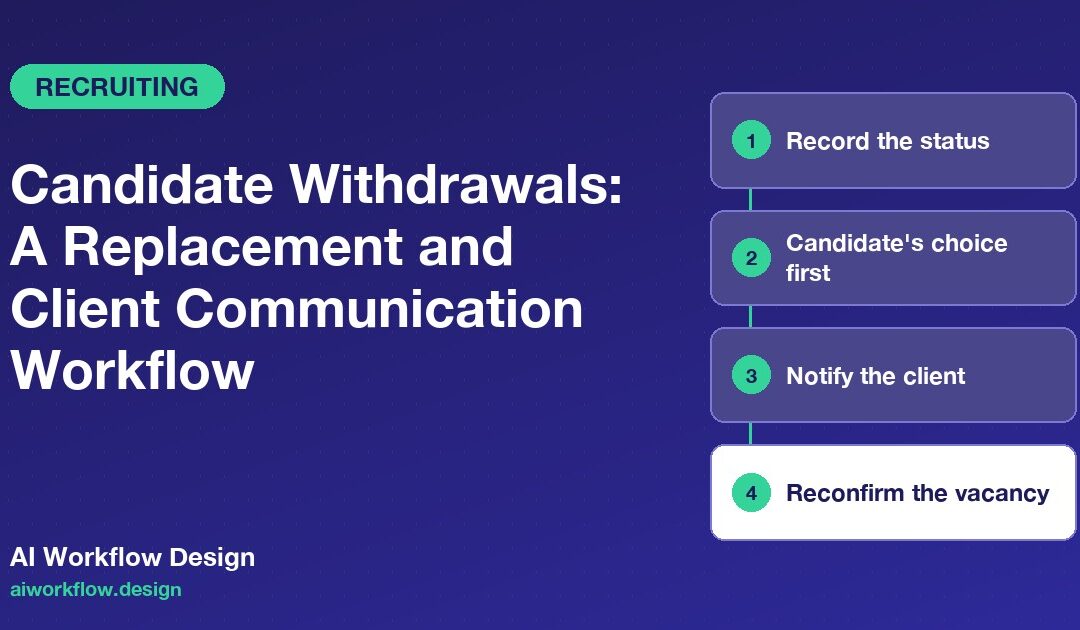
Quick answer: A fair candidate withdrawal replacement process records the candidate’s decision accurately, stops unapproved outreach, informs the relevant hiring team in neutral language and starts a replacement search only under the client’s confirmed requirements. It separates a voluntary withdrawal from a rejection, failed check or employment decision. A coordinator may arrange next steps, but should not speculate about the person’s reasons, disclose confidential information or automatically penalise future applications.
A recruiter has prepared three candidates for a final interview. Twenty minutes before the meeting, one sends a message: “Thanks for the opportunity. I’ve decided not to continue.” The client wants an explanation, the interview panel wants to know whether to keep the slot, and the account manager is worried about time-to-fill. This moment tests the agency’s operations more than its ability to write a polite text.
The first task is to respect what the candidate actually said. The second is to manage the client’s schedule and staffing need. The third is to launch a replacement only when the vacancy, pay band, location and urgency are still accurate. Mixing those tasks can turn a routine withdrawal into an unnecessary privacy or fairness problem.
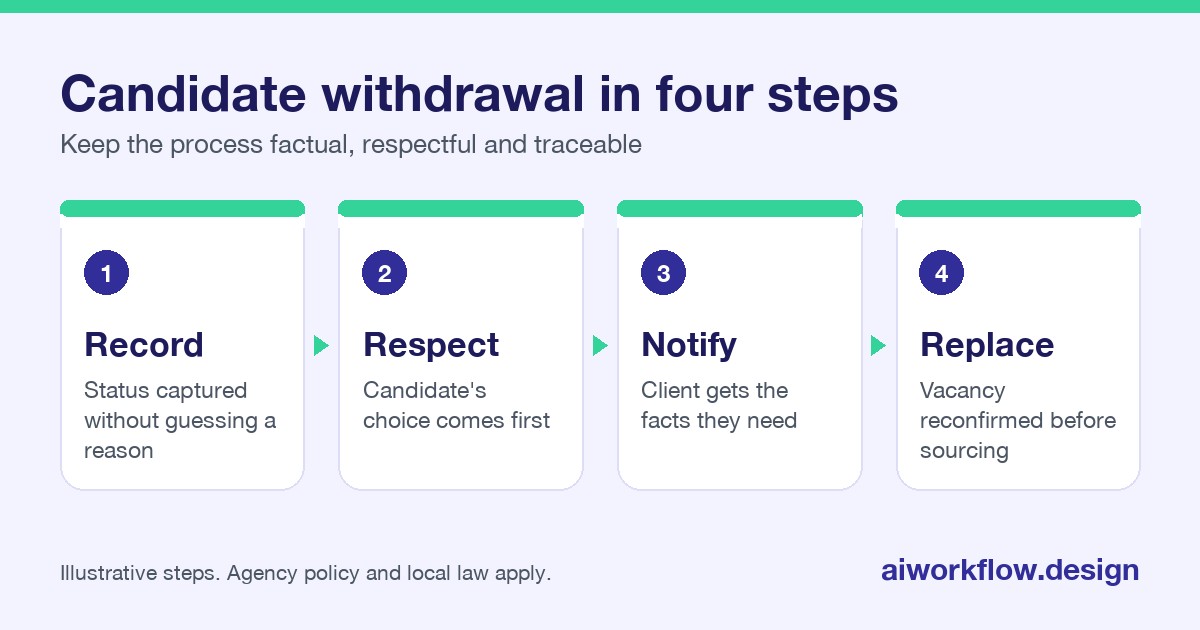
Capture the status without inventing a reason
Use a controlled reason code Candidate withdrew – no reason required. If the candidate voluntarily shares a reason that is appropriate and necessary to retain, it should be handled under the agency’s confidentiality and data-minimisation rules. The client usually needs an availability update, not details about the candidate’s health, family, immigration history or other sensitive circumstances.
A withdrawal may happen before screening, after an interview invitation, after a conditional offer or even close to an anticipated start date. The applicable contractual and employment implications may differ. Record the stage and the actual message or approved case reference. Do not represent a late-stage withdrawal as a failed background check or a rejected offer. In particular, an unanswered message should not automatically be classified as a confirmed withdrawal.
US EEOC guidance on applicant medical information demonstrates why recruiters must treat confidential health disclosures differently from routine progress updates. EEOC recordkeeping guidance also identifies retention duties for covered employers and selection records. Organisations should apply their own jurisdiction-specific requirements and policies rather than deleting relevant employment records arbitrarily.
Put the candidate’s choice first
Acknowledge the decision once, courteously, through an approved channel. Confirm only any logistical matter that genuinely needs resolution: for example, cancellation of a booked interview or return of a supplied access pass. If the candidate states they do not want further contact, ensure automation and recruiter sequences reflect that instruction. A future re-engagement invitation should be optional, not a condition of ending the process.
Do not send repeated “Are you sure?” reminders, seek a reason after the candidate declines to give one, or schedule an AI call to persuade them. If the agency needs to understand a genuine discrepancy—such as an apparent withdrawal sent from an unrecognised contact channel—use a limited, respectful verification route. The purpose is accurate administration, not pressure.
Update internal statuses in a way the whole team understands: Withdrawal received → Confirmation assessed → Interviews or offers cancelled where required → Client notified → Replacement decision pending → Search reopened. Each transition should have a clear actor and timestamp. Keep operational notes separate from restricted personnel information.
Notify the client with the information they need
The client-facing update can be brief: “The candidate has withdrawn from the process and is no longer available for the scheduled interview. We are confirming the replacement approach and will share the next qualified shortlist under the agreed role criteria.” Avoid claiming to know why they left or implying an adverse finding.
If an interview is imminent, state whether it has been removed from calendars and whether the panel should retain the slot for a potential replacement. Give an honest next-update commitment based on your actual delivery plan rather than promising another candidate today. When an offer-stage withdrawal affects start dates or operational coverage, involve the authorised account manager and HR or legal contacts as needed.
Some clients will ask for details. The recruiter should apply the agreed privacy policy and respond only with information legitimately shareable under the contract and law. A neutral update is not evasive; it keeps the client focused on the decision they can make: reopen sourcing, adjust the selection criteria or reconsider the urgency.
Reconfirm the vacancy before sourcing replacements
A role that was difficult to fill last week may now have different realities. Before copying the original requisition, verify the job title and duties, location and work arrangement, compensation range, essential skills, shift pattern, screening process, hiring contact and realistic interview slots. Ask whether the client wishes to revisit nonessential requirements that slowed the previous search. Do not quietly remove essential qualifications to produce a faster shortlist.
Create a new replacement work item linked to the original requisition. Retain the earlier candidate’s status for reporting, but do not place their private communication into a broad sales pipeline. Assign an owner to new outreach and a separate owner to client approvals when the agency’s operating model requires it.
A replacement search should not “inherit” candidate consent. Another person may be on a previous shortlist but their availability and continued interest are not guaranteed. Ask permission before representing them as ready for an interview, share only agreed information and follow applicable data-use rules.
Use one operational tracker rather than scattered chat threads
The job-level case can contain requisition ID, withdrawal stage, latest verified candidate status, interview cancellation owner, client notification timestamp, decision about reopening, search owner, revised criteria version, shortlist target and unresolved blockers. Record time to client notification and time to replacement shortlist as different measures.
Add a control for downstream systems: calendar invitation cancellation, interview panel alert, recruiter task closure, CRM or applicant-tracking system update and any scheduled candidate communications. If a candidate withdraws after a background check was requested, the applicable vendor or HR owner should handle cancellation and retention under the approved process. A general status board must not display confidential screening findings.
Avoid a single “closed” column for both the candidate case and the vacancy. The candidate case can be closed while the job remains open, or the client may choose to suspend the search. Keeping those states independent prevents embarrassing updates to the wrong audience.
Example: a candidate disappears before the first day
A hypothetical temporary assignment is due to start Monday. On Friday the worker explicitly confirms they are withdrawing. The agency acknowledges the message, notifies the client that the original worker is unavailable and checks whether the site still needs cover on the planned shift. The staffing lead reviews contractual terms, any previously issued kit or access and the worker’s legitimate outstanding employment matters.
Operations then asks an alternative candidate whether they are interested and available. The worker is not told “You’re already booked” until the client and worker approvals required by the process are complete. No automated system invents an explanation for the withdrawal or marks the first candidate as untrustworthy. Where urgent shifts are affected, provide the client with clear contingency options instead of an unsupported promise.
Automate reminders, not hiring judgments
An approved check-in may ask the internal recruiter whether the client has been notified, whether the replacement shortlist is ready and who is handling the next interview booking. For candidate-facing communication, use the candidate’s approved preferences, consider consent and make opting out easy. Avoid automated cold calls that repeatedly push a person to explain their decision.
AI Workflow Design’s agent products and custom integration services can support routine status capture with appropriate controls. A specific applicant-tracking or recruiting platform integration must be separately scoped. No product should be presented as determining candidate suitability, legal eligibility or the consequences of withdrawal.
Review outcomes without punishing legitimate withdrawal
Track withdrawals by process stage, last-minute cancellations affecting capacity, delay in client notification, number of stale job specifications and replacement acceptance rates. Use aggregate trends to diagnose preventable operational friction, such as very slow feedback or conflicting interview times. Do not turn a candidate’s decision into a simplistic personal reliability score.
The most useful learning question is often: “What did our process allow the candidate to understand about the job, and how quickly did the client make decisions?” If the answer is poor, the agency can improve transparency, interview scheduling and hiring-manager communication. That is more productive than pressing individuals to justify their personal choices.
Close the administrative loop with dignity
A withdrawal is complete when the candidate’s wishes are reflected in communications, affected appointments are handled, the client receives an accurate neutral update and any necessary records are retained through the approved process. The replacement case remains separate until a new candidate has actually agreed to proceed. Operational discipline lets the agency move quickly without treating people as interchangeable inventory.
Next step
Want these follow-ups handled consistently? Explore Autoza AI for monday.com or talk to AI Workflow Design about scheduled, permissioned status follow-ups that leave approvals with the right people.
Frequently asked questions
What is the first step after a candidate withdraws?
Record the candidate’s clear decision and honour their contact preferences. Then cancel affected appointments and notify the hiring manager with a neutral availability update.
Should recruiters share the candidate’s withdrawal reason with the client?
Not automatically. Share only information that is lawful, necessary and permitted by the relevant privacy arrangements; a simple notice that the candidate is unavailable is often sufficient.
Does a missed interview mean the candidate has withdrawn?
No. A missed interview needs its own follow-up status. Do not infer a voluntary withdrawal or an adverse finding from non-response alone.
Can an agency reuse a previously shortlisted candidate?
It may consider previously interested candidates subject to current consent, availability, role criteria and applicable data rules. The candidate must not be represented as committed without confirmation.
Can AI reject or penalise candidates who withdraw?
This workflow must not do that. AI may track administrative milestones and remind staff, while hiring decisions and legally sensitive assessments remain with authorised humans.
Related reading
- Assignment End Dates: Follow Up on Redeployment and Equipment Returns
- Candidate References: A Consent-First Follow-Up Schedule
- Candidate Availability Checks: Confirm Timing Before Sending a Shortlist
- Job Requisition Changes: A Hiring Manager Follow-Up Checklist
- After an Offer Is Accepted: A Staffing Handover Checklist