

Quick answer: A practical commercial solar underperformance workflow first verifies the asset, time period, data quality and agreed performance baseline. It then separates monitoring outages from genuine production loss, assigns a competent analyst, captures a documented finding, and escalates confirmed defects to the relevant O&M or warranty owner. An AI reminder can chase a report or vendor response, but it cannot diagnose a faulty inverter or decide that a contractual guarantee has been breached.
A portfolio manager receives a message saying a solar array produced 18% less energy last month. Within minutes, the message is forwarded to the installer, the inverter manufacturer and the finance team. Three tickets are opened, each with a different number. Two weeks later, nobody can explain whether the figure came from weather-normalised modelling, inverter telemetry or an incomplete meter feed.
This is not primarily a problem with alerts. It is a problem with the missing decision trail between solar production monitoring and a technically supported warranty case. A useful workflow fixes that handoff before it automates follow-up messages.
Define which performance question the alert is asking
Solar PV output changes with irradiance, temperature, shading, system age, grid conditions and availability. The U.S. Department of Energy describes performance ratio as a comparison of actual production with modelled output under measured solar conditions; availability asks whether the system could generate when solar resource and grid conditions permitted. Those are different questions from whether the monthly energy total fell below a budget forecast.
Record the metric name, calculation owner, reporting period and data source. “Below target” is meaningless unless the target is identified. A weather-adjusted performance ratio, a guaranteed annual yield, a raw energy-production budget and an equipment uptime commitment should not be placed in one red/green column.
Before anyone sends a warranty demand, retrieve the relevant O&M agreement, performance-guarantee definitions, exclusions, notice deadlines and manufacturer terms. Some contracts have minimum durations, cure periods or separate responsibility for monitoring systems. The process must follow the actual documents rather than a generic percentage threshold.
Triage the information quality before the hardware
Start with three questions: Did the meter report consistently? Was the comparison window complete? Did the data represent the correct plant and meter boundary? Common causes of misleading alerts include missing telemetry intervals, a meter replacement, time-zone mismatch, changed plant configuration or a monitoring gateway outage.
Create a data-quality review status separate from asset fault suspected. An analyst can then document whether production data are sufficient for comparison. Do not let an automatically generated chart turn “data missing” into “energy lost” without investigation. Preserve the raw readings and analysis version; if the initial alert was wrong, close it as a data issue with an explanation.
Where an alert involves a safety concern—such as damaged equipment, abnormal heat indications or an electrical incident—use the existing emergency escalation procedure immediately. Performance analysis is not a substitute for hazard management.
Monitoring setup affects data quality from day one; see PV monitoring activation.
Build a case with evidence a vendor can actually use
Create one case ID per affected asset and incident window. Collect the site ID, inverter or string identifiers when appropriate, first and last abnormal timestamps, performance baseline, monitoring source, equipment events, recent maintenance history, weather-normalisation method and the contract or warranty reference.
Include a chronology rather than a folder of screenshots: alert generated; monitoring validated; initial diagnostic request; O&M contractor response; manufacturer ticket submitted; parts or visit pending; repair performed; independent verification completed. Screenshots can supplement original telemetry, but a screenshot cropped to one bad day cannot establish a full-month failure.
The commercial owner should also identify who can approve a repair quote, whether a manufacturer return authorisation is required and who manages grid or occupier access. Even when warranty parts are covered, callouts, shipping, labour and production-loss terms may not be. Keep those costs separate until the relevant contract is reviewed.
Roof and installation warranties follow similar evidence rules; see solar roof warranty coordination.
Use a staged escalation rather than an all-purpose ticket
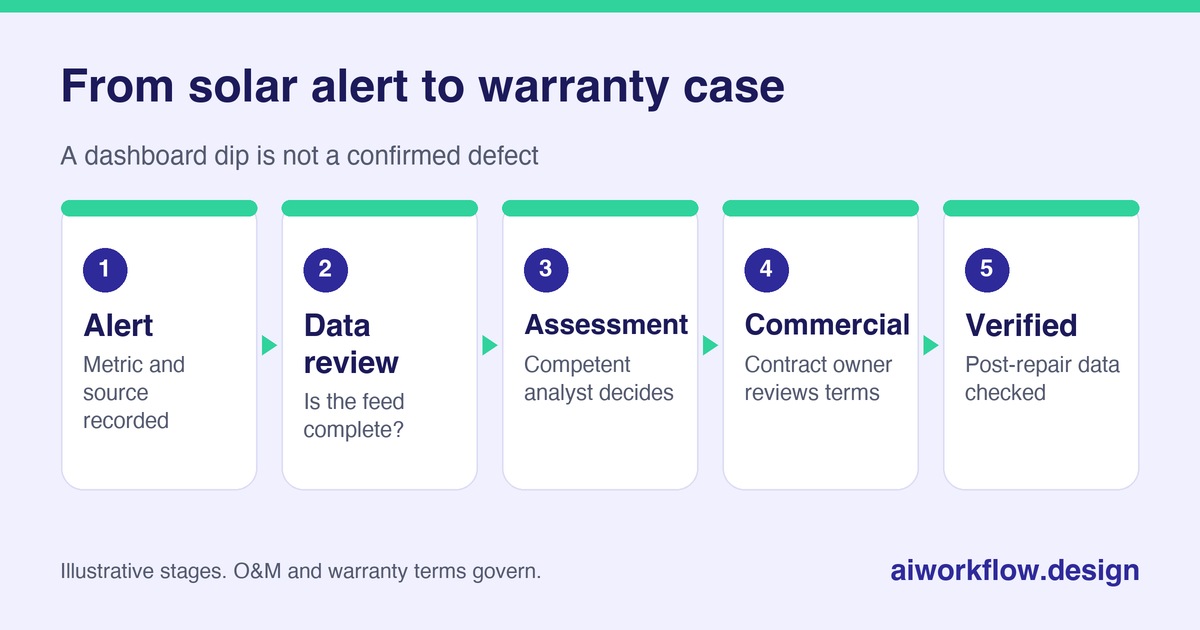
A useful operating sequence is:
- Alert received: record the source and the exact metric.
- Data review: decide whether the measurement is usable.
- Technical assessment: an appropriately competent specialist interprets the evidence.
- Responsibility assigned: the O&M provider, installer, OEM or owner takes the next action.
- Commercial review: an authorised contract owner evaluates notice and warranty requirements.
- Correction and verification: the service action is performed and post-work performance is assessed.
- Accepted closure: outstanding commercial and technical matters are resolved or clearly retained as open.
These stages expose the common mistake of treating “manufacturer responded” as “problem fixed.” A manufacturer may request additional telemetry, decline coverage or refer the case back to the site contractor. Each response needs a new owner and due date, not an automatic closeout.
Configure a monday.com underperformance register
Useful columns include Plant ID, Alert date, Metric and threshold, Monitoring source, Data quality, Analyst, Current finding, Vendor case number, Warranty type, Next response due, Escalation priority, and Acceptance authority. Link a document register containing the time-series export, O&M contract, diagnostic evidence and approved service reports.
Avoid putting confidential system login credentials or full power-system diagrams into unrestricted board comments. Use role-based access for source records. Link each vendor case to a work item without overwriting the original alarm; repeat incidents should remain visible for root-cause analysis.
One dashboard should answer: Which alerts still lack a data-quality decision? Which confirmed failures await a technician? Which vendor replies are overdue? Which assets have been repaired but not validated? Those views are more actionable than a large pie chart labelled “Solar Health.”
Follow up on obligations, not technical judgements
A scheduled call can ask an internal coordinator or vendor contact, “Has the requested diagnostic report been supplied?” or “Who will respond to ticket PV-041 by Friday?” It can capture a reply and place a reminder on the assigned case. It should never ask the model to interpret inverter fault codes, tell a technician to reset or isolate equipment, or promise a warranty replacement.
AI Workflow Design’s products describe status-calling and monday.com updates, while its custom automation services cover workflows that need additional system integration. That can help the administrative layer if approved by the customer and connected to authoritative data. It does not create an engineering certification or manufacturer warranty entitlement.
The script should expose uncertainty: “Vendor reply expected,” “No response,” and “Technical reviewer requested” are legitimate outcomes. “Failure confirmed” belongs only to the person with the evidence and authority to make that decision.
Example: the apparent inverter failure that was a data gap
A school’s PV system shows a sharp decrease on the dashboard after a network change. The automation creates a case, but the first task is to confirm meter completeness. The analyst discovers that the monitoring gateway stopped uploading for 36 hours while the revenue meter continued recording normally. The case is reclassified as a monitoring issue and assigned to the connectivity provider. The owner receives a factual update: the dashboard has incomplete data and an engineering investigation has not identified lost energy.
Contrast that with a site whose verified meter data, weather-adjusted comparison and recurring inverter alarms show sustained underperformance. The analyst records the finding, the contract manager checks the applicable guarantee and the vendor receives a complete evidence packet. A service visit is scheduled through authorised procedures. After repair, the analyst compares an agreed monitoring period and the owner signs off the technical and commercial closeout separately.
The same reminder infrastructure can support both cases, but the decisions are very different. That is why evidence classification must come first.
Report meaningful operational outcomes
Track time from alert to data-quality decision, confirmed failures awaiting first technical review, vendor response ageing, repeated fault categories and time from repair to verification. Separately report financial exposure only after contract interpretation and approved calculations. Avoid public claims that the workflow will recover a particular percentage of generation or guarantee a warranty payout.
Solar O&M improves when the team knows whether it has an actual production issue, an incomplete data feed or an unresolved contractual question. Automation should shorten the distance between owners, not shortcut the evidence needed to make that distinction.
Field visits need their own readiness checks; see the solar O&M site visit checklist.
Next step
Want these follow-ups handled consistently? Explore Autoza AI for monday.com or talk to AI Workflow Design about scheduled, permissioned status follow-ups that leave approvals with the right people.
Frequently asked questions
What is a solar underperformance investigation?
It is a documented review of the reported energy or performance shortfall, data quality, appropriate baseline, technical cause and contractual responsibilities before corrective or warranty action is taken.
Is low monthly production proof that an inverter failed?
No. Weather, availability, shading, meter issues and data gaps can affect reported output. A qualified analyst should examine the relevant measurements and equipment history.
What should a solar warranty evidence packet contain?
Typically the asset identifiers, warranty reference, incident dates, validated data, relevant alarms, maintenance history, diagnostic findings and the responsible contact, adjusted to the manufacturer’s stated requirements.
Can an AI agent approve a warranty claim?
No. It can request missing documents and log vendor status. Technical diagnosis, liability, coverage and commercial approvals remain with qualified personnel and authorised parties.
How do you close a solar production alert?
Use explicit closure evidence: data issue corrected or fault addressed, technical review completed, post-action performance checked as agreed, and contract owner acceptance recorded where required.
Related reading
- Solar O&M Site Visits: Coordinate Access and Safety Prerequisites Before Dispatch
- PV Monitoring Activation: Confirm Alerts and Owner Access After Installation
- Solar Roof Warranty Coordination: Questions Before Panel Mounting Starts
- Inverter Firmware Updates: Plan Vendor Windows and Change Records
- Battery Storage Commissioning: A Safety-First Documentation Follow-Up Plan