
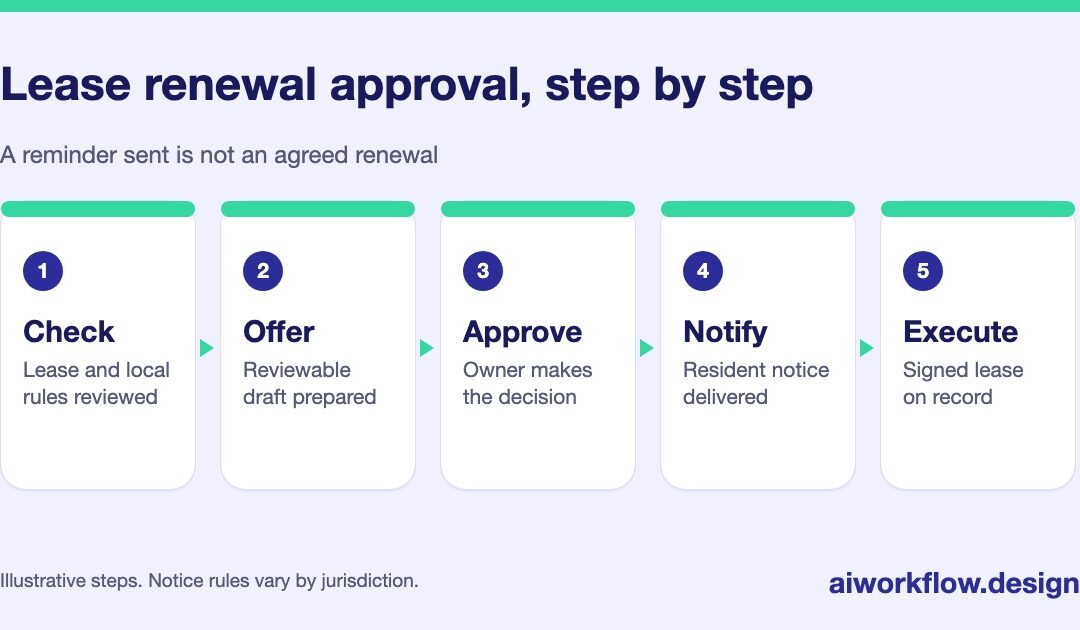
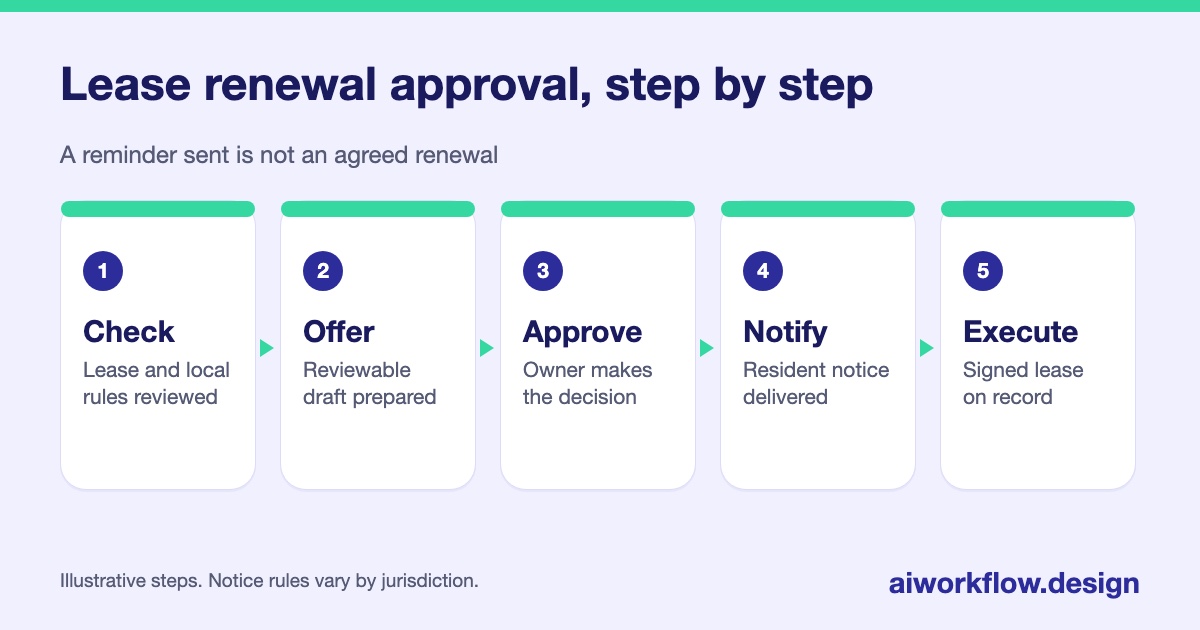
Quick answer: A lease renewal workflow should check the current lease and applicable housing rules, prepare a reviewable offer, obtain the property owner’s authorised decision, deliver any required notices correctly, record the resident’s response, and complete the executed lease or next lawful step. A reminder sent or conversation held is not proof that a new rent, term or renewal has been agreed.
Renewals can become surprisingly fragmented in a busy property portfolio. An owner has approved an annual increase in principle, but the final offer is not ready. The manager sends a draft to the wrong email address, the resident asks a question about a parking space, and the lease end date approaches. A spreadsheet shows “contacted,” which tells the next person almost nothing about whether an offer was lawful, properly issued or accepted.
The better approach is to treat each renewal as a controlled decision with several distinct participants: property owner, asset or property manager, compliance reviewer when needed, resident and lease administrator. The management platform and monday.com can coordinate work without making the legal decisions.
Verify the lease, jurisdiction and property type first
Before preparing numbers, check the signed lease, amendments, tenancy commencement and expiration terms, notice addresses, renewal options and any rent-adjustment provisions. Determine whether the property is subject to local rent regulation, affordable-housing or subsidy rules, owner-occupancy restrictions, or another specialised regime. Notice requirements may vary even between neighbouring jurisdictions; there is no safe universal renewal deadline or permissible rent increase.
Do not assume non-response means a tenant accepted new terms, or that the same renewal process is lawful for a month-to-month tenancy and a fixed term. Refer ambiguous legal questions to a qualified local housing professional or counsel. The Fair Housing Act also prohibits discriminatory treatment in covered rental transactions; property teams should use consistent procedures and escalate accommodation or other protected-rights issues through approved channels.
Store the verified rules source and review date in a restricted compliance record. The public task board needs the applicable deadline and approved process, not a reproduction of private legal advice or personal information.
Prepare an offer the owner can approve intelligently
A renewal recommendation should contain the property and unit identifier, existing and proposed lease terms, any regulated or contractual limits, maintenance or amenity commitments that affect the offer, and the proposed resident communication date. Explain the reasoning in terms the authorised owner can understand without making promises about future market conditions.
Separate the commercial recommendation from final authority. A leasing coordinator may gather comparable-market information; an owner or designated asset manager decides within the applicable agreement and law; a lease administrator generates the correct document. If the owner changes the rate or term after reviewing the draft, generate a new version so the resident never receives a document that does not match the recorded approval.
The same principle applies to concessions, parking, pet terms, utility responsibilities and renewal length. A seemingly small email offering an extra parking permit may create an obligation if it is issued as an authorised offer. Use a review gate for anything that changes a contractual term.
Create a resident communication schedule, not just a reminder date
Once the approved offer is ready, confirm the notice method and timing required by the applicable lease and law. Record who prepared it, who reviewed the content, the channel used, the recipient and the evidence of delivery or service. A platform notification may be useful administratively, but it may not satisfy a legal service rule. Keep a copy of the actual version delivered.
Plan accessible, respectful follow-ups that give the resident a clear way to ask questions and communicate a decision. Do not use an automated call to pressure a tenant or imply that a response is compulsory when it is not. Offer accommodation and language-access routes where required or appropriate. Sensitive account, medical or household details should not be collected by a generic check-in agent.
A property manager may receive three common responses: interest in renewal, questions or requested changes, and an intention not to renew. Each must lead to a different task. A question about repairs needs a maintenance owner; a request for altered terms needs a new owner approval; a non-renewal statement needs validation under the lease and local process. Recording all three as “responded” hides the work that remains.
Use one decision log for negotiation and document versions
Maintain the original offer reference, date sent, authorised terms, proposed changes, resident response and owner decisions. Avoid overwriting the first offer with the latest draft. The audit trail should show whether a revised document was issued and who had authority to approve it. Track any electronic signature invitation and actual completion separately; opening a link is not executing a lease.
Where the resident disputes a term or requests a different renewal period, pause the standard sequence and route the case for review. The board should never send a revised legal document solely because an AI system summarised a phone conversation. If rent-regulation, fair-housing or consumer-protection issues arise, use the property’s legal escalation process rather than improvising a standard answer.
The AI Workflow Design AI Receptionist describes property-management call handling, including leasing enquiries. That is useful background for the communications layer, but renewal decisions and legal service requirements require additional process design and authorisation.
Structure a monday.com lease renewal board
One item per unit-renewal cycle is usually sufficient, linked to the authoritative lease system. Fields can include property and unit ID; responsible manager; owner approver; lease end date; verified notice deadline; legal regime reviewed; proposed term; offer version; owner approval status; issue date and delivery evidence; resident response; change-request owner; signing status; executed document link; and final ledger or property-system update confirmation.
Use clear stages: eligibility and rules review → offer drafted → owner review → approved → issued → resident response pending → negotiation/revision or signing → executed and verified → archived. Add declined and requires legal review branches. An unsigned or disputed renewal should not automatically roll into an “active” lease simply because the planned start date arrived.
monday.com’s due-date and status automations can remind managers to follow up, but the board should not become the legal lease of record. Keep resident documents and personal information in the appropriate permission-controlled property-management system. If you want a cross-system update when a signed lease is received, design it with a human verification point rather than accepting any attachment with a familiar filename.
Use AI calls only for permitted administrative status
A routine check-in with the internal property manager can ask: “Has the owner approved the final offer version?” “Has the authorised notice been issued through the required process?” “Does the resident have an open question requiring a human reply?” A call to a resident should follow the organisation’s consent, privacy, accessibility and communications rules and should be limited to appropriate information, not negotiation or pressure.
AI Workflow Design’s Daily Check-in Agent is intended to collect task updates from authorised teams. Applying it to renewal administration would need confirmed contact permissions and a carefully scoped script. It must not infer a resident’s consent to a contract, pronounce a rent increase lawful or approve a discriminatory exception.
Close the renewal only after systems match
When the renewal is executed, verify that the actual signed document matches the approved offer, the correct parties have signed, any required notices and disclosures are complete, and the lease or property-management system reflects the new term. Check that billing or rent schedules have been updated by an authorised person. If the resident will vacate, open the proper move-out workflow rather than leaving a renewal item indefinitely pending.
Post-close review should focus on preventable delays: owners who routinely miss review windows, resident questions that lack a clear owner, document versions that generate confusion, and issues caused by incorrect notice addresses. Do not turn those findings into automatic decisions about which residents deserve offers; use them to improve administration and consistent service.
A reliable programme gives residents clearer communication and owners an accurate decision history. Its key advantage is not speed for its own sake: it is the ability to see precisely which part of a renewal is incomplete and who is allowed to resolve it.
Next step
Want these follow-ups handled consistently? Explore Autoza AI for monday.com or talk to AI Workflow Design about scheduled, permissioned status follow-ups that leave approvals and decisions with the right people. For a companion workflow, read Multifamily Pest Control Scheduling: Coordinate Access, Vendors and Follow-Ups. Related guidance for housing teams: see our property management automation page.
Frequently asked questions
How early should a property manager start a lease renewal?
Start far enough ahead to meet the actual lease and jurisdictional notice rules, allow owner review and handle resident questions. There is no universal legally sufficient number of days for every property.
Can a property manager raise the rent without owner approval?
Only if the management agreement authorises that decision and applicable law permits the proposed terms. The workflow should record the decision authority, approved version and legal review where necessary.
Does a resident answering a follow-up call count as accepting renewal?
No. A conversation is an administrative contact, not proof of valid contractual acceptance. Follow the lease’s and jurisdiction’s required acceptance, notice and signature processes.
What should be stored in monday.com versus property software?
Track task ownership, deadlines, approval status and references in monday.com. Keep the signed lease, detailed resident information, formal notices and financial records in the authorised property system.
How can automation improve renewals without risking noncompliance?
Use date reminders, internal owner check-ins and missing-document alerts. Keep legal interpretations, owner approvals, resident negotiations and lease execution with authorised people.