
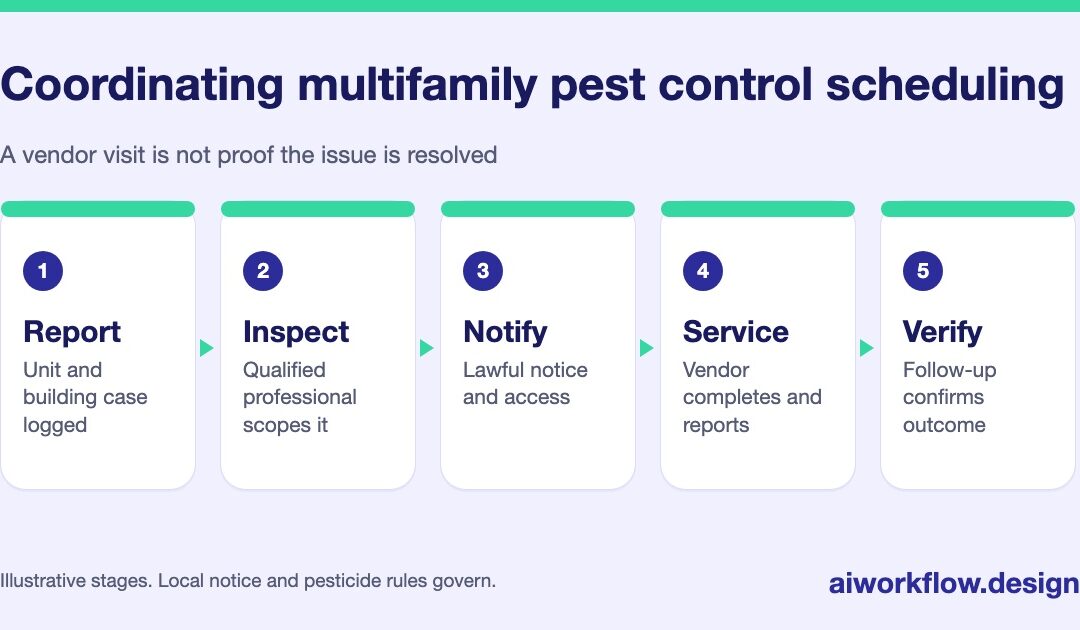
Quick answer: A multifamily pest control scheduling workflow records a resident or staff report, arranges qualified inspection, determines the authorised treatment or prevention plan, communicates access and preparation instructions, checks vendor completion evidence, and schedules verification. It should use integrated pest management principles rather than treating every complaint as an automatic chemical treatment request. The pest professional and property manager—not an AI caller—make safety, treatment and re-entry decisions.
A resident reports cockroaches near the kitchen sink. Maintenance previously repaired a leak, but the complaint returns and another unit reports similar activity. The pest contractor has availability next week; the resident works nights; the building manager is unsure which neighbouring units need inspection. Booking the first available appointment without coordinating these dependencies can waste the visit and leave the underlying issue unresolved.
Multifamily properties share walls, plumbing penetrations, waste systems and common areas. A useful process therefore coordinates property-wide evidence and access while respecting each resident’s privacy, legal notice rights and safety needs.

Record the complaint without making a diagnosis
Capture the property and unit identifier, date, reported location, type of observed activity where the resident can describe it, recurrence, photographs if voluntarily provided, relevant building-maintenance observations and any urgent safety concern. Do not require residents to diagnose the pest or upload medical information. A complaint about bites may have many explanations; a licensed professional should determine the appropriate inspection scope.
Set an initial triage status: new report, inspection needed, urgent human review, or linked to an existing building-level case. Avoid collapsing all reports into one generic “pest issue.” The shared case may reveal a common entry point, but individual access and resident communications still require distinct records.
EPA’s guidance for multifamily residents and housing managers emphasises cooperation and integrated pest management (IPM). A repeated spray appointment without investigating moisture, food sources and entry points may miss the conditions that allow the problem to persist.
Engage the right professional and define responsibilities
Check contractor licence or registration where required, insurance, approved scope, site policies and any building-specific risk or access restrictions. The pest professional determines the inspection method and, when necessary, treatment selection, application conditions and safety instructions under applicable rules and product labels. Maintenance personnel may address leaks, door sweeps, gaps, waste storage and repairs after the appropriate assessment. The property manager coordinates resident notice and access and documents decisions.
The distinction matters. A maintenance work order can be closed after a plumbing leak is repaired while the associated pest-management case remains open for verification. Likewise, a pest contractor’s service report may identify building repairs that require a different owner. Link the tasks; do not let either group independently declare the whole issue resolved.
If the complaint is part of a larger building problem, open a building-level parent item with related unit-specific scheduling items. This lets the manager compare evidence without making tenants’ names, complaints or occupancy patterns visible across unrelated staff groups.
Confirm resident notice and access requirements before booking
Review the lease, local entry laws, applicable housing or pesticide notification requirements and the contractor’s approved preparation instructions. These rules may vary by jurisdiction, treatment type and building. Do not copy a generic “24-hour notice” into every property’s process. Record the required notice channel, who is authorised to serve it and the evidence of delivery where appropriate.
Give residents the date and appointment window, what area requires access, why the visit is needed, whom to contact for questions and the preparation instructions supplied or approved by the professional. Where lawful and operationally possible, provide an accessible method for requesting another appointment. Avoid asking a resident to disclose a medical diagnosis to an automated system to explain a scheduling conflict; route sensitive questions to the authorised property team.
A missed appointment should be classified accurately: resident requested reschedule, notice not confirmed, contractor unavailable, access issue, safety hold or appointment completed. Labelling every failed visit “tenant refused” creates a misleading record and can damage relationships.
Build prevention work into the same plan
IPM looks beyond treatment to conditions that sustain pests. The assigned team may need to inspect for water intrusion, repair gaps and penetrations, improve waste-management practices or address recurring sanitation problems in common areas. These tasks should be recorded with owners and due dates separately from the vendor’s service appointment.
When the professional recommends an action, document who received the recommendation and who must approve and implement it. Do not automatically issue resident instructions or order a chemical service based on a keyword in a call summary. Product selection, exposure restrictions and re-entry timing are matters for the qualified professional and applicable label and law.
Create separate schedules for access, treatment and verification
A single calendar entry hides several obligations. The resident access appointment needs an agreed window and notice evidence. The contractor service needs a defined scope and qualified personnel. Maintenance repairs may be scheduled before or after inspection. Verification should occur at the interval recommended by the professional or required by the site’s approved programme, not automatically the day after a visit.
If a resident cannot be present or provide access, follow the lawful process for rescheduling or entry. If a vendor cancels, notify affected residents promptly and update the notice plan. If the professional reports incomplete work, keep the case open and document the reason. Avoid recording “treated” as “pest-free.” Only appropriate monitoring and professional assessment can support the outcome.
For housing teams juggling many incoming calls, AI Workflow Design’s AI Receptionist describes maintenance intake and after-hours routing for property management. It can support the intake side of a workflow, but any actual pest-control scheduling integration, communication consent and escalation procedure should be confirmed during implementation.
Configure monday.com around a building-level case
Use one parent item for the building or shared-area investigation and linked items for each relevant unit, vendor appointment and maintenance repair. Fields can include case ID, site, issue category, reported date, qualified inspection status, professional owner, lawful notice status, appointment window, resident communication owner, access outcome, contractor report reference, recommended repairs, verification date and authorised closure decision. Apply role-based restrictions to resident-specific data.
Stages might be reported → triage → professional inspection pending → plan approved → resident notices and access → service in progress → repairs pending → verification scheduled → reviewed and closed. Include urgent escalation, cannot access and professional review required as explicit branches. A vendor’s visit should not automatically mark all linked resident reports closed.
Use date and status notifications for tasks such as a missed confirmation or outstanding contractor report. AI Workflow Design’s workflow automation services can be evaluated for reducing repeat phone calls or connecting task systems. The actual capabilities should be mapped against the chosen property software and the organisation’s access, privacy and safety controls.
Keep AI calls administrative and respectful
For internal staff, a short check-in can ask whether the notice has been sent, whether the vendor confirmed an appointment, or whether a repair ticket is awaiting a contractor. For residents, any automated scheduling communication must follow applicable consent and privacy rules, clearly identify its purpose and offer human assistance for concerns. It should not provide pesticide safety advice or decide whether a unit is safe to enter after treatment.
AI Workflow Design’s product overview describes scheduled calls and recorded outcomes. These can be used as the administrative layer only if the correct scripts, access permissions and escalation paths have been configured. Residents who communicate symptoms, accessibility needs or allegations of unsafe conditions should be routed to appropriate humans, not treated as routine appointment-status fields.
Close with evidence, not simply a vendor invoice
A sensible closure check asks whether the qualified service was performed, whether the professional’s report is stored, whether needed building repairs were completed, whether residents received the required follow-up, and whether verification took place. Record the responsible human reviewer and remaining monitoring tasks. The presence of an invoice confirms commercial activity, not necessarily effectiveness.
Review repeat reports by building area and issue type without producing unnecessary resident profiles. Clusters of complaints may indicate a property-level repair or sanitation problem; repeated no-access visits may indicate a communication or scheduling problem. These require different remedies and owners. The objective is a programme that residents can trust and property staff can administer consistently—not a board full of green completion labels.
Next step
Want these follow-ups handled consistently? Explore Autoza AI for monday.com or talk to AI Workflow Design about scheduled, permissioned status follow-ups that leave approvals and decisions with the right people. For a companion workflow, read Lease Renewal Offers: Track Owner Approvals and Resident Communications. Related guidance for housing teams: see our property management automation page.
Frequently asked questions
What should a pest control scheduling checklist include?
Complaint details, qualified inspection, vendor scope, lawful resident notices, appointment confirmation, preparation guidance from the professional, access outcome, service evidence, needed repairs and verification follow-up.
Should property managers automatically order treatment after every complaint?
No. Assess the report and follow the qualified professional’s inspection and IPM process. Treatment choices, including whether pesticides are necessary, depend on evidence and applicable requirements.
Can a resident’s missed appointment be recorded as refusal?
Only when the facts and lawful procedure support that description. Distinguish a missed contact, defective notice, scheduling conflict and explicit refusal; provide the required next steps.
Does a completed vendor visit mean the unit is pest-free?
No. Retain the service report and follow the recommended monitoring or verification process. Necessary prevention repairs or building-level actions may still be outstanding.
Can an AI receptionist give pesticide re-entry instructions?
It should not generate its own safety advice. Route residents to the qualified professional’s approved instructions and an authorised human for treatment, exposure or medical concerns.