
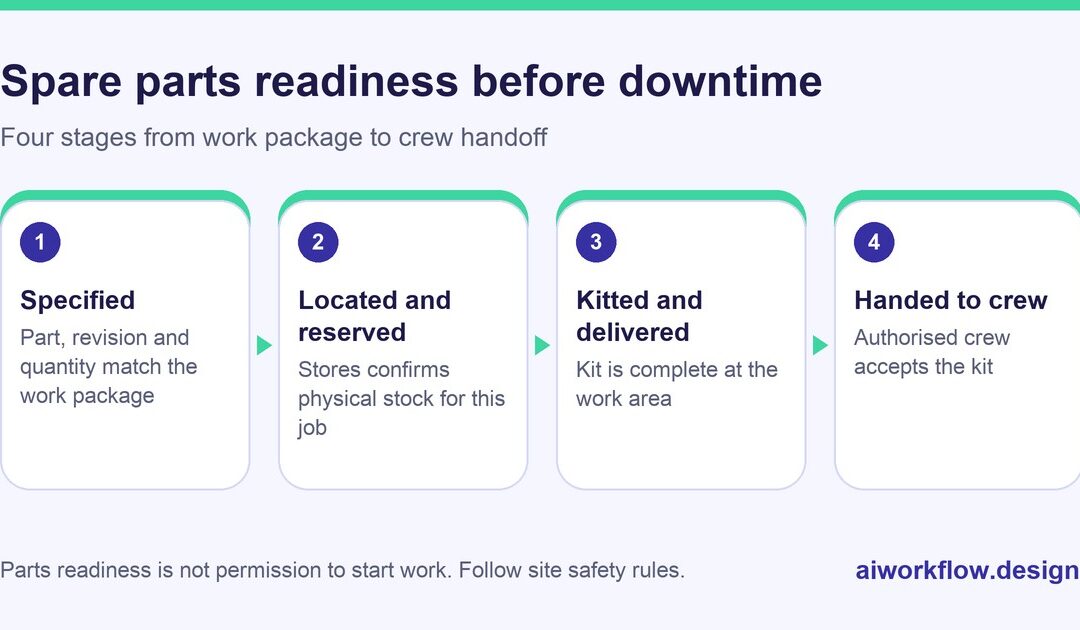
A maintenance spare parts readiness checklist helps prevent a planned plant shutdown from turning into a parts-search exercise. Availability is more than the number shown in an inventory report: the right component must be identifiable, correctly specified, physically available or reserved, accessible when the crew needs it, and compatible with the approved maintenance work package. A short status call can reveal a missing bearing or gasket before downtime starts, but it cannot certify a part as safe or authorise maintenance work.

Start with the actual maintenance work package
Before contacting stores or suppliers, define the equipment, planned intervention, work-order reference, engineering revision and expected task sequence. Separate critical spares from consumables and contingency materials. A substitute or alternative part might be acceptable only after a qualified engineer or designated technical approver reviews compatibility; the warehouse cannot make that decision merely because an item appears similar.
The work package should identify every planned component’s internal stock reference, required quantity, correct revision or specification, confirmed storage location, reservation status, kitting owner, supplier or transfer dependency and expected delivery date. Include the authorised maintenance window and the person responsible for resolving shortages. Keep manufacturer drawings and confidential repair procedures in the approved system.
Inventory in the computer is not material at the job site
A system balance of five units does not mean five usable units are available for this work. Some may be reserved for a different outage, located at another plant, in quarantine after an incoming inspection, damaged, expired or awaiting engineering review. Ask the stores team to confirm the actual position rather than allowing the project board to copy the ERP on-hand number as “ready”.
A useful stage model is specified → located → reserved → inspected as applicable → kitted → delivered to work area → handed over to authorised crew. Physical issue and return transactions should remain in inventory and maintenance systems of record. The project board is a coordination view, not a replacement for material-control procedures.
Name the owner of each readiness decision
Planning owns the outage schedule and work-package completeness. Stores owns the location, reservation and physical picking status. Procurement follows up with suppliers or inter-site transfers. Engineering decides whether a proposed alternative is technically suitable. Maintenance supervision confirms the crew, lifting and access plans and safe coordination requirements. Health and safety procedures govern hazardous-energy control and any work permits.
OSHA’s control-of-hazardous-energy standard requires appropriate energy-control procedures for relevant servicing and maintenance activities. An AI call that reports “parts ready” must never be interpreted as permission to remove a guard, isolate equipment, begin work or restart a machine. Safety authority remains with designated, trained personnel under the site procedure.
Ask stores and suppliers different questions
For an approved stores check-in, ask whether the listed components are physically located, reserved for the correct work order and prepared for kitting. For a supplier, ask whether the confirmed shipment and supporting documentation remain on schedule. For maintenance planning, ask whether the materials match the latest approved work package. These roles supply different evidence and should not receive the same generic “is everything ready?” question.
A practical five-question administrative script is:
- Are you the assigned owner for this maintenance material milestone?
- Is the correct stock reference and revision identified for the approved work package?
- Is the quantity physically available, reserved and ready for the required handoff?
- Are any supplier, inspection, access or transport dependencies preventing readiness?
- What is the next confirmed checkpoint and who must resolve the blocker?
If a supplier says “the parts have shipped”, record it as a reported shipment milestone. Do not mark it “on site” until receiving records confirm arrival. If stores says “we found a substitute”, record a proposed alternative awaiting approval rather than silently replacing the bill of materials.
A two-day workback plan for a planned intervention
A hypothetical maintenance planner preparing for a short conveyor outage may use the following decision sequence: review the approved work package and material list well ahead of the outage; check supplier commitments before the final scheduling meeting; ask stores to locate and reserve stock; inspect or verify controlled components where required; assemble the kit; confirm crew handover during the authorised preparation window. If a critical item remains unavailable, the responsible manager decides whether to revise the plan. The automated assistant records the dependency but must not decide to proceed without the part.
A more complex job may require specialist tooling, lifting gear, software versions, spare seals or calibration of instruments. The same tracking principle applies, but the work package—not a universal checklist—determines the actual technical requirements. Treat this content as a coordination framework, not a service procedure for a particular machine.
Build exception handling before sending calls
Create distinct categories for not found, quantity short, wrong revision, quality hold, delivery delayed, kit incomplete and awaiting engineering decision. Assign each category to a human owner and deadline. A wrong-revision item should not be solved by a procurement status call; technical engineering review is needed. A quality hold must remain visible until its own authorised disposition.
The existing supplier shortage tracking guide discusses suppliers that cannot fulfil demand. This article has a narrower focus: confirming that a planned maintenance job has the right approved spares at the point of use. The equipment installation article also covers safe separation of status reporting from technical commissioning.
What should a project dashboard measure?
Track the number of work packages with complete material kits, unreserved critical components, expected deliveries at risk, engineering substitutions awaiting review and work orders delayed due to material readiness. For data quality, record whether status was self-reported, physically verified or confirmed through the source system. Avoid dashboards that count every answered phone call as a readiness success.
AI Workflow Design’s published tools describe scheduled operational calls, retries and summaries. A carefully scoped monday.com pilot could collect administrative material-readiness updates after the team verifies permissions and field mappings. It should not write directly to safety, quality release, or inventory adjustment fields without the organisation’s approved controls.
Final maintenance spare parts readiness checklist
Before downtime, confirm work-package revision, every critical part’s authorised specification, physical stock and reservation, receiving or supplier evidence, kit completeness, transport arrangements, crew access, unresolved engineering approvals and an escalation owner. The maintenance supervisor should review material readiness alongside the independent site safety and operational requirements before work begins.
Next step
Discuss a planned-maintenance check-in workflow that helps the coordination team know what is missing without shifting technical authority to a voice agent. Explore Autoza AI for monday.com or browse more workflow guides.
Frequently asked questions
What should be on a maintenance spare parts readiness checklist?
Include the approved work-order reference, part numbers and revisions, quantities, reservations, physical locations, kitting status, supplier dates, authorised alternatives and responsible handoff owners.
Does stock-on-hand quantity prove that a critical spare is ready?
No. Stock may be reserved elsewhere, under quality hold, at the wrong site, damaged or the wrong revision. Physical and controlled-system checks are needed.
Can an AI check-in approve a substitute maintenance component?
No. Compatibility and substitution decisions require the organisation’s designated engineering or technical authority. The caller can record that approval is pending.
How should an incomplete maintenance kit affect a planned shutdown?
Escalate the missing material to maintenance planning and the authorised decision-maker. The team must decide whether to delay, change scope or use an approved alternative rather than letting a status tool choose.
Do spare-parts readiness calls replace lockout/tagout procedures?
No. OSHA’s hazardous-energy rules and the site’s authorised isolation, permit, training and verification processes govern applicable maintenance work independently of material readiness updates.
Related reading
- Supplier Part Shortages: A Manufacturing Follow-Up Matrix for Planners
- Planned Plant Shutdowns: Confirm Parts, Contractors and Work Packages
- Pilot Production Readiness: A Follow-Up Plan Before Ramp-Up
- AI Calls in Manufacturing: Where Human Safety Approval Must Stay in Control
- Corrective Action Ownership: Following Up on Manufacturing CAPA Tasks