
A privileged access review succeeds when an accountable application owner confirms whether elevated access is still justified and the identity team records the decision in the approved access-governance system. A privileged access review checklist helps teams follow up on missing attestations, but asking someone whether access is acceptable is not the same as collecting a signed, auditable approval. The operational goal is fewer overdue decisions without exposing privileged account information in routine calls.
Why privileged reviews stall even when the access report is ready
An identity team may export a list of administrators and service accounts on time, yet review completion still slips. One owner is on leave; another has moved departments; a business application has two competing owners. A reviewer may select “retain” without a reason or misunderstand whether a shared service identity is covered by the campaign. The technical inventory and the review workflow must therefore be separated. A report can be accurate while the attestation process is incomplete.
NIST’s security-control framework addresses account management and least-privilege principles. It supports defined access responsibilities and review processes, but does not prescribe an AI-phone-call approval method. The safest use of automated follow-up is administrative: remind the named reviewer about the pending request, capture a high-level blocker and direct the person to the authorised access-review portal. Never read privileged user lists or sensitive entitlements over an unverified call.
Start with the minimum attestation record
For each application, record a campaign identifier, application owner, review window, number of review assignments, current owner-response state, escalation owner, secure evidence location and last contact. Put entitlements and user-identifying detail in the identity governance platform, not in the voice assistant’s call script. If a review is already approved, the project board may reference a completion receipt; it should not be the system where the approval is recreated.
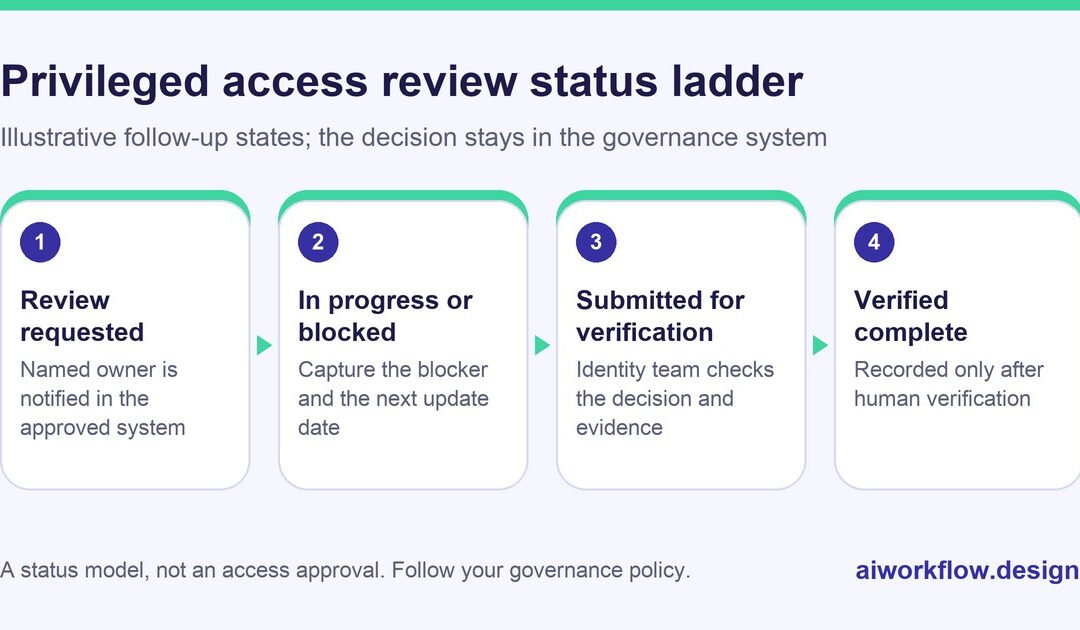
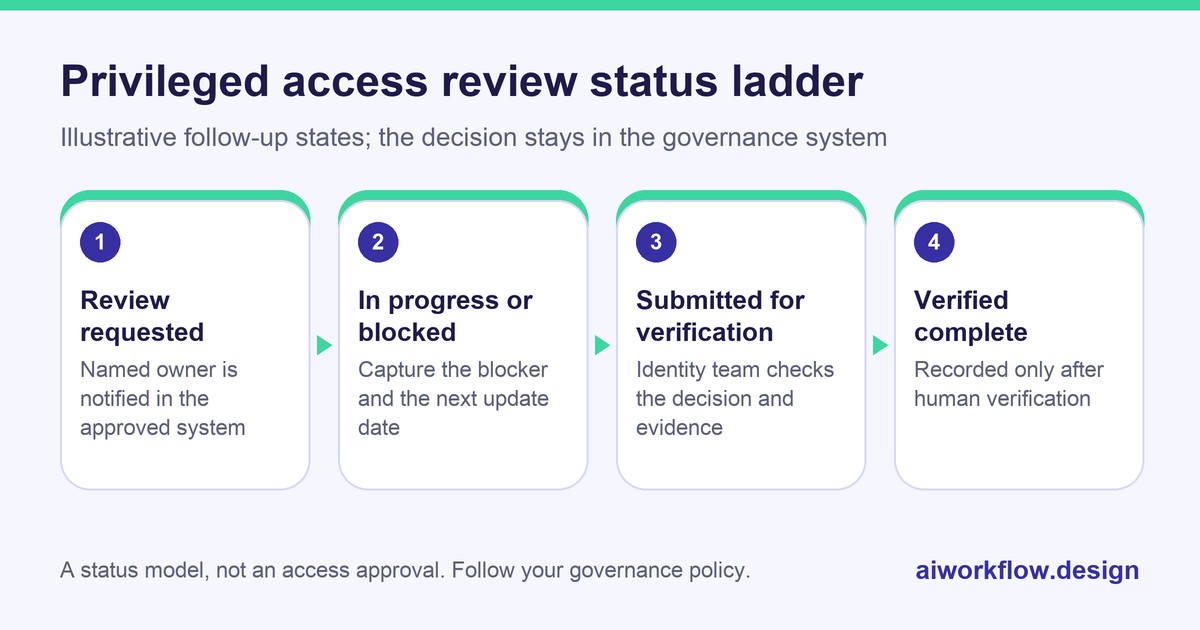
A practical status vocabulary is not contacted, review requested, review in progress, owner blocked, submitted for verification and verified complete. Avoid treating “I looked at it” as verified complete. The identity team should reconcile the actual submitted decision and the evidence reference before moving that item to its final state.
Build an escalation ladder that respects separation of duties
First, confirm the responsible owner through the approved application register. If the owner is missing, route reassignment to the service owner or governance coordinator. If a reviewer asks for guidance on a particular entitlement, send the question to the authorised security or application administrator using the secure ticket channel. If an attestation is late, contact the campaign coordinator before escalating under the organisation’s documented policy. A high-risk access concern should use the security reporting path, not routine reminder retries.
The review coordinator can chase dates and identify missing ownership, but should not override a conflict-of-interest control. If an account needs a second independent reviewer, a spoken assurance from the first owner cannot replace it. Similarly, removing an account is an authorised identity-administration action with validation, not an automatic consequence of a missed call.
A five-question owner follow-up script
An approved short call might say: “This is the scheduled project follow-up for the application access-review campaign. Are you the designated owner for the pending review task? Please do not share usernames, permissions or credentials on this call.” After confirming that the person can talk, ask:
- Have you opened your assigned review in the approved system?
- Is your next action to review, request clarification or submit a decision?
- Are you blocked by unclear ownership, missing instructions or unavailable evidence?
- What date can the campaign coordinator expect your next update?
- Do you need a named human owner to help with a blocked review?
Do not ask the person to say “approve all” or list administrative accounts out loud. A summary such as “owner reports review in progress; needs clarification from identity governance” is enough for a project board. The actual decision is completed in the review platform.
When and how frequently to follow up
Plan contacts around the review window, not the clock. A useful first reminder goes out soon after assignment if the reviewer has not acknowledged it. A second follow-up may be appropriate before the campaign’s internal deadline. Escalate overdue items to the responsible coordinator rather than increasing call frequency indefinitely. Respect recipient working hours, applicable consent rules and internal policies for recordings and transcription.
Consider a hypothetical review covering several applications. Two application owners have submitted valid attestations, one owner requests clarification, and one has not responded. A well-designed board shows two verified complete, one blocked—needs governance guidance, and one awaiting owner. It does not show “75% privileges compliant,” because campaign responses do not establish the ongoing security condition of every account.
Where AI calling can fit without becoming an identity platform
AI Workflow Design describes scheduled status calls, retry handling and updates to connected work-tracking tools. Teams using monday.com can explore whether a limited calling pilot helps chase reviewer acknowledgement and high-level blockers. Scope the allowed questions, confirm the precise mapped fields and test redaction, human escalation and retention before including identity-related information. For general project tracking, see the company’s product options.
The workflow should be measured by owner response latency, number of unclear-owner cases, valid attestations received and time spent manually chasing responses. It must not be sold as automated least-privilege enforcement or certification. For adjacent security coordination, the existing guide on vulnerability remediation project tracking explains why secure technical evidence and project-status summaries should remain separate.
Privileged access review checklist before launch
Confirm a current owner register, approved attestation tool, review period and decision rights. Define the permitted call language and a rule to stop questions when the wrong recipient answers. Identify who can reassign owners, verify evidence and apply access changes. Test at least one no-answer case, one contested ownership case and one request for sensitive information. Only expand after the governance owner confirms that the project board contains no unnecessary privileged details.
Next step
If the review team already uses monday.com for campaign coordination, request a workflow discussion about collecting owner status while keeping access approvals in the security system. Explore Autoza AI for monday.com or browse more workflow guides.
Frequently asked questions
Can an AI caller approve privileged access on behalf of an application owner?
No. The authorised application or security owner should submit the decision through the approved access-governance process. A caller may record that the review is pending or that a blocker needs attention.
What should a privileged access review checklist contain?
Include the review campaign, application owner, due date, high-level status, escalation recipient and a permission-controlled evidence reference. Keep entitlement details, credentials and individual access decisions in the secure identity system.
How often should overdue application owners be contacted?
Use a cadence aligned to the review deadline and your organisation’s notification policy. One scheduled reminder and a targeted escalation may be more useful than repeated calls to the same reviewer.
What if an application owner has left the organisation?
Treat the review as awaiting reassignment. Route it to the authorised service or identity governance owner; do not let a different respondent approve access merely because they answered the phone.
Does a completed attestation prove least privilege?
Not by itself. Attestation records a reviewer decision. Security teams still need appropriate provisioning controls, evidence checks, periodic reassessment and remediation of unjustified access.
Related reading
- Vulnerability Remediation Projects: Track Action Owners Without Exposing Findings
- Third-Party IT Vendor Delays: A Dependency and SLA Escalation Plan
- Backup Restore Exercises: A Task-Owner Follow-Up Checklist
- User Acceptance Testing Delays: Follow Up on Test Owners and Evidence
- IT Service Tickets vs Project Tasks: Which Updates Belong on a Call?
- SaaS License Renewals: A Client Approval and Vendor Follow-Up Checklist for MSPs