

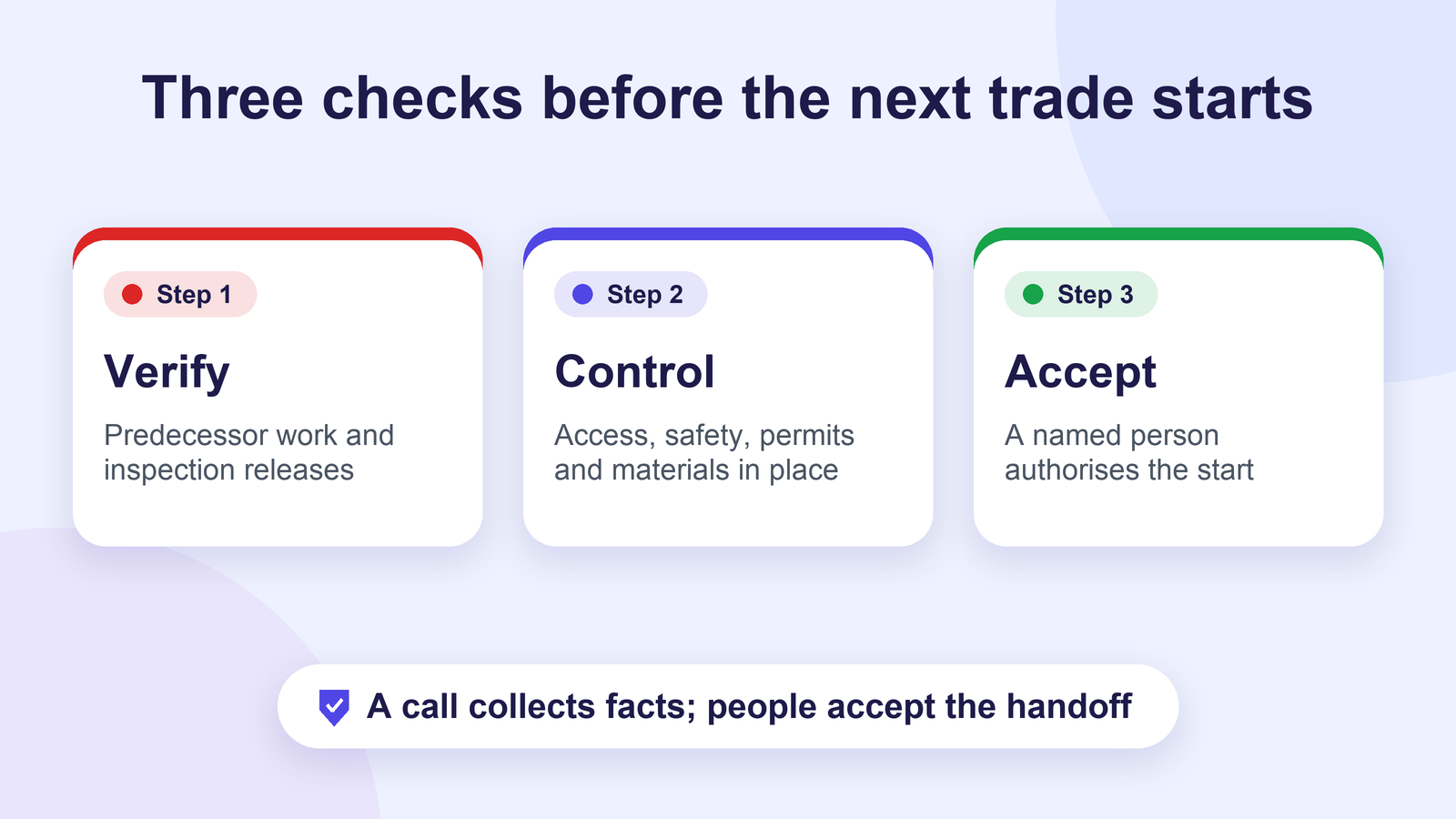
Answer in brief: A construction trade handoff is ready when the preceding work has been verified to the required standard, the successor trade can access the area, unresolved defects and hazards are controlled, and a named authorised person accepts the transfer. A call can collect readiness facts and identify missing evidence, but it cannot declare an area safe or replace inspections and work permits.
Why trade handoffs create avoidable rework
A subcontractor arrives to start work in a space that appears available, only to find temporary storage, incomplete penetrations or a required inspection still open. The incoming crew is on site, but production cannot begin. The resulting delay is not always a scheduling problem; it is frequently a handoff problem. The predecessor reported progress, but nobody confirmed that the receiving trade’s conditions for starting had been met.
A more reliable handoff distinguishes three states: the predecessor says its own work is complete; the necessary evidence and approvals are available; and the receiving trade is authorised and ready to begin. Combining those states into one ‘Done’ column obscures the decision that matters. The following method helps projects separate status collection from acceptance.
Identify predecessor and successor responsibilities
Before work starts, create a handoff item for every high-risk or time-critical interface. Name the preceding trade, receiving trade, location, planned start, site supervisor and any inspection or hold-point owner. The incoming trade should define what it needs—such as unobstructed access, current drawings, protected services or a completed prerequisite—before its crew is mobilised.
For example, a drywall team may depend on completion of electrical rough-in and required inspection steps. An electrical contractor’s statement that ‘our work is finished’ is useful, but it does not establish that walls may be closed. The authorised inspection or quality release must be confirmed separately and recorded where the project requires it.
Use a seven-point trade handoff checklist
| Readiness check | Required evidence or decision | Responsible party |
|---|---|---|
| Defined work zone | Area, boundaries and access route | Site superintendent |
| Predecessor work | Completion record and open-items list | Outgoing trade lead |
| Inspections and hold points | Required releases or outstanding approval | Authorised inspector or QA lead |
| Safety and permits | Site-specific risk review and work authorisations | Competent site safety/permit owner |
| Materials and drawings | Current revision and installation supplies | Receiving trade lead |
| Shared services and protection | Scaffolds, power, isolation and protection plan | Relevant controlling contractor |
| Acceptance and start | Named handoff decision and mobilisation plan | Authorised site management |
The list should become part of the scheduled look-ahead review. It is not an inspection certificate. If a condition cannot be verified, record ‘not confirmed’ and do not casually convert it to ‘ready’.
What a useful pre-handoff call should ask
Start with specific questions rather than broad prompts such as ‘Are you good to go?’ Ask: ‘Which area are you handing over? What work remains? Are any inspections or hold points open? Is access clear? Have the latest drawings been shared? What supporting evidence has been submitted? Who is authorised to confirm the handoff?’ The question order matters because it distinguishes facts, documents and sign-off.
Calls should never encourage workers to declare a hazard controlled without the proper site procedure. Where someone mentions exposed wiring, unsupported excavation, conflicting access or another safety concern, stop routine workflow collection and direct the matter into the established incident or hazard process. OSHA’s communication and coordination guidance calls for employers and contractors to exchange hazard information and plan work to minimise safety impacts.
A proposed monday.com board structure
Build one handoff item for the defined zone and use subitems or connected tasks for the prerequisites: predecessor completed, approved drawing available, inspection outcome, access preparation, permit check and receiving crew confirmation. Include an owner, planned date, evidence location and status for each. A proposed status set might be ‘Not started’, ‘Evidence pending’, ‘Awaiting authorised review’, ‘Approved to hand over’ and ‘Blocked’. These are example labels, not default Autoza statuses.
Use monday.com’s dependency relationships so the successor activity references the predecessor and acceptance record. The dependency can improve visibility, but the board must not automatically equate a predecessor’s verbal completion with permission to proceed.
Escalate before the incoming crew is booked
A practical approach is to check the interface several working days before the planned start, recheck outstanding prerequisites at the look-ahead meeting and confirm close to mobilisation only when the authorised site team has agreed to do so. The exact timing depends on the trade, site rules, contract and inspection lead times. No one-size-fits-all number of hours can guarantee readiness.
If an inspection is delayed, the manager should decide whether to rearrange work, reschedule the receiving trade or reallocate labour. The AI or coordinator should record the issue and notify the responsible person—not issue a substitute instruction. Separate commercial notice requirements also matter if the delay affects contract time or cost.
An illustrative handoff scenario
A mechanical contractor reports that pipework is installed in a plantroom. The scheduled check-in also finds that the pressure-test record is pending and a shared access scaffold remains in use. The board records the installation update but leaves the handoff status as ‘Awaiting authorised review’. The superintendent asks the mechanical QA lead to provide the test evidence and coordinates the scaffold release. Only after the relevant people verify the prerequisites is the receiving insulation contractor told to mobilise.
The value here is not a magical AI approval. It is that the project catches a missing prerequisite before the next team wastes a visit. It also creates a traceable distinction between what was said, what was evidenced and what a manager decided.
Where scheduled follow-up calling fits
Autoza AI for monday.com is presented by AI Workflow Design as a scheduled check-in and board-update solution. For trade handoffs, an appropriate proposed use is to collect agreed status answers from the selected task owner and route exceptions back to the superintendent. Confirm the scope of supported mappings, call permissions and exception handling with the product owner before rollout.
For adjacent context, our guide to construction milestone check-in questions explains how to make calls more specific. The handoff process adds an acceptance gate: a call may indicate readiness, but it does not give a trade permission to start hazardous or controlled work.
Next step: Teams already using monday.com can review an Autoza check-in workflow to reduce last-minute chasing while preserving their established inspection, safety and handover controls.
Frequently asked questions
Can a phone update confirm a trade area is safe?
No. A call can reveal that someone reports the area as clear or identifies a concern, but only the authorised, competent people following the site’s actual safety procedures can assess and release the work area.
What evidence should the next trade request?
It depends on the work. Common records include current drawings, relevant inspection or test results, open-defect lists, permitted access arrangements, and documented release of the predecessor’s hold points. The receiving trade should define its required evidence in advance.
Who accepts the handoff?
The role depends on the contract and site arrangements. Typically an authorised superintendent, package manager, QA representative or other designated person records acceptance. The outgoing subcontractor should not unilaterally declare the successor authorised to start.
Should every handoff get an automated call?
No. Prioritise interfaces that are time-sensitive, involve outside contractors or have a history of missing information. Simple, already-evidenced transitions may only need a board update. Avoid interrupting site personnel with redundant calls.
What happens when the outgoing trade does not answer?
Keep the status unconfirmed and use the approved escalation route. A missed call is not proof of incomplete work or lack of attendance. The site manager should assess any implications for planned mobilisation.
Related reading
- 7 Questions an AI Construction Check-In Should Ask Before a Milestone
- Pre-Inspection Follow-Up: Which Construction Tasks Need a Phone Call?
- Construction Daily Progress Updates: A Better Way to Hear From Field Crews
- Phone Calls vs monday.com Notifications for Subcontractor Updates
- Managing Multiple Construction Sites: Standardise Foreman Status Reports
- Autoza AI for monday.com: scheduled status calls
- Workflow automation services
- Daily Check-in Agent