

Utilities can determine whether a development opens on time even when the building work is progressing. Water connections, electrical supply, drainage, telecoms and physical access may involve different organisations, permits and handover documents. Effective land development utility coordination means tracking each service from capacity enquiry through design, permissions, site works, testing and confirmed availability, with a named owner for every dependency. An upbeat contractor update is not the same as an authority’s approval or a live connection.
The purpose of a utility follow-up plan is to make outside dependencies visible without overwhelming project managers with daily calls. Early coordination matters: industry guidance on connecting new developments generally advises developers to engage service providers before late-stage construction, assess network capacity and maintain agreed connection schedules. The same planning principle applies elsewhere, though providers, approval names and legal requirements vary by location.
Map every utility as a separate workstream
Start with electricity, potable water, foul and surface-water drainage, data or fibre, gas where applicable, and site access. Each workstream should include the provider or authority, developer-side coordinator, design engineer, contractor, application reference, latest confirmed milestone, outstanding documents, target dates and next decision. Do not assume that a single utility contractor controls every approval.
Water and sewerage connections can include service pipes, mains and adoption requirements, and developers may engage water companies or accredited self-lay providers depending on the location. Electrical connections can involve a network operator, an independent connections provider, metering parties and a separate energisation step. The point is not to import one country’s terminology into every project. Map the organisations and evidence required for the particular site.
Confirm capacity before setting construction dates
A utility design often begins with capacity enquiries and a connection strategy. If the existing network needs reinforcement, long-lead engineering or statutory work may become a critical dependency. Ask the coordinator whether the capacity response is formal, whether a quotation has been accepted, who is preparing design information, and which assumptions remain provisional. A preliminary budget estimate is not a guaranteed connection date.
In an illustrative housing scheme, the civil contractor wants to install service trenches in March. The water provider has acknowledged an application, but the electricity design is awaiting capacity confirmation. The follow-up plan should identify whether trench layouts or shared corridors depend on the electrical design. This is more useful than asking every vendor to repeat a broad percentage-complete figure.
Build a dependency chain with real hold points
For each service, identify the sequence: application prepared, official submission received, technical questions resolved, quotation or offer accepted, design approved where required, land rights or permits secured, physical works arranged, tests witnessed, provider acceptance obtained and service confirmed available. Sequence names must be adapted to the governing agreement and authority.
Project managers should also track cross-service conflicts. If drainage crosses a future power duct route, someone must resolve the design coordination before excavation. If a road closure is needed for a main connection, its permission and notice period may control the earliest feasible construction window. If fibre installation requires a completed riser or duct, access dates matter as much as the network operator’s promised attendance. The same discipline helps when you build a dependency-based calling schedule for delayed inspections.
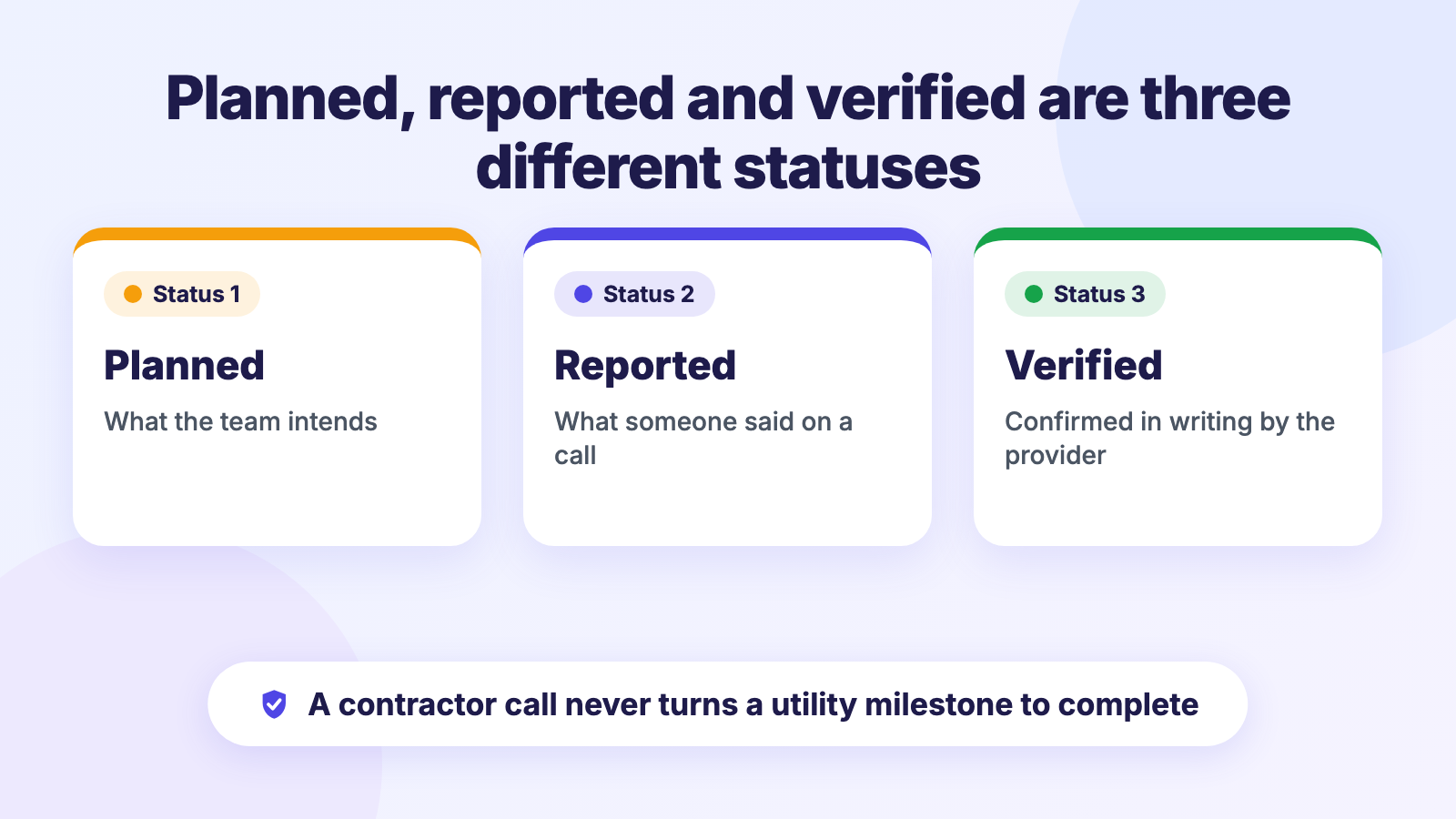
Use a clear division between planned, reported and verified
A helpful board might contain three separate status groups: planning status (what the team intends), reported progress (what someone said in a call) and verified external decision (what the provider officially confirmed). Supplement them with a next action owner, evidence link, impacted building or phase, last check-in and escalation flag. These are proposed design ideas, not ready-made Autoza fields.
Avoid setting an external approval field to ‘complete’ on the basis of a contractor call. Store the official notice or portal acknowledgement in a protected system, then have an authorised team member update the verified field. Scheduled AI calls can collect an installer update, but cannot issue a utility connection offer, certify drainage works or energise a service.
Decide who actually needs a scheduled call
The best recipients are usually the people owning an outstanding action: the developer’s utilities coordinator, engineer producing revised plans, contractor responsible for trench readiness or administrative person chasing a missing document. Providers may require enquiries through regulated portals or specified channels. Do not assume an AI caller can contact authority staff repeatedly or use a provider’s phone line contrary to its rules. Our guide on internal teams vs external contractors explains how to choose who gets a status call.
Ask five questions: ‘Which service and application are you responsible for?’ ‘What evidence is the last confirmed milestone based on?’ ‘What is blocking the next step?’ ‘Who needs to take action?’ and ‘When should the developer verify the result?’ The answer ‘the water company said soon’ needs a reference, named contact and next date; it is not a reliable handover commitment.
Escalate work that threatens dependent trades
Not all overdue actions carry equal risk. A noncritical telecoms detail may be monitored weekly, while an unapproved access permit for tomorrow’s connection works deserves immediate human escalation. Classify actions according to their effect on safety, occupied buildings, dependent trades and contractual completion. An automatic retry after a missed call may be useful, but a no-answer status should never be interpreted as evidence that an authority rejected an application.
Human oversight is mandatory when excavation risks arise, an unexpected live cable or pipe is found, a provider changes the design, a price or land-rights agreement is disputed, or a service is about to be activated. Qualified utilities personnel and authorised authorities must decide whether work can proceed.
Create a pre-occupation readiness view
Near handover, separate three questions: Are the physical works finished? Has the responsible provider issued the necessary formal confirmation? Can the relevant building or phase legally and safely be occupied? These answers may fall on different dates. Combine them in one management summary, but preserve source records separately.
For multi-phase developments, include the building, parcel or meter identifier so a confirmed connection for one phase is not assumed to apply to the entire site. Review occupation and emergency access prerequisites with the competent local team. A connection milestone should be recorded with the actual evidence and verifier, not a copied contractor message.
Use operational metrics instead of escalating every open task
Track the age of unresolved provider questions, days between application and formal response, percentage of milestone dates supported by written confirmation, missed access appointments and programme impacts by utility. This reveals whether the bottleneck is incomplete developer documentation, provider review, site readiness or conflicting designs.
Read the AI Workflow Design blog for related project follow-up topics. For organisations using monday.com, Autoza AI for monday.com offers scheduled calls and status updates that may help gather routine coordination information while leaving all technical decisions with people.
Make the next action obvious
At the next utilities coordination meeting, identify the three external milestones that most directly affect construction or occupancy, assign a verifier to each and agree when to request a new status. The highest-value improvement is not more phone calls. It is knowing exactly whose answer matters and what document will establish that the milestone really happened.
If your development team is considering routine status calling, contact AI Workflow Design to discuss an appropriately configured process with human approval boundaries.
Frequently asked questions
Who approves water and power connections for a new development?
Relevant water companies, electricity network organisations, technical reviewers and statutory authorities control their own approvals under local law and agreements. Contractors can report that work is done, but service acceptance and energisation must be verified through the proper issuing organisation.
Which utilities should be tracked on the critical path?
Track any service whose absence blocks dependent construction, testing, commissioning, access or lawful occupation. The critical path may involve electricity, water, drainage, fibre, gas or highway access depending on the development. Review the dependencies rather than giving every utility the same priority.
How do teams follow up with external utility providers?
Use the provider’s approved portal, case reference and communications procedures. A project administrator may report a portal update in monday.com, but do not assume an AI caller is authorised to contact regulated or emergency lines. Store the official notice or approval separately.
What should a utilities coordination board contain?
Useful proposed fields are service type, site phase, provider, application reference, owner, formal stage, evidence source, planned works, physical readiness, next decision and affected milestone. Keep planned dates, verbal reports and verified provider responses distinct.
Does a contractor saying a service is installed mean a building can open?
No. The service may still require inspection, testing, metering, connection or formal acceptance, and building occupation has separate conditions. The authorised project and regulatory teams should verify every applicable step before treating the premises as ready.
Related reading
- Construction Draw Requests: Follow Up on Development Evidence and Signatures
- Tenant Fit-Out Projects: Coordinating Landlord, Tenant and Contractor Actions
- Permit and Inspection Follow-Up for Real Estate Development Projects
- Site Inspections Delayed? Build a Dependency-Based Calling Schedule
- How Developers Can Get Contractor Milestone Updates Without Extra Meetings
- Autoza AI for monday.com: scheduled status calls
- Workflow automation services
- Industries we support
- Permanent Utility Connections: A Pre-Handover Readiness Checklist