
In brief: Coordinate hospital renovation tasks around infection control risk assessment, contractor briefings, dust barriers, approved access and human sign-off.
What should be checked before hospital renovation work starts?
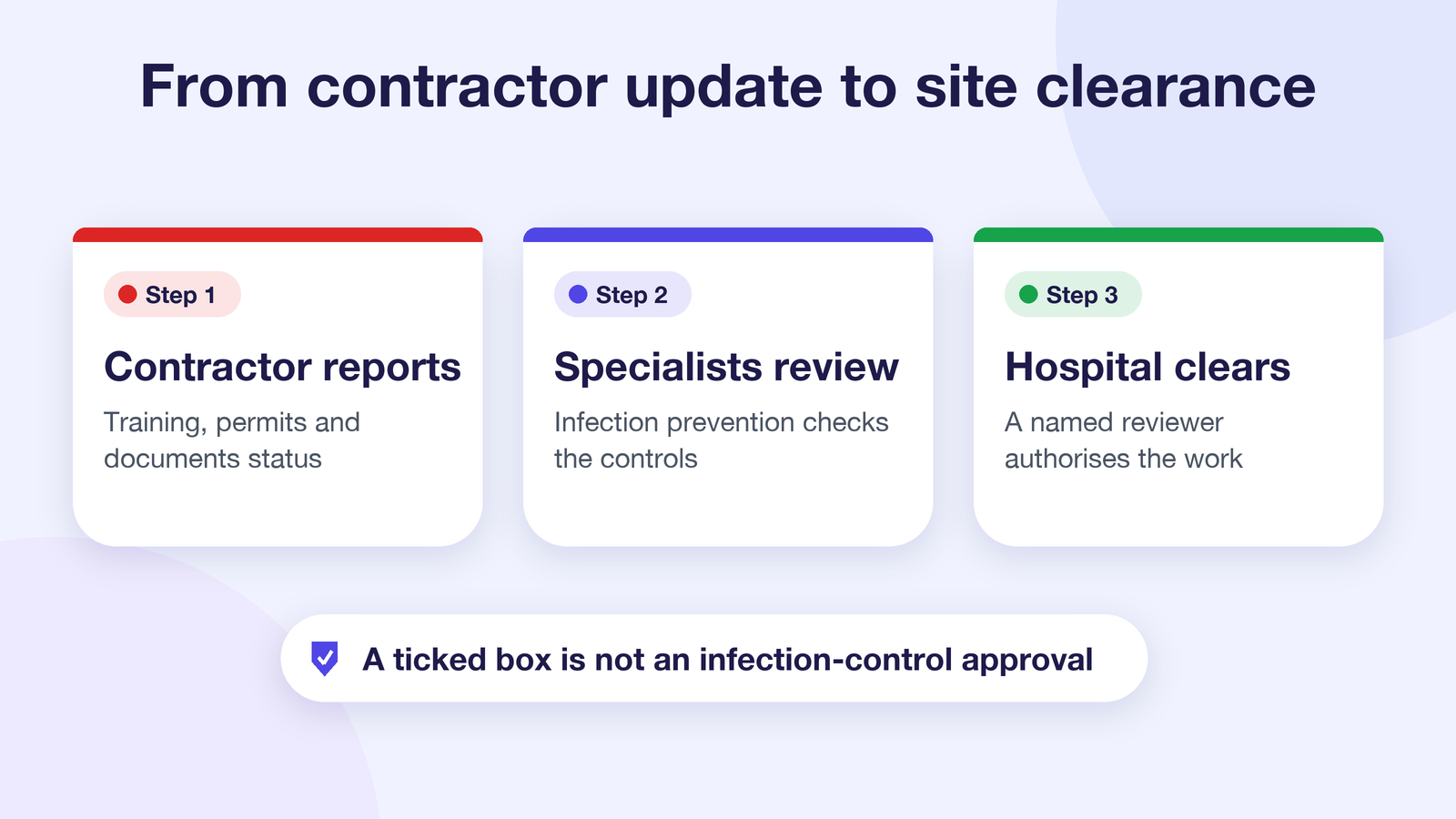
Hospital renovation infection control coordination brings facilities, contractors, infection-prevention specialists and affected hospital departments together before work disturbs a healthcare environment. Administrative follow-up can confirm that training, permits, access, deliveries and inspection appointments are on track. It cannot evaluate airborne infection risk, approve protective barriers or authorise work in a sensitive area.
Renovation can disturb dust, airflow, water systems and movement routes, even when the physical work is in one room. The CDC’s construction-related infection-control recommendations call for a multidisciplinary team, risk assessment and appropriate protective measures. The Joint Commission’s preconstruction guidance recognises risks affecting air quality, infection control, utility systems, noise, vibration and more.
Start with the hospital’s infection-control risk assessment
The project owner should ask whether an infection-control risk assessment (ICRA) or other preconstruction review is required under policy. The relevant professionals assess the nature and intensity of the work, its location and the susceptibility of nearby occupants. They determine controls such as containment, airflow management, access routes and monitoring. The project coordinator records that the required review exists, who owns it, and when the next decision is due.
Do not let a generic checklist claim that an ICRA ‘passed’ because a contractor ticked a field. It is a qualified judgement based on the real site and work, and controls may need to change if conditions shift. A project status caller can follow up on an assigned document-submission task, not interpret the assessment or decide protective measures.
Build a work package with named responsibilities
An operational readiness register should identify the project reference, work zone, planned activity type, contractor lead, facilities engineer, infection-prevention reviewer, department contact, access coordinator, approved start window, training status, required permits, containment-plan approval reference, monitoring owner, outstanding issues and closeout reviewer.
Keep clinical and patient-specific information out of the calling dataset. Use a narrowly described facilities task and an appropriately protected document reference. Not every person on the project should receive the same building or department details. Permissions should reflect the recipient’s role and the hospital’s rules for sharing site information.
Readiness sequence: from design review to first shift
- Assess the scope. The hospital determines whether the activity affects air, water, utilities, circulation or nearby care areas and convenes the required reviewers.
- Approve the controls. Infection prevention and facilities or other competent authorities agree the required measures before the contractor mobilises.
- Orient the team. The contractor receives approved training, access rules, work-hour boundaries and escalation contacts, with completion evidence captured in the required system.
- Verify pre-start conditions. Qualified personnel review barriers, airflow provisions or other controls as applicable. A status call records whether this review is booked, not whether technical criteria have passed.
- Monitor throughout work. The assigned team documents changes, incidents and control effectiveness according to hospital procedures; unexpected conditions trigger human action.
- Close out deliberately. Qualified reviewers confirm cleaning, inspection, restoration and release requirements before normal use resumes.
The CDC guidance includes measures such as dust containment, protected routes and monitoring appropriate to the circumstances. This is not a generic specification to be copied for every project; the facility’s risk assessment determines the controls actually required.
Questions appropriate for contractor status calls
A limited project follow-up can ask: ‘Have you received your approved work-package reference?’ ‘Is your scheduled orientation complete?’ ‘Have the required documents been submitted through the approved process?’ ‘Is your team available for the authorised work window?’ and ‘Do you need the facilities coordinator to contact you about a blocker?’
Avoid questions such as ‘Is the clinical wing safe?’, ‘Are the barriers sufficient?’, ‘Can the negative-pressure controls be switched off?’ or ‘May workers enter now?’ Those require professionals with site knowledge, authority and the right evidence. If someone reports a barrier breach, unexpected dust, water leak or other risk, the approved process should cease routine questioning and initiate the hospital’s human incident and safety response.
Separate reported progress from site clearance
Suggested monday.com labels might be Contractor documents pending, Training scheduled, Training recorded, Risk review outstanding, Pre-start technical check pending, Human clearance documented, Work in progress, Exception escalated and Closeout under review. These are illustrative statuses, not built-in vendor features. Clear visibility comes from having separate administrative and approval fields, not from an attractive progress percentage.
An AI or vendor can report that a protective barrier has been installed. Only the appropriate hospital reviewer can determine whether it meets the project’s approved requirements. The board should show both facts separately, with access to the actual inspection evidence for authorised people.
A change in work scope requires renewed attention
If renovation scope expands from painting to cutting into a wall, the approved controls and ICRA assumptions may change. Schedule, affected departments, dust controls and contractors may also need review. The project coordinator should stop routine ‘on track’ messaging and route the change through the hospital’s formal assessment and change-control system. Nobody should infer that an existing approval covers new activity merely because it is in the same room.
Likewise, a delayed contractor response is not proof that a work area is safe or unsafe. It is an administrative unknown. Assign a person to investigate rather than letting a rule automatically advance the work package.
Illustration: planned refurbishment near an occupied area
A hospital schedules a limited facilities refurbishment. The contractor reports that training is finished and materials will arrive on time. Separately, the infection-prevention reviewer has not yet confirmed all site-specific controls. A sensible project record shows administrative readiness improving while the Human clearance pending gate remains closed. The project manager may adjust the schedule, but the contractor cannot begin restricted work until the authorised process allows it. This is a hypothetical coordination example, not a documented hospital project.
During work, an unexpected access-route conflict is raised. The coordinator records the concern and alerts the responsible hospital staff through the approved channels. The caller does not renegotiate work-zone routes or issue safety instructions. This preserves the distinction between communication automation and accountable risk management.
What an AI workflow may contribute
The Autoza AI product describes scheduled calls with summaries and monday.com board updates. A hospital might assess such a tool for non-clinical contractor reminders only after appropriate privacy, security, vendor and governance review. Its public page does not establish approval to capture protected health information, run infection-control surveillance or grant access permissions. Review what an AI healthcare project caller should never ask before designing scripts.
Track overdue administrative tasks, time to resolve documentation blockers, number of work-package scope changes, exception response time and missing approval evidence discovered in review. Never claim that fewer calls equal a reduction in infection risk without suitable clinical evidence. The intended benefit is reliable follow-through on the tasks that qualified staff have defined.
Next step: Choose a narrow renovation coordination process, document the formal ICRA and clearance decision owners, and only then explore an AI Workflow Design status-calling review. Keep protective measures and clearance decisions with the hospital’s designated specialists.
If your team uses monday.com and wants dependable follow-up on narrow, well-governed tasks, explore Autoza AI or request a workflow discussion.
Frequently asked questions
When is an infection-control risk assessment needed for renovation?
The hospital determines that under its policies and the project’s actual risks. Construction, renovation, repair and demolition near care areas may require assessment and protective measures, particularly where dust, air or water systems could affect patients.
Can an AI call clear a construction zone to start work?
No. Calls can collect administrative status, but the authorised infection-prevention, facilities and other qualified personnel must review site conditions and approve work under the hospital’s procedures.
Which contractor tasks are suitable for automated status follow-up?
Narrow questions about scheduled orientation, work-package receipt, secure document submission, agreed arrival windows and named coordination blockers can be candidates after organisational review.
What if the contractor changes the work scope?
Escalate the change to the project owner and required risk reviewers. Do not assume an earlier infection-control or access approval automatically covers a materially different activity.
How should barrier or airflow concerns be handled?
Use the hospital’s approved human safety and incident process immediately. A project caller should not diagnose conditions, propose technical fixes or delay escalation while asking routine status questions.
Related reading
- What an AI Healthcare Project Caller Should Never Ask
- AI Calling Escalation Rules for Healthcare Administration Teams
- Healthcare Vendor Follow-Up Calls Without Sharing Patient Information
- Hospital Planned Shutdowns: Who Must Confirm Facility Communications?
- Hospital Equipment Installations: A Non-Clinical Vendor Coordination Plan
- Autoza AI for monday.com: scheduled status calls
- Workflow automation services