
In brief: Build a candidate availability confirmation workflow before sharing shortlists. Check interview timing, contact preferences, ownership and safe follow-up rules.
What should a recruiter confirm before sending a shortlist?
A candidate availability confirmation workflow checks whether each person can realistically attend an interview, start within the employer’s timetable, and receive contact through their preferred channel. It does not decide whether the person is qualified. Before sending a shortlist, the recruiter should confirm scheduling facts, record when the answer was received, and identify anything that still needs a personal conversation. Those three steps prevent an attractive shortlist from becoming a chain of rescheduled interviews.
An availability check becomes especially valuable when several recruiters and hiring managers are working from the same monday.com project. Someone may have confirmed a candidate on Monday while a client offers Thursday interview slots on Wednesday. The older answer is not automatically wrong, but it should not be treated as current without checking the candidate’s preferred timing.
Define what ‘available’ actually means
Availability is not a single yes-or-no field. A recruiter should distinguish interview availability, notice period or earliest possible start, working pattern, and permission to be contacted. A candidate may accept an interview tomorrow but be unable to start for six weeks. Another might be ready to start immediately but not be available for an on-site interview during business hours.
Capture only the information needed for the current stage. Avoid collecting personal explanations about childcare, disability, health, family circumstances, or protected characteristics in a routine AI call. If someone needs an accommodation or wants to discuss sensitive circumstances, direct the conversation to an authorised human recruiter through an appropriate channel. The EEOC’s pre-employment guidance explains important limits on medical and disability-related questions.
Assign a clear owner before making the call
Use one person to own candidate contact and another, where appropriate, to own client scheduling. A useful internal board can include candidate reference, role reference, current stage, interview slot offered, preferred contact window, last confirmed date, next check date, communication preference, status, owner and exception reason. Store personal contact information in an access-controlled system; the project board should not become a copy of the whole applicant record.
Suggested status values are Unconfirmed, Confirmed for stated window, Needs alternative slot, Candidate requested recruiter, No response, and Withdrawn by candidate. These are proposed workflow labels, not default Autoza AI settings. In particular, No response must never be interpreted as rejection or lack of interest. The recruiter, not an automated call outcome, owns any candidate-status decision.
Build a four-step confirmation sequence
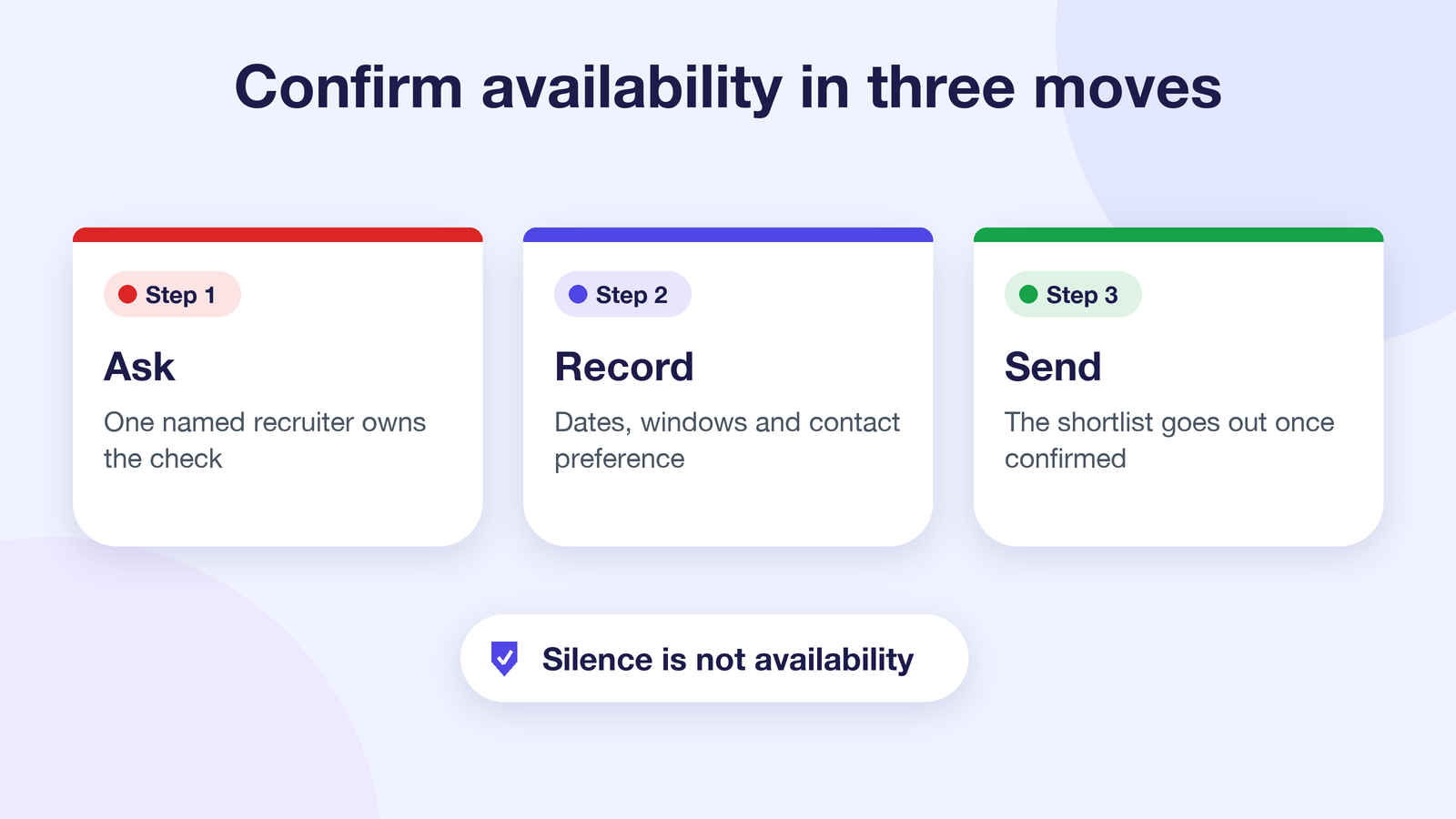
- Check the shortlist criteria first. The human recruiter confirms that each proposed person is being considered under the client’s approved, job-related requirements. An availability call does not replace this review.
- Offer concrete scheduling options. Instead of ‘Are you free next week?’, ask whether the candidate can attend one of the approved windows, or whether the recruiter should contact them about alternatives.
- Record the answer and time. Link the response to the candidate’s current requisition, not just a general contact record. Record any preferred next action without guessing at the reason.
- Reconfirm near the handoff. If the hiring manager has changed the date or the previous availability confirmation is stale, check again before promising an interview slot.
For example, a recruiter handling a distributed technical team might confirm that three shortlisted candidates can attend video interviews on two specified afternoons. One answers yes, one requests a later time and one does not answer. The appropriate output is one confirmed option, one scheduling task for a recruiter and one pending response—not two confirmed candidates and one rejected candidate. This example illustrates a process rather than a claim about a real client.
Questions a scheduled check-in can safely ask
The call should clearly identify the organisation and automated caller, explain the narrow purpose and respect the recipient’s preferences. A short script can ask: ‘Are you still interested in discussing the position with the recruiter?’ ‘Can you attend one of the two interview times already shared?’ ‘Would you like a recruiter to contact you about other times?’ and ‘Is this still an appropriate way to reach you?’ If the answer is ambiguous, record a human follow-up rather than interpreting the response optimistically.
Do not ask the caller to rate the candidate’s enthusiasm, accent, confidence, suitability, medical background or other personal traits. A voice impression is not an objective screening assessment. Consent, disclosure, recording and opt-out requirements vary by jurisdiction, so the agency must obtain the relevant review before using automated voice calls.
Where Autoza fits—and where it does not
Autoza AI for monday.com is presented as a scheduled check-in and board-update product, with call summaries and retries. A staffing agency can discuss adapting that pattern to routine availability follow-up. It should not assume candidate-CRM integration, consent tracking, specific call questions or hiring-status automation is already configured. Request a workflow review before using it with recruitment data.
The right design is narrow: approved call list, permitted scheduling questions, mapped administrative fields, defined retry limits and a human escalation owner. Recruiters should review the record before making any candidate or client commitment. Related reading: hiring-manager feedback delays and responsible AI calls in staffing.
Set escalation and follow-up rules before launch
Escalate when a candidate asks to stop calls, challenges a proposed slot, mentions a confidential circumstance, requests accessibility assistance, or is repeatedly unreachable. Do not create endless retries. Define the maximum attempts per day, approved contact hours and a stop rule that leaves the next action with a named recruiter. A candidate’s silence after two attempts is a communication result, not evidence about their competence or commitment.
A practical quality review looks at time from invitation to confirmed slot, percentage of candidates with up-to-date scheduling information, reschedules caused by stale details, opt-out handling, and how quickly human follow-ups are completed. These are operational measures. They should not reward recruiters or automated systems for pressuring people into accepting times they cannot meet.
A simple shortlist-readiness checklist
Before sharing any shortlist, the recruiter should be able to answer: Is the requisition current and approved? Has each person been assessed by a responsible human against job-related criteria? Is the latest availability response dated? Are preferred contact methods respected? Do any changes require the hiring manager to approve a new window? Is there a named owner for unresolved questions? If any answer is missing, label the scheduling step pending rather than filling the gap with a guess.
Next step: Review your interview-scheduling handoffs and ask AI Workflow Design about a controlled monday.com status-call pilot. Keep suitability decisions and candidate relationships in human hands; automate only the repetitive requests for factual scheduling updates.
If your team uses monday.com and wants dependable follow-up on narrow, well-governed tasks, explore Autoza AI or request a workflow discussion.
Frequently asked questions
When should a recruiter recheck candidate availability?
Recheck when a hiring manager changes the interview slot, a previous confirmation is no longer current, or the candidate requests another time. Use a reasonable, documented cadence rather than repeatedly calling every candidate.
Can automated availability calls decide who belongs on a shortlist?
No. They can collect scheduling facts within an approved workflow. Shortlisting, assessment and rejection decisions remain with people using job-related criteria and appropriate legal safeguards.
What if a candidate never answers the calls?
Mark the contact attempt as unanswered, stop at the approved retry limit and assign human follow-up. Do not turn a no-answer event into an automatic withdrawal or rejection.
Can a candidate ask not to receive AI calls?
Yes. The programme should provide an accessible opt-out and alternative recruiter contact route, and honour the candidate’s stated preference within applicable requirements.
What information should appear on the project board?
Use a role reference, responsible recruiter, approved interview windows, last-confirmed timestamp, contact outcome and next action. Keep confidential applicant records and sensitive information in access-controlled systems.
Related reading
- Responsible AI Calls in Staffing: Consent, Privacy and Escalation
- Interview Panel Follow-Up Calls: What Can and Cannot Be Automated?
- Hiring Manager Feedback Delays: A Follow-Up Workflow for Staffing Teams
- Credential Renewal Tasks: How Staffing Agencies Track Expiring Documents
- Job Requisition Changes: A Hiring Manager Follow-Up Checklist
- Autoza AI for monday.com: scheduled status calls
- Workflow automation services