

In brief: Create a staffing credential renewal tracking process with expiry alerts, secure evidence review, owner accountability and careful candidate follow-up calls.
How should a staffing agency manage expiring credentials?
Staffing credential renewal tracking should start well before a licence, certification, training record or required administrative document reaches its deadline. The agency needs a current inventory, a named owner, a secure source for verification and an exception process when evidence has not arrived. Scheduled reminders can improve follow-through, but a reminder response is not proof that a professional is licensed, trained or authorised to work.
Different documents require different rules. A professional licence may need direct verification with an issuing body; a training certificate may have a course-completion record; an employment-authorisation record has its own legal requirements. Treating all of them as ‘documents expiring in 30 days’ is an easy way to make a compliance tracker look complete while hiding real uncertainty.
Build a credential inventory before sending reminders
For each assignment or placement category, identify the documents actually required by the client, regulator, role and location. Keep a credential type, issuing authority, stated expiration or review date, verification method, responsible reviewer, last verified date, next review milestone and approved storage location. The date on a PDF is not sufficient for every credential: a licence can be restricted, suspended or subject to a different verification process.
A staffing team may be supporting workers with professional licences, site-access qualifications or annual training. Do not assume all certifications are transferable between states or that every expiry requires the same legal action. A compliance specialist should own the rule set and establish the verification source. For U.S. employment eligibility records, follow current USCIS Form I-9 guidance; not every document should be reverified merely because a printed expiration date exists.
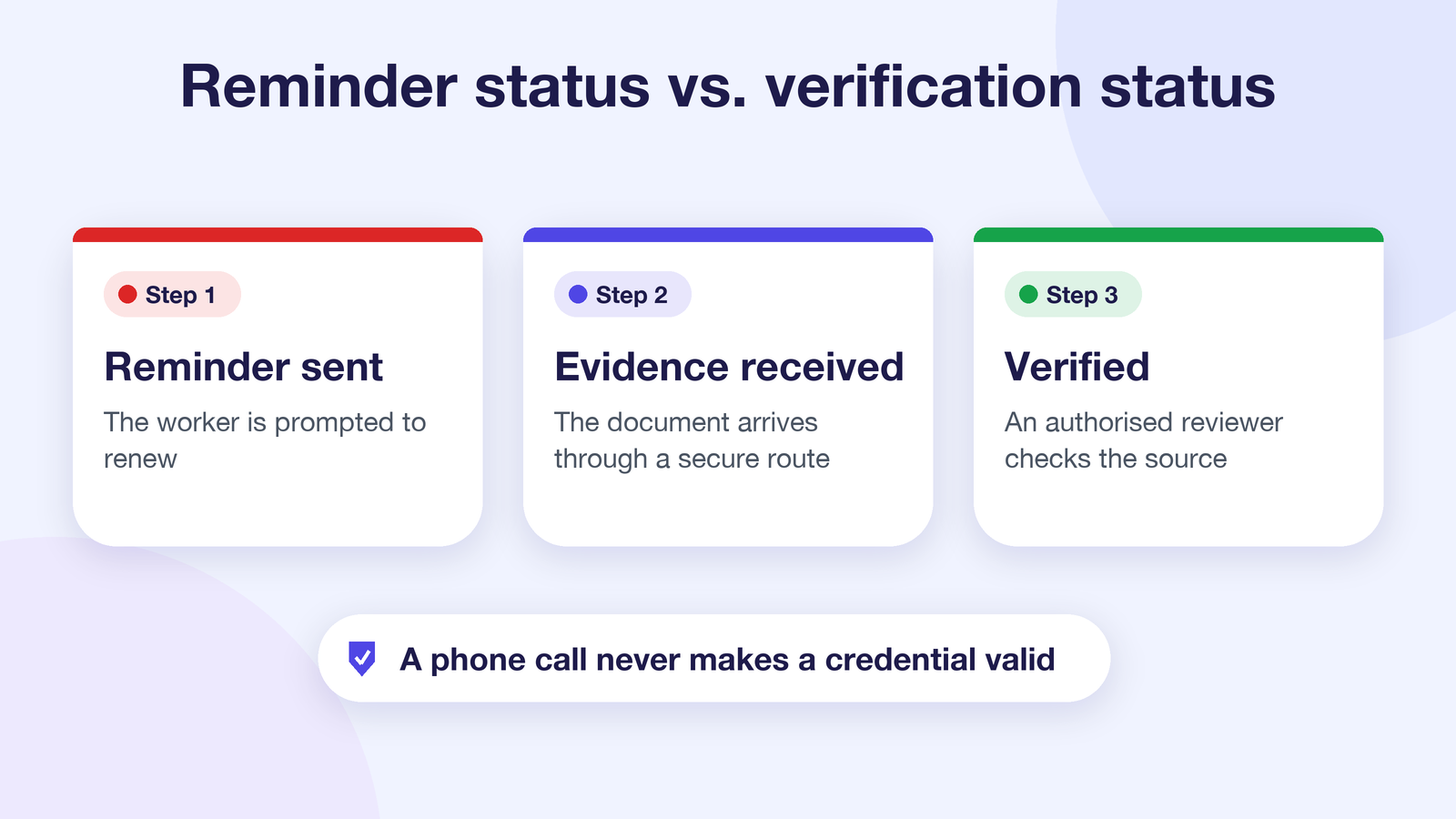
Separate reminder status from verification status
One proposed monday.com board can have Document required, Renewal reminder sent, Candidate reports submitted, Evidence received securely, Verification pending, Verified by authorised reviewer, and Exception / assignment review. These reflect different facts and should not be compressed into a single green status.
Include the assignment reference, document category, due date, contact owner, next follow-up, secure-record reference and verification reviewer. Avoid uploading identity documents or medical records into a general task board. Store them only in an appropriately controlled HR, credentialing or compliance system and link to the record using access rules that prevent unnecessary disclosure.
Use a risk-based reminder cadence
A practical illustrative cadence begins with an early reminder well before the expiry date, followed by a nearer-due-date check and an escalation when a required document remains unverified. The actual timing must follow the credential’s legal and operational rules; a ‘30/14/7 day’ series is not universal policy. Some renewals take weeks for regulators to process; others can be completed more quickly.
Before contacting someone, verify whether the record has already been updated. Calling a person after the compliance team has approved their renewal wastes time and reduces trust. Contact windows should respect the worker’s preferences, agency policy and applicable automated-calling rules. For a renewal that needs identity or document review, send the recipient to the authorised secure portal rather than asking them to read sensitive details aloud.
What the AI check-in should and should not ask
A narrowly designed reminder can say that an administrative renewal task is open and ask whether the recipient has started it, submitted material through the approved channel or needs a human coordinator. It can capture a next update date and a request for help. It should not ask for a Social Security number, passport information, licence number, identification image, login code, medical documentation or other sensitive details over the call.
The agent should also avoid saying ‘You are cleared to work’ because the recipient said a document was renewed. A staff member must complete the required validation and determine assignment eligibility under the relevant rules. If the worker disputes the record or says that a regulator delayed a renewal, pause automatic reminders and route the issue to a qualified coordinator.
Example: from approaching deadline to verified status
Consider an agency preparing for an upcoming assignment requiring a current professional registration. Its tracking board shows a renewal deadline, and the compliance team has not yet received verified evidence. An automated call asks only if the individual has used the approved secure channel and whether a coordinator should make contact. The person reports that renewal is pending with the regulator. The board records Reported renewal pending and assigns a follow-up to compliance; it does not move the item to Verified.
A compliance reviewer checks the official authority, records the evidence through the authorised system and decides whether the placement may proceed. If the required credential remains unresolved at the decision deadline, the agency follows its documented staffing contingency plan. This example is illustrative, not a claim about an existing deployment.
Build escalation rules around real deadlines
A useful rule distinguishes a routine reminder from a genuine operational block. Escalate to the compliance owner when evidence is overdue, the worker disputes the requirement, the verification source is unavailable, the credential is restricted or the assignment date could be affected. Record whether the issue requires client notification, but do not automatically share a worker’s confidential circumstances with the client.
Recruiters should also avoid treating failed contact as misconduct. A missed call proves only that the phone call was not answered. The next action may be email, secure portal notification or a human conversation, depending on prior preferences and the urgency of the requirement.
Where scheduled voice follow-up may help
Autoza AI for monday.com describes scheduled calls, summaries, retries and board updates. A credentialing team could explore that pattern for narrow renewal reminders and administrative status collection. However, secure document integration, professional-licence verification, eligibility decisions and retention controls must be specified and independently approved; those are not established by a generic product page.
Review responsible AI calling in staffing for governance considerations, and recruitment onboarding document follow-up for missing onboarding records. The renewal process discussed here is different: its focus is dates, verification and ongoing eligibility rather than first-day paperwork.
Measure verified readiness, not reminder volume
Track percentage of required credentials verified before assignment, average time between secure submission and reviewer approval, number of urgent expiry escalations, and errors discovered during audit. Track opt-outs and unanswered calls separately. Avoid claiming compliance because an automated system made all scheduled reminders. The decisive evidence is the verified record and the authorised review.
Next step: Audit one high-volume credential category and map all its verification rules before testing phone reminders. Ask AI Workflow Design to review a deliberately limited status-call workflow, with documents and formal decisions kept in secure, human-controlled systems.
If your team uses monday.com and wants dependable follow-up on narrow, well-governed tasks, explore Autoza AI or request a workflow discussion.
Frequently asked questions
What can an AI renewal reminder ask?
It can ask whether a required renewal task has been started or submitted through the approved secure route, whether assistance is needed and when a coordinator should follow up. It should not collect sensitive document details.
Who verifies licences and certifications?
An authorised compliance reviewer or designated credentialing specialist should verify them using the required issuing authority, approved system and applicable rules. A worker’s verbal confirmation is not sufficient proof.
Does every expiring document require the same reminder schedule?
No. Lead time, legal obligations and verification procedures depend on the credential and jurisdiction. Adopt a category-specific policy rather than using one automatic deadline for all records.
Can I-9 employment eligibility be reverified whenever a document expires?
Not necessarily. USCIS rules specify when reverification is required and exceptions. Employers should follow current Form I-9 instructions and qualified advice, not a generic credential-expiry rule.
What should happen if the renewal has not been verified by assignment day?
Escalate to the authorised compliance and scheduling teams for a documented eligibility and contingency decision. Do not let a reminder bot declare the person cleared or automatically reject the worker.
Related reading
- Responsible AI Calls in Staffing: Consent, Privacy and Escalation
- Interview Panel Follow-Up Calls: What Can and Cannot Be Automated?
- Hiring Manager Feedback Delays: A Follow-Up Workflow for Staffing Teams
- Job Requisition Changes: A Hiring Manager Follow-Up Checklist
- Candidate Availability Checks: Confirm Timing Before Sending a Shortlist
- Autoza AI for monday.com: scheduled status calls
- Workflow automation services