
A consulting deliverable is not approved simply because a client has commented on it. Effective consulting deliverable revision tracking distinguishes a draft under review, feedback received, a revised version awaiting confirmation, and formal acceptance by someone authorised to sign off. When those states collapse into a generic “review complete” label, teams risk presenting unfinished work as approved, starting dependent activity too early, or arguing later about which version the client accepted.
The practical solution is a controlled review register: one owner for each deliverable, a named client reviewer, a specific version, a deadline, and an explicit decision record. Scheduled status calls can help the team chase missing responses, but they cannot interpret informal feedback as a binding approval.
Why consulting review rounds become unreliable
A strategy deck may be circulated to an operations director, finance lead, and programme sponsor on the same day. The operations director supplies six corrections, finance says the budget assumptions need work, and the sponsor replies “looks good” without naming a version. Meanwhile, the project board shows “Reviewed.” Did the sponsor accept the deck? Probably not: there may be open corrections and unresolved financial assumptions. Yet a downstream team might treat the item as ready for implementation.
This problem gets worse when files are sent by email, comments appear in collaborative documents, and meetings generate verbal instructions that never reach the official log. The project manager may report that feedback was received while the consultant responsible for revisions has no agreed action list. A dependable process preserves the difference between receipt of comments, their resolution, and approval of a specific revision.
Define a revision workflow before sending the first draft
Use a simple sequence: Draft prepared → Sent for review → Comments received → Revisions in progress → Resubmitted for approval → Formally approved. Add Blocked and Changes requested as exception states rather than squeezing them into “In progress.” If a client provides partial comments, record the response but keep the review task open until the agreed reviewer confirms completion of their review.
The core consulting feedback log should store a deliverable ID, document owner, reviewer, baseline version, current version, review deadline, link to the controlled file, and acceptance authority. Give every comment an issue ID and a disposition: accepted, rejected with rationale, clarification needed, or deferred by agreement. Avoid duplicating the deliverable in several locations with conflicting names.
A practical monday.com project board can represent each deliverable as a parent item and individual review actions as subitems. For example, “Operating Model v0.8” can contain “Finance validate costs,” “Operations confirm staffing assumptions,” and “Sponsor accept v1.0.” Keep the approval evidence in the organisation’s governed document repository, with a link from the task; do not put confidential client material into an outbound calling script.
Decide who can say what during a review call
Not every stakeholder can approve a deliverable. A technical reviewer may confirm that their section is accurate but lack contractual sign-off authority. A programme manager may confirm that the comments are closed but still need sponsor approval. Define the decision role before the review period begins, especially when multiple business units participate.
For routine follow-up, questions should remain administrative: “Have you completed your assigned review?”, “Is any decision blocking your response?”, “Which version did you review?”, and “When can the written feedback be submitted?” A caller should not ask the recipient to read privileged financial figures or reproduce the text of confidential advice. If someone says “I approve it” verbally, the system should log that statement as approval claimed—written confirmation required, not change the formal acceptance record by itself.
The Autoza AI product overview describes scheduled status calls and monday.com board updates. A consulting-specific calling map, permission rules, and exact update behaviour should be verified with the product owner before deployment. The dashboard and board can help capture the status of the review, while client acceptance remains governed by the engagement contract.
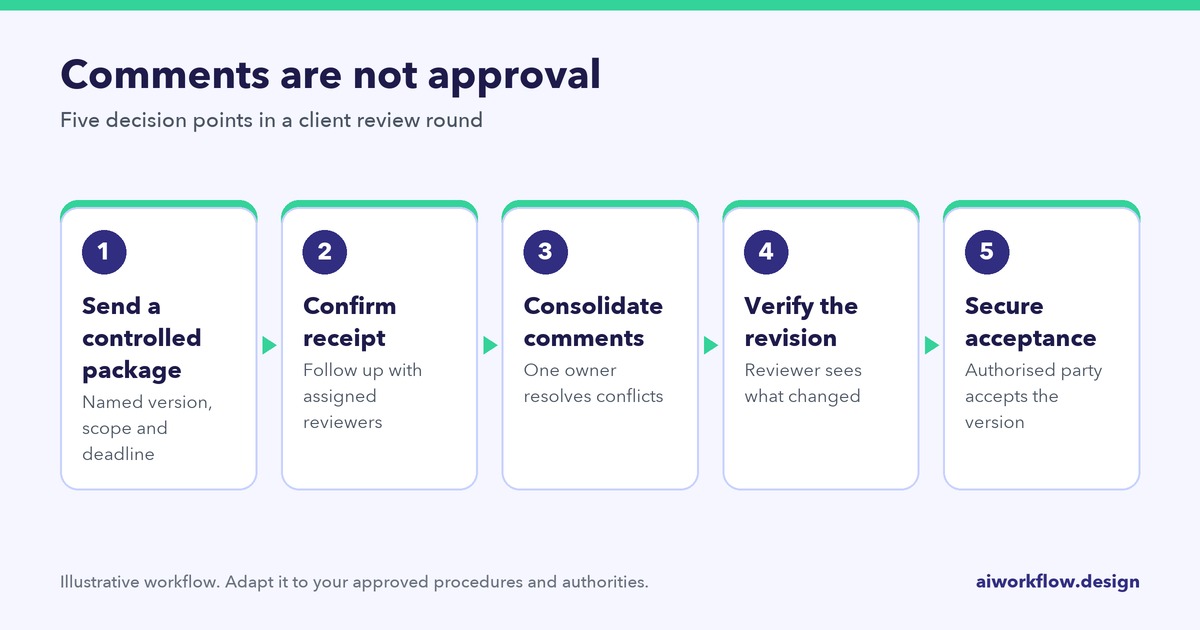
Structure the review round around five decision points
First: send a controlled package. The delivery email names the version, the scope being reviewed, the response deadline, the approving person, and the route for consolidated feedback. Record which files were included; a comment on an earlier copy is not necessarily a comment on the current one.
Second: confirm receipt. After the agreed response interval, follow up only with assigned reviewers. Ask whether they received the package and can meet the deadline. If the package is inaccessible, fix the access issue instead of marking the review late.
Third: consolidate comments. A single action owner translates fragmented input into a list of specific proposed revisions. Contradictory comments—such as finance wanting lower costs while operations requests additional resources—should become an explicit decision for the sponsor, not independent instructions to different writers.
Fourth: verify the revised version. The consultant documents which feedback items were resolved and where. The client reviewer must see the version proposed for approval, rather than an informal summary of changes. If the scope or commercial terms have changed, route the request through the contractual change process.
Fifth: secure acceptance. Close the item only when the authorised party records acceptance of the named version in the agreed form. This protects both the client and the consulting team. The Project Management Institute’s project-closing guidance similarly emphasises formal recognition of completed work and stakeholder acceptance.
Use a review-round tracker that exposes the real blocker
Instead of a single “status” column, record: Current version, Review owner, Comments due, Comments received?, Open comment count, Approval authority, Acceptance recorded?, and Next follow-up. Example: “Transformation roadmap v1.3 | Client finance | 6 Nov | Yes | 2 | Steering sponsor | No | 7 Nov.” This is an illustrative board setup, not a claim about default product fields.
Flag contradictions explicitly. If a reviewer claims to have approved v1.2 but the project team has issued v1.3, the action is not “complete.” The owner must reconcile the versions, verify impact, and obtain acceptance of the correct one. If a reviewer is unavailable, reschedule with a recognised delegate; do not silently transfer approval authority.
Measure review-cycle quality, not just call volume
Track median days from draft sent to consolidated feedback, the number of resubmissions, overdue reviews by owner, and the percentage of deliverables with documented acceptance. Also review how often a “comments received” status was incorrectly interpreted as approval. Those measures expose where the process needs better briefing, fewer reviewers, or clearer decision rights.
The goal is not to pressure clients with daily calls. It is to set one agreed cadence, reach the right stakeholder when progress is missing, and preserve the decision trail. Teams managing several engagements may find the difference between “waiting for feedback” and “approved” is the difference between a credible delivery forecast and a costly rework cycle.
How scheduled AI check-ins fit without replacing approvals
A carefully scoped workflow can contact authorised task owners at agreed hours, collect simple progress answers, and propose updates to mapped monday.com fields. The team should configure a human review queue for unclear replies, any request to alter scope, and any statement that appears to grant legal or commercial approval. The AI Workflow Design products page explains the status-calling capability, while the pricing page gives a starting point for evaluating the service.
Before a pilot, agree on notification and recording rules, client confidentiality, call frequency, opt-outs, and what data may appear in call summaries. Review the sample script with the engagement partner. A transparent administrative call is useful; a machine making approval decisions on behalf of a sponsor is not.
For a closely related workflow, read Consulting Project Closeout: Follow Up on Ownership Transfer and Knowledge Handover. You can also explore Project Sign-Off Delays: A Follow-Up Workflow for Consulting Teams, or browse more industry workflows.
Frequently asked questions
Does receiving client comments mean a consulting deliverable is approved?
No. Comments confirm that some review activity occurred. Approval requires the named authority to accept a specific version through the agreed process. Keep comments received, changes completed, and formal acceptance as separate statuses.
Who should own consulting deliverable revision tracking?
The engagement manager should assign one accountable deliverable owner and a named client reviewer. Specialists can own individual comment responses, but the accountable owner maintains version control and escalates conflicting instructions.
How many review reminders should a consulting team send?
Use the cadence agreed during kickoff, with a receipt check and a deadline-based reminder. Escalate when a dependent milestone is threatened; repeated calls to every reviewer often create more friction than clarity.
Can an AI caller record verbal approval from a client?
It can record that a person stated approval if the calling workflow is authorised and complies with applicable rules. That recorded statement should not automatically substitute for contractual sign-off or acceptance of a controlled document version.
What should happen when reviewers disagree?
Record the conflicting requests, their effect on scope and timing, and the decision needed. Send the issue to the authorised sponsor or governance body instead of combining incompatible changes into an unapproved deliverable.
Review your consulting follow-up workflow
Want clearer status without confusing it with client sign-off? Explore Autoza AI and other project check-in products and map a short pilot with your engagement manager. Keep the approved document repository and human acceptance process as the source of truth.
Related reading
- Consulting Project Closeout: Follow Up on Ownership Transfer and Knowledge Handover
- Project Sign-Off Delays: A Follow-Up Workflow for Consulting Teams
- How Consulting Firms Can Automate Follow-Up on Client Deliverables
- Client Action Items After Workshops: Who Should Be Called and When?
- What Should Never Go Into an AI Consulting Project Follow-Up Call?
- Consulting Change Requests: Track Scope, Fees and Client Approval